
Reverse osmosis typically removes 95% to 99% of dissolved solids under proper conditions, supporting strong water quality and water purity for residential and commercial use.
A residential reverse osmosis system usually produces 50 to 100 gallons of purified water per day. Commercial reverse osmosis systems, typically ranging from a few hundred to many thousands of gallons per day, serve higher-demand environments.
Residential reverse osmosis systems provide clean and safe drinking water for households and support water for drinking and cooking. Commercial reverse osmosis systems supply purified water for restaurants, offices, manufacturing and other operations that depend on consistent output and a reliable water supply.
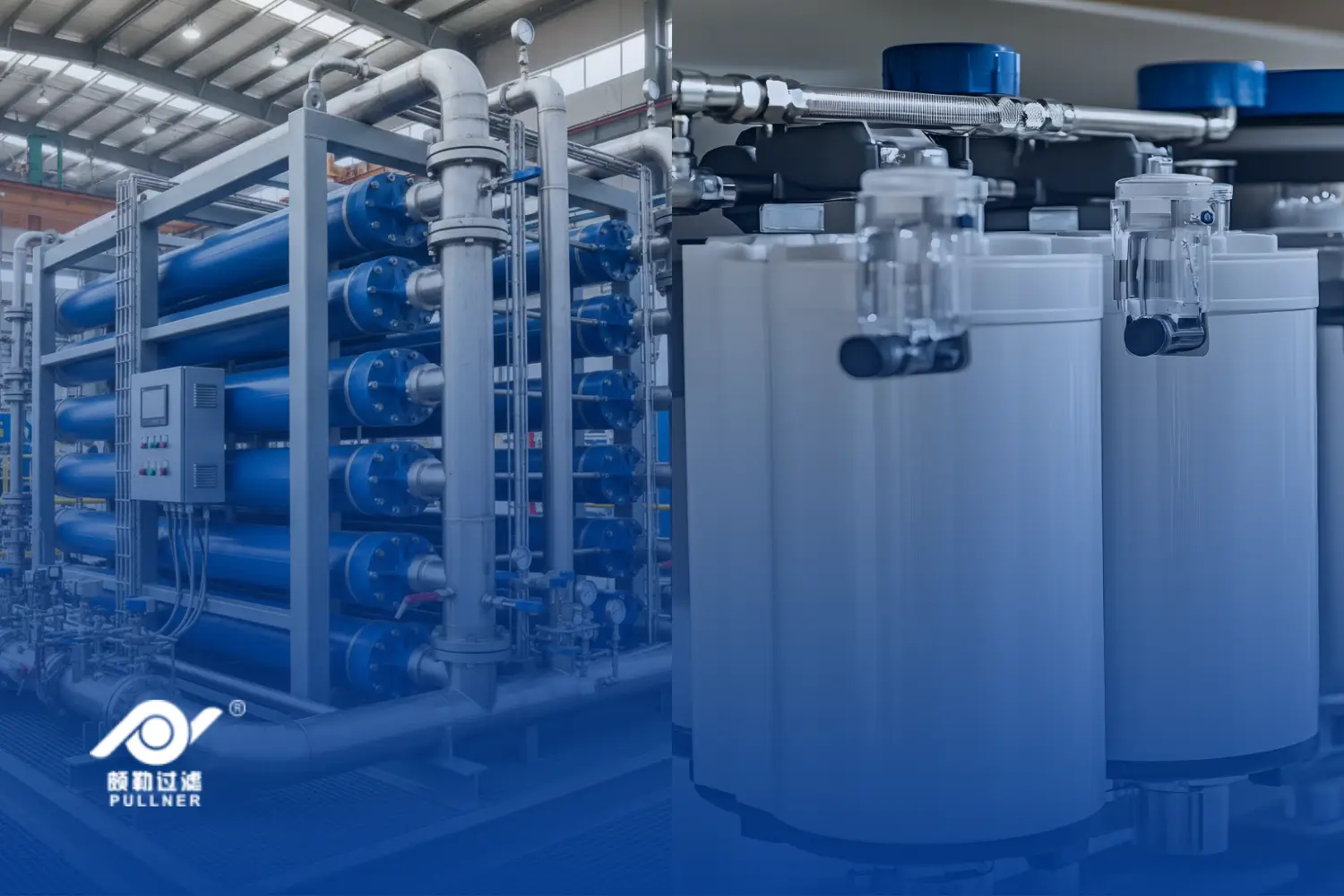
What Is Residential Reverse Osmosis (RO)?
Residential reverse osmosis describes a point-of-use water purification system installed at a single tap, most often under a kitchen sink, for direct access to drinking water.
Residential RO systems target contaminants that affect taste and safety, including lead, chlorine and total dissolved solids, improving overall water quality and water purity for daily consumption.
These residential systems rely on compact RO membranes measuring 2 to 4 inches in diameter, which move water through a semi-permeable membrane to separate water molecules from dissolved impurities.
Residential RO systems are designed for simple installation using basic plumbing connections, modest pressure requirements and straightforward filter changes, making them practical for homeowners who want clean water without complex equipment or infrastructure.
What are Commercial Reverse Osmosis (RO) Systems?
Commercial reverse osmosis systems are engineered for high-demand applications that require continuous operation and consistent output.
Commercial RO systems serve restaurants, hotels, laundries, bottling lines and process water operations where interruptions affect operations. These commercial systems use larger RO membranes measuring 4 to 8 inches in diameter, arranged in multiple elements to manage higher flow rates and sustained pressure.
Commercial RO systems include booster pumps and advanced pretreatment to protect the osmosis membrane and stabilize water quality. Systems are often modular, allowing expansion to meet larger volumes of water as production needs grow.
Residential vs Commercial Reservse Osmosis | What Are the Differences?
Residential and commercial reverse osmosis systems differ primarily in scale, durability, infrastructure and performance expectations. In short, residential systems support intermittent household use, while commercial systems are built for continuous or variable high-demand production in business and industrial environments.
| Category | Residential Reverse Osmosis System | Commercial Reverse Osmosis System |
|---|---|---|
| Output Capacity and Demand Fit | Produces 18 to 150 gallons per day, supporting household drinking water and cooking needs. | Produces from a few hundred to more than 20,000 gallons per day, matching business or industrial water needs. |
| Typical Daily Output | Delivers 50 to 100 gallons per day in most residential systems. | Produces 2,000 to 10,000 gallons per day or more, with smaller commercial systems operating at 500 to 1,000 gallons per day. |
| Performance Under Continuous Use | Operates intermittently and stores water in a pressure tank for on-demand use. | Operates continuously or variably without storage dependence to support consistent production. |
| Membrane Configuration | Uses one to a few small RO membranes measuring 2 to 4 inches in diameter. | Uses multiple larger membranes measuring 4 to 8 inches arranged in arrays for higher throughput. |
| Pump and Pressure Design | Relies on low inlet pressure, often without a pump or with a small booster. | Uses high-pressure pumps to maintain a consistent force across multiple osmosis membranes. |
| Flow Rate Stability | Delivers variable flow moderated by tank capacity and refill cycles. | Maintains stable flow through controls designed for continuous operation. |
| Pretreatment Requirements | Includes basic drinking water pretreatment using sediment and carbon filtration. | Requires extensive pretreatment, such as sediment, carbon, softening, and antiscalants to protect membranes. |
| Downtime Tolerance | Allows downtime without major impact since alternative water sources exist. | Interruptions affect operations and the water produced. |
| Regulatory Oversight | Faces minimal oversight for household use. | Faces stricter health, safety, and plumbing codes depending on the jurisdiction. |
| Scalability | Offers limited expansion through fixed configurations or minor add-ons. | Supports modular expansion to handle larger volumes of water compared to residential systems. |
| Operating Cost | Maintains lower upfront and ongoing costs for small-scale water purification. | Incurs higher costs due to energy use, maintenance, and pre-treatment demands. |
Installation and Infrastructure Implications
Installation requirements differ sharply between residential and commercial reverse osmosis systems because each system supports very different water needs and operating demands.
Residential reverse osmosis system installation includes:
- Installing a compact residential RO system under a sink or on a countertop.
- Connecting to standard household plumbing for water supply and drainage.
- Using a single 110V outlet when a booster pump supports the RO system.
- Operating without special floor loading or structural reinforcement.
- Integrating easily into existing residential systems for water at home.
Commercial reverse osmosis system installation includes:
- Allocating dedicated space for commercial RO systems and pretreatment equipment.
- Supplying three-phase electrical service when required for larger high-pressure pumps in commercial systems.
- Installing heavy-duty drainage to handle larger volumes of water produced.
- Checking and, if necessary, reinforcing floor loading for larger industrial skids and industrial systems.
- Integrating pretreatment as part of the full water treatment system.
- Completing permitting and inspections for plumbing, electrical and safety of drinking water compliance.
These differences reflect how systems are designed to meet the needs of residential and commercial water purification.
Water Quality Consistency and Performance Expectations
Residential expectations focus on better taste, reduced odor and reliable contaminant reduction for everyday use. A residential RO setup improves drinking water quality by reducing dissolved solids and delivering purified water for routine household consumption. Performance priorities emphasize simplicity, predictable results and acceptable output rather than continuous operation.
Commercial environments demand stable performance under changing flow rates and production cycles. A commercial reverse osmosis system must maintain consistent water quality while supporting process requirements, compliance targets or regulated uses tied to water treatment and water purification. Many commercial RO systems operate around the clock and must sustain defined purity thresholds to deliver high-quality water.
To support uptime, many commercial RO systems are designed with membrane redundancy. Parallel vessels and multiple elements within an RO system maintain steady output when individual membranes foul, require cleaning or face peak demand. This configuration protects water purity, stabilizes water produced and preserves a reliable supply of clean water across residential and commercial systems.
Maintenance, Monitoring and Operational Control
Maintenance and oversight differ sharply between residential and commercial RO use because operating risk, water usage and accountability are not the same.
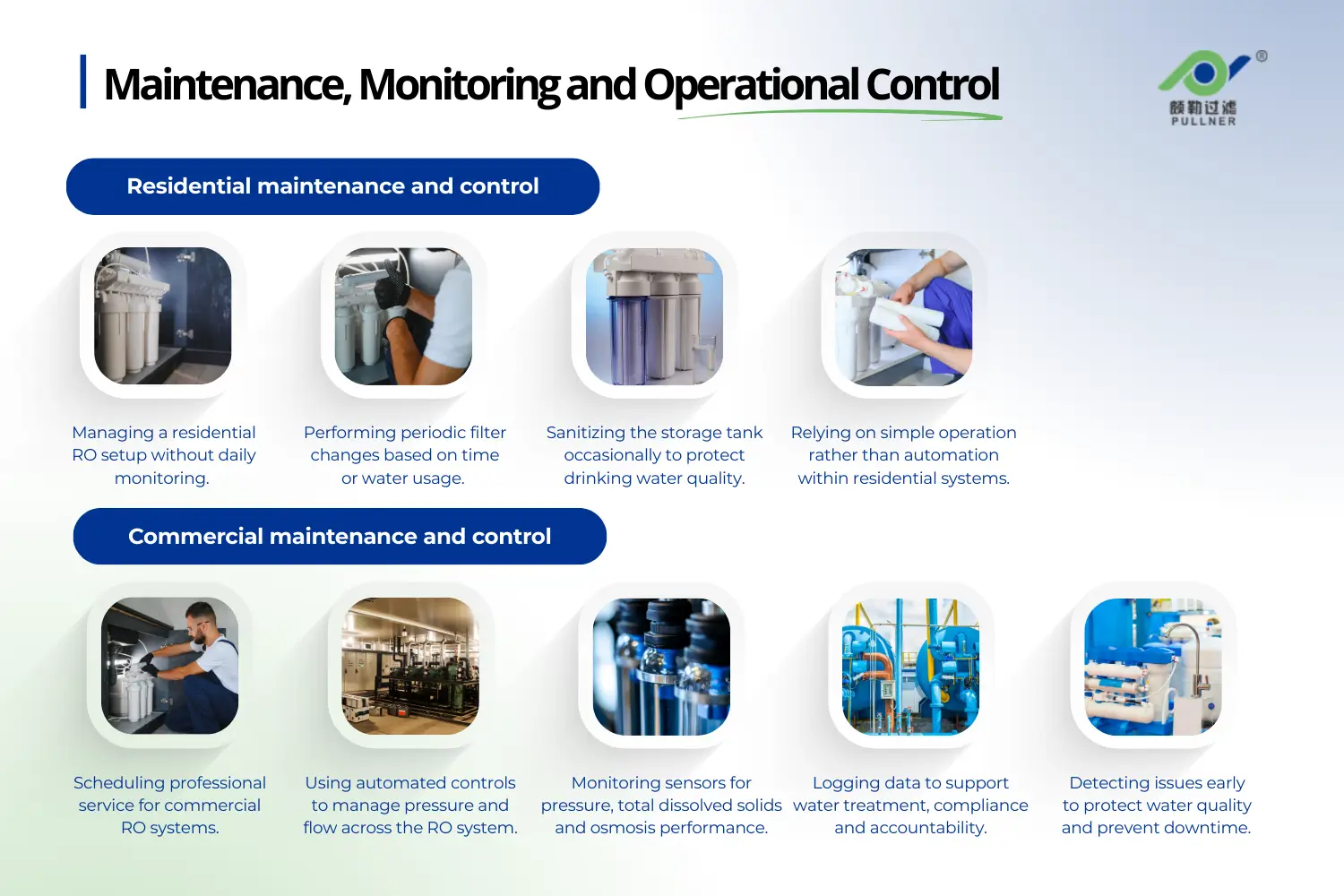
Residential maintenance and control typically involve:
- Managing a residential RO setup without daily monitoring.
- Performing periodic filter changes based on time or water usage.
- Sanitizing the storage tank occasionally to protect drinking water quality.
- Relying on simple operation rather than automation within residential systems.
Commercial maintenance and control usually include:
- Scheduling professional service for commercial RO systems.
- Using automated controls to manage pressure and flow across the RO system.
- Monitoring sensors for pressure, total dissolved solids and osmosis performance.
- Logging data to support water treatment, compliance and accountability.
- Detecting issues early to protect water quality and prevent downtime.
Automation plays a central role in continuous operation. Downtime risks increase significantly in commercial settings, so monitoring safeguards water produced and maintains a dependable supply of clean water.
Choosing the Right Reverse Osmosis System
Choosing the right reverse osmosis system begins with accurate demand analysis. Correct sizing protects water quality, manages operating cost and supports long-term performance for residential and commercial use.
Factors to consider include:
- Calculating daily and peak demand to define how much water per day the system provides.
- Avoiding undersizing, which causes low pressure, limited output, rapid cycling and premature RO membrane wear.
- Avoiding extreme oversizing, which increases cost and may reduce efficiency when the system operates far below its design load.
- Completing professional water testing to assess total dissolved solids, hardness, pH and contaminants tied to water purification needs.
- Matching system type to use, selecting residential RO for household demand and commercial systems for large-scale water production.
- Choosing the right RO system based on verified usage, required level of water purity and long-term operational goals.
Residential vs Commercial Reverse Osmosis System FAQ
Can a residential RO system handle restaurant or office use?
No, residential RO setups producing 50 to 100 gallons per day run out quickly under business demand. Restaurants and most offices need commercial RO systems that deliver larger volumes of water, often starting around 500 gallons per day, to maintain a consistent supply of purified water.
Why do commercial RO systems need extensive pretreatment?
High flow rates and continuous operation stress RO membranes. Pretreatment such as softeners, antiscalants and multi-stage filtration, reduces fouling, protects water quality and extends membrane life in commercial reverse osmosis systems.
Is it worth oversizing a commercial RO system for future growth?
No, Extreme oversizing raises upfront cost and may reduce efficiency when the RO system operates far below its design load. Modular commercial systems allow expansion while preserving stable water treatment performance.
How often does a residential RO system need professional service vs commercial?
Residential use stays low maintenance, with filter changes every 6 to 12 months to maintain drinking water quality. Commercial RO systems require professional service every 3 to 6 months, along with monitoring to protect water purity and prevent downtime.
Back to Top: Residential vs Commercial Reverse Osmosis Systems
 English
  Spanish
  Arabic