
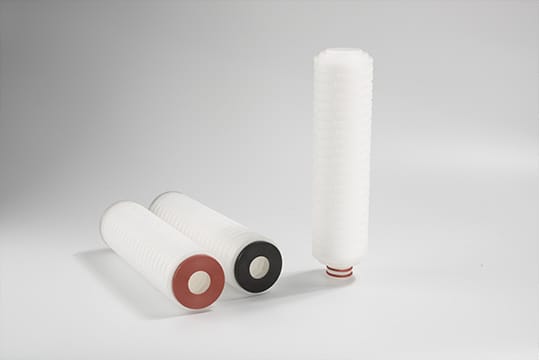
Glass Fiber Filter Cartridge for Oil and Gas, PLGF Series
The PLGF glass fiber filter cartridge is built for oil and gas liquid service: amine solution, glycol and produced water. It is chosen where a polypropylene element loads too quickly on a heavily contaminated stream. The media is pleated glass fiber in grades of 0.1, 0.2, 0.45, 1, 3, 5 and 10 µm. Each cartridge has a 2.7″ (69 mm) outer diameter, comes in 5″, 10″, 20″, 30″ and 40″ lengths, and is rated to 176°F (80 °C), with a maximum differential pressure of 4 bar at 21 °C. Viton and FEP seals are specified for hydrocarbon contact. Send your current model and stream data for a fit check and quote.
- Micron Rating
- 0.1–10 µm
- Flow Rate
- 1–5 GPM per 10"
- Max Temperature
- 80°C (176°F)
- SKU
- PLGF
| Series | PLGF |
| Filter media | Ultrafine glass fiber, pleated |
| Micron rating | 0.1 · 0.2 · 0.45 · 1 · 3 · 5 · 10 µm |
| Outer diameter | 2.7" (69 mm) |
| Length options | 5" · 10" · 20" · 30" · 40" |
| End cap | DOE · SOE (226 fin, 226 flat, 222 fin, 222 flat) |
| O-ring / gasket | EPDM · silicone · Viton · FEP |
| Flow rate | 1–5 GPM per 10" element (suggested) |
| Max. differential pressure | 4 bar at 21 °C · 2.4 bar at 80 °C |
| Max. temperature | Up to 80 °C (176 °F) |
| Certifications | ISO 9001 |
| Minimum order | 25 pieces |
| Lead time | 7 working days |
Glass fiber earns its place on cost per liter filtered, not on retention. The fibers are far finer than a spun polymer and can be laid in a graded structure, so the media holds substantially more dirt before it reaches the same differential pressure. On a heavily loaded line that is the difference between changing elements weekly and changing them monthly.
The PLGF cartridge is offered in seven grades from 0.1 to 10 µm, on a 2.7" (69 mm) body in five lengths from 5" to 40". Standard duty is oil and gas and petrochemical process filtration: amine sweetening, glycol dehydration, produced water and general hydrocarbon polishing.
Key Features
- Ultrafine glass fiber media — more capacity than PP at equal differential pressure
- Seven grades from 0.1 to 10 µm
- Five lengths — 5", 10", 20", 30", 40"
- Hydrocarbon-rated seals — Viton and FEP available
- Rated 80 °C with pressure published at two temperatures
- ISO 9001 with batch documentation on request
Applications
- Amine systems — particle removal from circulating amine solution.
- Glycol loops — solids control in circulating glycol.
- Produced water — filtration of water separated from production streams.
- High-load oil and gas liquid service — where a polypropylene pleat reaches change-out pressure too quickly.
Glass Fiber or Polypropylene
Both filter. They cost differently over a year.
| Polypropylene | Glass fiber | |
|---|---|---|
| Cost per element | Lower | Higher |
| Dirt-holding capacity | Baseline | Substantially higher at equal ΔP |
| Change-out frequency | Higher | Lower |
| Best on | Light, clean feeds | Heavy or variable loading |
The decision is straightforward: if elements are being changed more often than the labor and downtime justify, the cheaper element is the expensive one. On light duty PP remains the correct specification and glass fiber is money spent on capacity that never gets used.
Seals on Hydrocarbon Duty
Four seals are offered and they are not interchangeable on this service.
Viton and FEP are the specifications for hydrocarbon duty. EPDM is offered on the same body for aqueous service and is not compatible with most hydrocarbons — it swells, loses compression and lets fluid past the element rather than through it. Silicone sits between the two and should be confirmed against the specific stream.
Send the fluid, its concentration and its working temperature with the inquiry. Pullner confirms the seal against the stream before quoting, and on hydrocarbon service that check matters more than the grade selection.
Up to two samples ship worldwide free of charge, with freight paid by the customer.
Who it is for
Oil and gas operators, O&M teams and EPC contractors running amine, glycol or produced water filtration who need a second-source candidate for a 2.7" pleated glass fiber cartridge.
Typical operating conditions
- Micron rating: 0.1, 0.2, 0.45, 1, 3, 5 or 10 µm
- Media: glass fiber, pleated
- Flow rate: 1–5 GPM per 10" element (suggested)
- Max differential pressure: 4 bar at 21 °C; 2.4 bar at 80 °C
- Temperature limit: 176°F (80 °C)
- Size: 2.7" (69 mm) OD; 5", 10", 20", 30" or 40" long
- End caps: DOE or SOE (226 fin, 226 flat, 222 fin, 222 flat)
- Seals: Viton or FEP for hydrocarbon contact; EPDM for aqueous service; silicone confirmed per stream
Recommended Pullner product family
PLGF series. See Pullner's oil and gas filtration solutions and the wider filter cartridge range. For petrochemical process streams, the Glass Fiber Pleated Filter Element uses the same PLGF construction.
What to send before quotation or sample
- Fluid / media (stream, hydrocarbon content and concentration)
- Flow rate
- Micron rating
- Temperature
- Pressure
- Existing housing or current model
- Maintenance / change-out cycle
- Validation requirement
Minimum order: 25 pieces. Lead time: 7 working days.
Next step: Get Quote · Request Sample · Send Current Model · Ask Engineering
When is a glass fiber cartridge filter chosen over polypropylene on oil and gas duty?
When a polypropylene element reaches change-out pressure too quickly on a heavily loaded amine, glycol or produced water stream. Glass fiber is specified for solids capacity. On light, clean feeds a polypropylene pleated cartridge usually remains the practical choice. Send your change-out history and engineering will compare the two.
Can the PLGF replace the glass fiber cartridge in our amine or glycol filter housing?
It is a replacement option where the housing takes a 2.7" (69 mm) OD cartridge, 5" to 40" long, with DOE or SOE 226 or 222 end caps. Send the current model and housing details. Engineering confirms dimensional fit and seal material first; performance is confirmed only after a sample and a field trial.
How is it validated before we switch?
A fit check against your housing, a seal check against the stream, a sample, then a trial on the live service with your usual change-out pressure as the benchmark. Switch only once the trial meets your acceptance limits.
What documentation is available?
PLGF cartridges are manufactured under ISO 9001, and Pullner holds Saudi Aramco approval. Tell us which documents your quality or procurement team needs when you request a sample, and engineering will confirm what can be supplied with the order.
What are the limits on temperature, pressure and chemistry?
The temperature limit is 176°F (80 °C). Maximum differential pressure is 4 bar at 21 °C and 2.4 bar at 80 °C. On hydrocarbon contact specify Viton or FEP seals; EPDM swells in most hydrocarbons and is for aqueous service only. PLGF is specified for liquid service.
 English
  Spanish
  Arabic