
When feed quality fluctuates and conventional treatment fails to meet tighter discharge or purity targets, membrane filters provide a reliable, compact barrier – retaining particles, microorganisms, and dissolved species at a controlled pore size.
Compliance risk increases as facilities work toward tighter discharge limits and reuse targets instead of relying on once-through water. Membrane filters for water treatment help facilities stabilize sensitive operations and support reuse targets and high-purity requirements through a more reliable barrier against fine contaminants.
What Is a Membrane Filter?
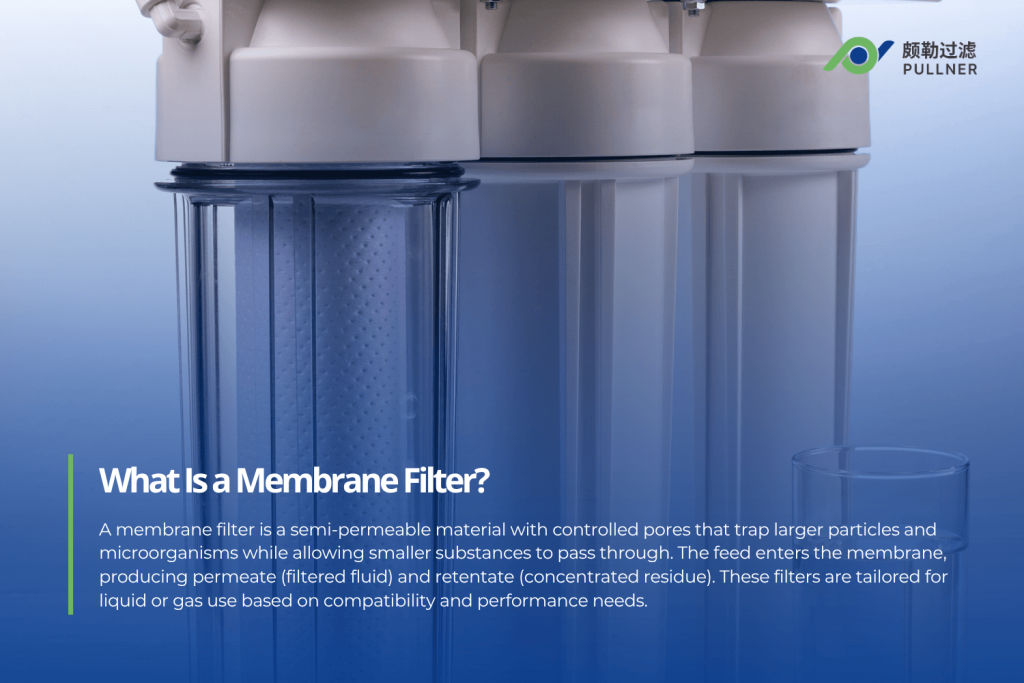
A membrane filter is a microporous, semi-permeable medium with a controlled pore size that retains particles and microorganisms larger than its rating. Smaller particles and dissolved species pass through the surface as filtrate.
In the membrane filter method, the feed is the incoming fluid, and the permeate is the filtered product that passes through the membrane. The retentate is the concentrated stream that remains on the membrane side.
Membrane filters for water treatment can be designed for liquid or gas service, with polymer choice and pore structure matched to chemical compatibility, temperature limits, and required performance in industrial or laboratory settings.
How Membrane Filtration Works
Pressure or vacuum creates a pressure difference across the membrane, known as transmembrane pressure (TMP), driving the filtration process. In a membrane filter, surface separation occurs because particles larger than the rated pore size remain at the membrane surface rather than moving into the thick depth filter media.
Many membrane filters for water treatment are absolute-rated, meaning the filter is tested to retain a very high percentage of particles at the stated rating under defined conditions. In finer membrane filtration, such as ultrafiltration and nanofiltration, separation is often specified by molecular weight cut-off rather than just pore size.
MWCO describes solute retention as a function of molecular weight. Cross-flow operation sweeps the membrane surface, but dead-end filtration directs all flow straight into the filter. During filtration, rejected material builds near the membrane surface.
Concentration polarization raises resistance and reduces permeate flow before irreversible fouling begins. To manage this, operators use periodic backpulsing or backwashing, reversing the flow of clean filtrate to dislodge surface deposits and restore performance without manual teardown.
What Is a Membrane Filter Used For?
A membrane filter converts unstable, contaminant-laden feed streams into controlled, specification-compliant outputs. The barrier retains fine particles and microorganisms, then limits selected dissolved species in critical process and utility applications.
Removal of Suspended Particles and Turbidity
A filter membrane removes suspended solids, colloidal material, and fine particulates that conventional strainers or depth media often leave behind. The step improves clarity and reduces variability in the feed stream.
By retaining material at the surface, the filtration system protects downstream equipment from fouling, abrasion, and pressure loss:
- Pumps
- Heat exchangers
- Resin beds
- Reverse osmosis membrane
A controlled membrane pore size is selected to match the expected particle size in the incoming stream. Pretreatment improves water quality before tighter separation stages begin. As pretreatment, the unit stabilizes the flow rate and supports longer run times in later membrane filtration systems.
Microbiological Control and Sterilization
Membranes with 0.2 to 0.45 micron pores are used for microbiological control because most bacteria and yeast cells exceed the opening size. A semi-permeable membrane retains the cells as fluid passes through the membrane.
In sterile liquid service, the barrier removes viable cells from water or chemical solutions without heat exposure, protecting proteins and preserving sensitive active ingredients. Operators place the sterilizing cartridge at the last process position before filling or packaging to block downstream contamination.
For sterile air lines, hydrophobic gas-grade media serve as the final microbial barrier before compressed gas enters tanks or transfer equipment.
Separation of Dissolved and Low‑Molecular‑Weight Species
Ultrafiltration is the first, tighter barrier and removes viruses and large organic macromolecules that broader treatment stages leave behind. Nanofiltration is tighter than ultrafiltration, and it removes dissolved organics plus multivalent hardness ions such as calcium or magnesium.
Reverse osmosis (RO) is the tightest barrier of the three, and it strips salts plus most low-molecular-weight molecules. At the molecular level, membrane separation follows pore size or molecular weight cut-off rather than visible particle size. Plants use that control for demineralization, softening, concentration and removal of PFAS or pesticides.
Product Concentration and Fractionation
In membrane separation, valuable proteins or enzymes remain on the feed stream side of the filtration membrane as water and smaller dissolved species pass through. Low-temperature operation protects sensitive biologics or pharmaceutical intermediates from thermal damage during concentration.
A properly configured membrane system can raise product strength without evaporation, preserving activity and reducing heat-related loss. With the right molecular-weight cut-off, membrane technology can fractionate one stream into separate outputs with different compositions.
Each fraction can move to recovery or treatment, giving operators tighter control over downstream processing and product value.
Types of Membrane Filters and Their Typical Uses
Different types of membrane filters are selected based on particle size and target contaminants, then refined by membrane material for specific process conditions. Selection defines filtration needs and determines where each filter operates within different process environments.
By Pore Size / Separation Range
Membrane types are grouped by separation tightness because membrane pore size determines what each barrier can retain within a filtration system. Microfiltration operates in an approximate 0.1-10 micron range and removes particles and microorganisms such as yeast or bacteria, supporting clarification or pretreatment.
Ultrafiltration is tighter and retains macromolecules or colloids, including proteins and viruses, along with other high-molecular-weight organics. Nanofiltration holds back larger ions and many organic molecules for partial demineralization and contaminant reduction, which improves water quality.
RO membranes are the tightest class in this group, providing very high rejection of dissolved salts and many trace contaminants for desalination and high-purity production across different filtration demands.
By Filter Media and Material
Base polymer selection controls chemical compatibility, temperature tolerance, and extractables in different types of membrane filters.
Common media are grouped here by process use, showing where membrane filters come into service based on operating demands rather than product branding.
- Mixed cellulose esters (MCE): Highly porous and fast-wetting, MCE membrane filters are common in microbiological analysis, air monitoring, and laboratory filtration requiring strong bacterial retention.
- Cellulose acetate: Hydrophilic construction and low protein binding make cellulose acetate suitable for biological fluids or enzyme solutions when protein recovery matters.
- Nylon: Hydrophilic structure and broad solvent compatibility make nylon membrane filters common in HPLC sample preparation, electronics filtration, and terminal filtration of organic or aqueous solutions.
- PVDF: Chemical resistance and low extractables make hydrophilic PVDF membrane media useful in pharmaceutical bio-burden reduction, biological liquid sterilization, and selected wastewater or seawater duties.
- PTFE: Hydrophobic and hydrophilic forms make PTFE membrane media suitable for aggressive solvents and strong acids. Gas streams and corrosive conditions often require this material.
- PES and PP: PES membrane filters support high-flow sterile liquid service. PP membrane suits warmer beverage lines and food or pharmaceutical filtration because the polymer offers low extractables.
Absolute vs. Nominal Membrane Filtration
Nominal filtration uses depth-type media that capture particles as water moves through a tortuous internal path.
Adhesion supports retention inside the structure, so removal remains approximate and shifts with flow, pressure, and contaminant load. Water systems use nominal media as economical pre-filters ahead of tighter stages.
Absolute filtration uses surface media with controlled pores that retain larger particles under specified test conditions.
Retention stays predictable at the stated rating, so operators place absolute membranes at final control points before bottling or sterile filling. In laboratory water filtration, mixed cellulose esters or MCE membranes wet fast and support strong bacterial retention.
Advantages of Using Membrane Filters
Membrane filters improve water treatment by creating a controlled barrier within a compact system. Different membrane solutions fit different applications and filters offer stable output with lower chemical demand across many process conditions.
Controlled, predictable retention
Absolute-rated membranes are tested to retain 99.9% or more of target particles at the stated pore size under defined conditions. That predictability gives QA and validation teams a defensible, documented barrier for sterile filling, compliance sign-off, and change control records.
Sterilization and microbiological safety
Validated sterilizing-grade membranes remove bacteria and many viruses from pharmaceutical liquids, beverages, and process water without heat exposure. Cold sterilization protects proteins, active ingredients, and sensitive formulations that thermal processing would degrade, while keeping microbial control at the final process position before filling or packaging.
The same barrier approach protects bottled water and beverage lines from pathogens such as Cryptosporidium and Giardia, where a single contamination event can trigger a full product recall.
Compact footprint with lower chemical demand
Thin membrane media pack a high active surface area into a small housing, reducing plant space requirements compared to conventional treatment trains. Physical separation at the membrane surface also lowers reliance on coagulants and flocculants, which cuts sludge volume, reduces chemical handling, and simplifies waste disposal.
Stable permeate quality through feed variability
Controlled pores maintain consistent output even when feedwater composition shifts – a critical advantage in reuse systems, surface water applications, and industrial processes where feed quality fluctuates. Pressure control systems and automated monitoring track transmembrane pressure in real time, triggering cleaning at the right point rather than on a fixed schedule.
Longer run times through backwashing
Periodic backpulsing or backwashing reverses filtrate flow to dislodge surface deposits and restore flux without manual teardown or system shutdown. In cross-flow configurations, continuous surface sweep further reduces cake formation, supporting higher solids loading and extending element service life between full cleaning cycles.
Combined with backwash automation, this supports continuous 24/7 operation with minimal planned downtime – an important factor for facilities running round-the-clock production.
Flexible integration and retrofit compatibility
Skid-mounted membrane units simplify installation and reduce site work for new builds. For existing plants, standard cartridge and housing dimensions often match current layouts, allowing upgrades to finer membrane filtration – including UF, NF, or RO – without a full system redesign or extended shutdown.
Limitations and Operating Challenges
Membrane systems improve separation, but water treatment still involves trade-offs. Process conditions shape cost, service life, and maintenance needs across different filtration applications. Material selection matters because filters are made for specific chemical and operating limits.
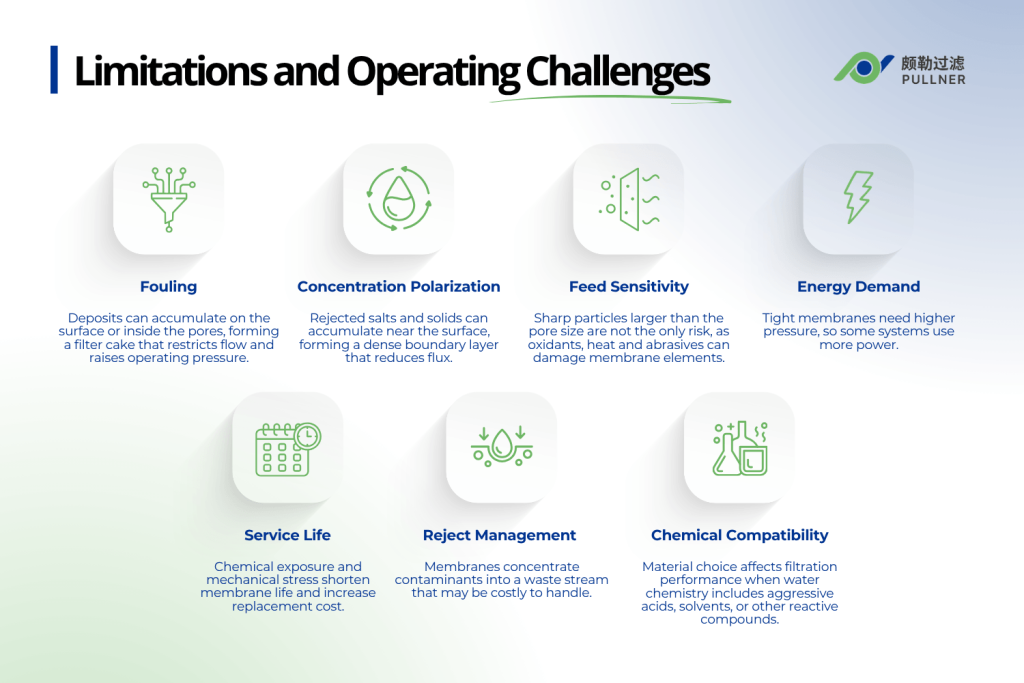
- Fouling: Deposits can accumulate on the surface or inside the pores, forming a filter cake that restricts flow and raises operating pressure.
- Concentration polarization: Rejected salts and solids can accumulate near the surface, forming a dense boundary layer that reduces flux.
- Feed sensitivity: Sharp particles larger than the pore size are not the only risk, as oxidants, heat, and abrasives can damage membrane elements.
- Energy demand: Tight membranes need higher pressure, so some systems use more power.
- Service life: Chemical exposure and mechanical stress shorten membrane life and increase replacement costs.
- Reject management: Membranes concentrate contaminants into a waste stream that may be costly to handle.
- Chemical compatibility: Material choice affects filtration performance when water chemistry includes aggressive acids, solvents, or other reactive compounds.
How to Choose the Right Membrane Filter for Your Application
Choose the right membrane filter by starting with the process target. Define whether you need a cleaner permeate or retained product, then match pore size or molecular weight cut-off to that result.
Check the membrane media, cartridge style, and housing design against fluid chemistry, operating temperature, fouling risk, and cleaning method. A filter that fits the process holds stable flow, meets quality targets, and avoids early failure in daily production.
Pullner Filter brings over 20 years of manufacturing experience in industrial filtration. They provide cartridge and housing solutions, from membrane and pleated cartridges to stainless steel housings. Their range includes high-flow options, string-wound, and melt-blown designs – all under ISO 9001 quality management with 100% factory testing.
Pullner’s engineering team helps companies select the right solution by matching process chemistry, micron rating, and operating limits to the application. They provide up to two free sample cartridges – customers cover shipping – so teams can validate membrane performance under real process conditions before committing to a full purchase.
Contact Pullner Filter to review your process requirements and request a quote for the right membrane filter or housing solution.
Membrane Filter FAQs
How often should industrial membrane filters be replaced?
Replacement depends on the fouling rate, not a set replacement interval. Plants often track differential pressure, flux decline, or integrity test results to decide when a changeout is needed. Condition-based replacement helps extend service life and protect product quality.
Can membrane filtration be combined with other purification technologies?
Yes, plants often combine membrane filtration with ion exchange or activated carbon. Other systems add ultraviolet disinfection or advanced oxidation. A membrane stage helps steady feed quality, so downstream equipment runs more consistently and needs less frequent servicing.
Are membrane filters suitable for retrofitting into existing systems?
In many cases, yes. Cartridge and housing dimensions can often match existing layouts or work with minor piping changes. Plants can upgrade to finer membrane filtration without a full redesign or a long shutdown.
Back to Top: Membrane Filter: What Is It Used For?
 English
  Spanish
  Arabic