
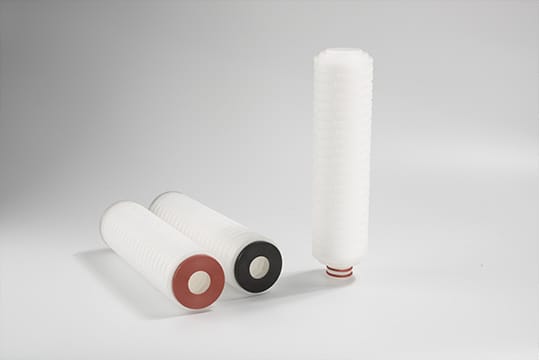
Cartucho filtrante de fibra de vidrio
Glass fibre earns its place on cost per litre filtered, not on retention. The fibres are far finer than a spun polymer and can be laid in a graded structure, so the media holds substantially more dirt before it reaches the same differential pressure. On a heavily loaded line that is the difference between changing elements weekly and changing them monthly.
The PLGF cartridge is offered in seven grades from 0.1 to 10 µm, on a 2.7″ (69 mm) body in five lengths from 5″ to 40″. Standard duty is oil and gas and petrochemical process filtration: amine sweetening, glycol dehydration, produced water and general hydrocarbon polishing.
- Clasificación Micron
- 0.1–10 µm
- Caudal
- 1–5 GPM per 10"
- Temperatura máxima
- 80°C (176°F)
- SKU
- PLGF
- Ultrafine glass fibre media — more capacity than PP at equal differential pressure
- Seven grades from 0.1 to 10 µm
- Five lengths — 5", 10", 20", 30", 40"
- Hydrocarbon-rated seals — Viton and FEP available
- Rated 80 °C with pressure published at two temperatures
- ISO 9001 with batch documentation on request
| Serie | PLGF |
| Medio filtrante | Ultrafine glass fibre, pleated |
| Micron rating | 0.1 · 0.2 · 0.45 · 1 · 3 · 5 · 10 µm |
| Outer diameter | 2.7" (69 mm) |
| Length options | 5" · 10" · 20" · 30" · 40" |
| Tapa | DOE · SOE (226 fin, 226 flat, 222 fin, 222 flat) |
| O-ring / gasket | EPDM · silicone · Viton · FEP |
| Flow rate | 1–5 GPM per 10" element (suggested) |
| Max. differential pressure | 4 bar at 21 °C · 2.4 bar at 80 °C |
| Max. temperature | Up to 80 °C (176 °F) |
| Certificaciones | ISO 9001 |
| Minimum order | 25 pieces |
| Lead time | 7 working days |
- Oil and gas: amine, glycol and produced water filtration.
- Petrochemical: hydrocarbon polishing and process clarification.
- High-load duty: where a PP pleat blinds too quickly.
- Prefiltración: protection ahead of finer membrane stages.
Both filter. They cost differently over a year.
| Polipropileno | Glass fibre | |
|---|---|---|
| Cost per element | Lower | Higher |
| Dirt-holding capacity | Baseline | Substantially higher at equal ΔP |
| Change-out frequency | Higher | Lower |
| Best on | Light, clean feeds | Heavy or variable loading |
The decision is straightforward: if elements are being changed more often than the labour and downtime justify, the cheaper element is the expensive one. On light duty PP remains the correct specification and glass fibre is money spent on capacity that never gets used.
Four seals are offered and they are not interchangeable on this service.
Viton and FEP are the specifications for hydrocarbon duty. EPDM is offered on the same body for aqueous service and is not compatible with most hydrocarbons — it swells, loses compression and lets fluid past the element rather than through it. Silicone sits between the two and should be confirmed against the specific stream.
Send the fluid, its concentration and its working temperature with the enquiry. Pullner confirms the seal against the stream before quoting, and on hydrocarbon service that check matters more than the grade selection.
Up to two samples ship worldwide free of charge, with freight paid by the customer.
 English
  Spanish
  Arabic