
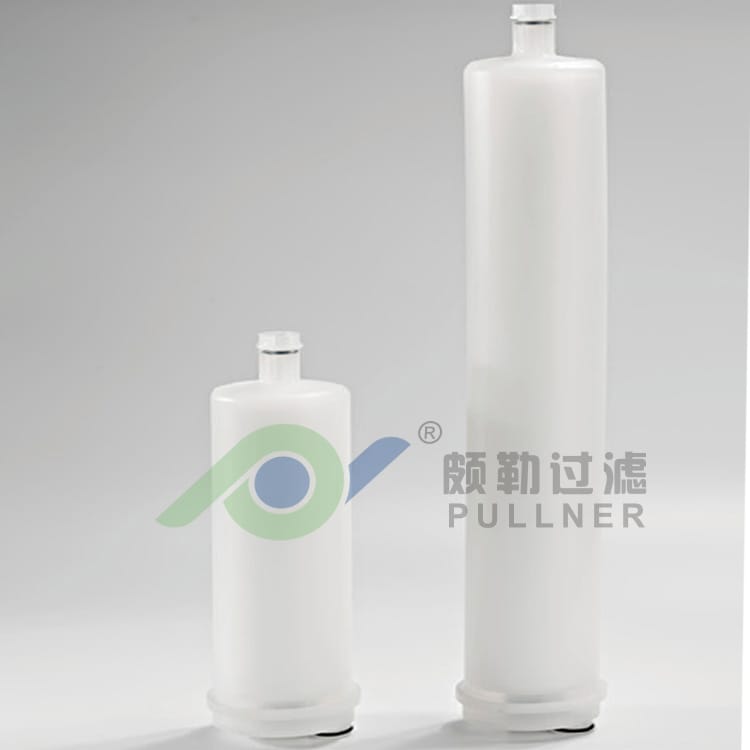
Microelectronics Semiconductor Filter Cartridge
A capsule filter carries its own housing. Media, cage and connections are welded into one sealed body, so there is no bowl to open, no O-ring to seat, and no path for fluid to travel around the element instead of through it. That is why capsules are chosen at point of use — the last filter before a coater, a wet bench or a fill head, where one particle that slipped past becomes scrapped product rather than a line on a maintenance log.
Pullner’s capsule series is built in polypropylene and rated 1 to 10 µm. The body measures 72 mm across and comes in five lengths from 114 mm to 202 mm, with 1/4″, 3/8″ or 1/2″ connections in either NPT thread or Swage compression fitting. Inside is a pleated element rather than a depth wrap, which is what allows a body this compact to pass 1 to 10 GPM.
- Micron Rating
- 1–10 µm
- Flow Rate
- 1–10 GPM
- Max Temperature
- 50°C / 122°F
- SKU
- N/S
- No housing required — self-contained capsule installs inline at point of use
- No elastomer in the flow path — thermally welded body removes the bypass and extractables risk
- Pleated internal element — 1–10 GPM from a 72 mm body
- Five lengths — 114, 138, 152, 183 and 202 mm, same rating throughout
- Six connection options — 1/4", 3/8", 1/2" in NPT or Swage
- Custom geometry available — in-house moulds and 3D-printed prototypes
- ISO 9001 manufacture with batch test documentation on request
| Series | N/S |
| Format | Capsule — self-contained, no separate housing |
| Filter media | Polypropylene (PP), pleated |
| Micron rating | 1–10 µm |
| Body diameter | 72 mm · non-standard available |
| Length options | 114 · 138 · 152 · 183 · 202 mm |
| Inlet / outlet | 1/4", 3/8", 1/2" NPT · 1/4", 3/8", 1/2" Swage |
| Seal | None — thermally welded body |
| Flow rate | 1–10 GPM |
| Max. differential pressure | 4.1 bar / 60 PSI |
| Max. temperature | 50 °C / 122 °F |
| Quality system | ISO 9001 |
| Minimum order | 50 pieces |
| Lead time | 10 working days |
- Semiconductor process fluids: final filtration ahead of the tool.
- Wet etch and clean chemistry: particle removal from working baths.
- Ultrapure water: point-of-use polishing on a UPW loop.
- Liquid crystal display (LCD): panel process fluids.
- Hard disk media manufacturing: process fluid filtration.
- General electronics assembly: process and rinse fluids.
The capsule is thermally welded shut. There is no housing joint to seal and no elastomer anywhere in the flow path, which is why the seal row in the specification table is empty — buyers occasionally read that as an omission, and it is not.
For high-purity work this removes two recurring problems at once: a source of extractables, and an assembly step where a pinched or badly seated seal quietly lets unfiltered fluid through. The trade is that the capsule cannot be serviced. There is no element to lift out, so when differential pressure reaches its limit the whole unit is replaced.
Inside the welded body the element is pleated rather than depth-wound. Pleating is what gives a 72 mm body enough surface area to pass 1 to 10 GPM; a depth wrap in the same envelope would reach its differential pressure limit far sooner.
Non-standard sizes and connections
Both are available, and it is worth knowing what they involve. Every combination of cage diameter and connection adaptor is a separate mould. Pullner cuts those in-house and prototypes non-standard end caps and frames on a 3D printer first, so the answer is rarely no — but a genuinely new geometry is a tooling conversation rather than a catalogue selection, and it moves the lead time.
Send the body dimensions and the fitting standard with your enquiry and engineering will tell you whether it runs on an existing mould before you commit to anything.
Length sets capacity, not rating. All five bodies filter to the same grade; a 202 mm capsule simply runs longer before differential pressure climbs. Buyers on short change-out intervals usually step up a length before they step up a micron, because a coarser grade changes what reaches the tool.
Connection choice carries more weight, because it cannot be changed in the field. NPT threads suit fixed pipework and existing threaded manifolds. Swage compression fittings suit tube runs and are the more common request on wet benches and tool feeds, where the line is stainless or PFA tube rather than pipe.
| If you need | Specify |
|---|---|
| Longer service life at the same grade | A longer body — 183 or 202 mm |
| Fixed threaded pipework | NPT, 1/4", 3/8" or 1/2" |
| Stainless or PFA tube runs | Swage, 1/4", 3/8" or 1/2" |
| A geometry not listed | Send dimensions — it may need a new mould |
When a cartridge and housing is the better answer
This is a point-of-use device, and there are four situations where it is the wrong specification:
- Above 50 °C or 4.1 bar. Both are hard limits on this body.
- Continuous high-volume duty. Past roughly 10 GPM the economics move to a multi-cartridge housing.
- Below 1 µm. This series starts at 1 µm; finer work belongs to the pleated membrane cartridge range.
- Gas. This capsule is rated for liquid service only.
Chemical compatibility depends on the specific fluid, its concentration and its working temperature rather than on the material name alone. Send the fluid and the operating conditions with your enquiry and Pullner will confirm compatibility before quoting.
Most enquiries for this product come from plants already running a Pall, Parker, 3M CUNO or Pentair capsule that has become slow to source or expensive to hold. Cross-referencing one is straightforward, but it needs six things, and an enquiry carrying all six is usually quoted the same day:
- The part number printed on the capsule body
- Body diameter and overall length
- Inlet and outlet fitting — thread standard or tube size
- Micron grade currently in service
- The fluid, its concentration and its working temperature
- Flow rate and the change-out interval you are getting today
Photographs of the capsule and its fittings help more than a description.
Qualifying the replacement
Every element is tested in Pullner’s own laboratory, from incoming raw material to finished goods, on a bench that includes a PMI pore size analyser, an SEM resolving to 3 nm, ICP-MS, an ion chromatograph and an IFTS single-pass rig. Batch test documentation is available on request, and buyers qualifying a second source usually ask for it before the sample rather than after.
Up to two samples ship worldwide free of charge, with freight paid by the customer. Standard minimum order is 50 pieces and standard lead time is 10 working days, across 30+ production lines running more than 4,000 elements a day.
 English
  Spanish
  Arabic