
At a 3nm technology node, a single metallic ion at the parts-per-billion level can cause a device failure that won’t appear until final testing. By then, the wafer has passed through dozens of high-value process steps.
Semiconductor wafer fab filtration is a contamination control mechanism that supports yield, process stability, and advanced-node manufacturing. Every process fluid, from ultrapure water to CMP slurry, photoresist, and aggressive wet chemicals, needs a filtration system matched to its contamination risk.
Production inside Class 100, Class 1,000, and Class 10,000 cleanrooms is the manufacturing baseline. SEM pore verification at 3 nm resolution and ICP-MS testing at 20 parts per trillion define the analytical capability floor. Four process fluid categories are covered: UPW filtration, CMP slurry filtration, photoresist filtration, and wet chemical process filtration.
Why Contamination Control at Advanced Nodes Demands More from Filtration
Semiconductor production at advanced nodes operates under contamination thresholds that no general industrial environment matches. Defect sources in semiconductor process fluids cover a broad range.
Particles, metallic ions, and organic extractables each require a different filtration response. So do anions, cations, particles, and agglomerates from abrasive slurries and gel particles in photoresist streams. A filter sized for particle removal may do nothing to control ionic impurity or extractable contamination from its own membrane material.
Filtration requirements shift by process fluid, chemistry, temperature, pressure, and point of use. A filter performing reliably in a general chemical process can fail in a fab environment for reasons unrelated to pore size.
Extractables from incompatible membrane materials introduce contamination directly into the process stream. Poor cleanroom handling deposits particles onto filter media before the cartridge reaches the tool, and inadequate batch testing leaves pore structure and metallic cleanliness unverified. Any of these failure modes can affect semiconductor devices and reduce process yield.
Semiconductor Process Fluid Filtration Overview
| Process Area | Process Fluid | Key Contamination Concern | Typical Pore Size | Common Membrane Material | Relevant Standard |
|---|---|---|---|---|---|
| UPW System | Ultrapure water | Particles, ions, TOC, extractables | 0.05–0.2 µm | PTFE, PVDF | SEMI F57 |
| CMP | Silica or ceria slurry | Oversized agglomerates, scratches, and slurry instability | 0.5–5 µm | PP, nylon | Process-specific |
| Photolithography | KrF, ArF, or EUV photoresist | Particles, gels, ionic contamination, extractables | 0.05–0.2 µm | PTFE, nylon | SEMI F19 |
| Wet Etch and Cleaning | HF, H2SO4, HCl, NH4OH, H2O2, SC-1, SC-2, SPM | Metallic ions, particles, and chemical attack | Process-specific | PTFE, PVDF, PFA | Chemical compatibility |
Pullner’s Cleanroom and Lab Credentials for Semiconductor-Grade Filtration
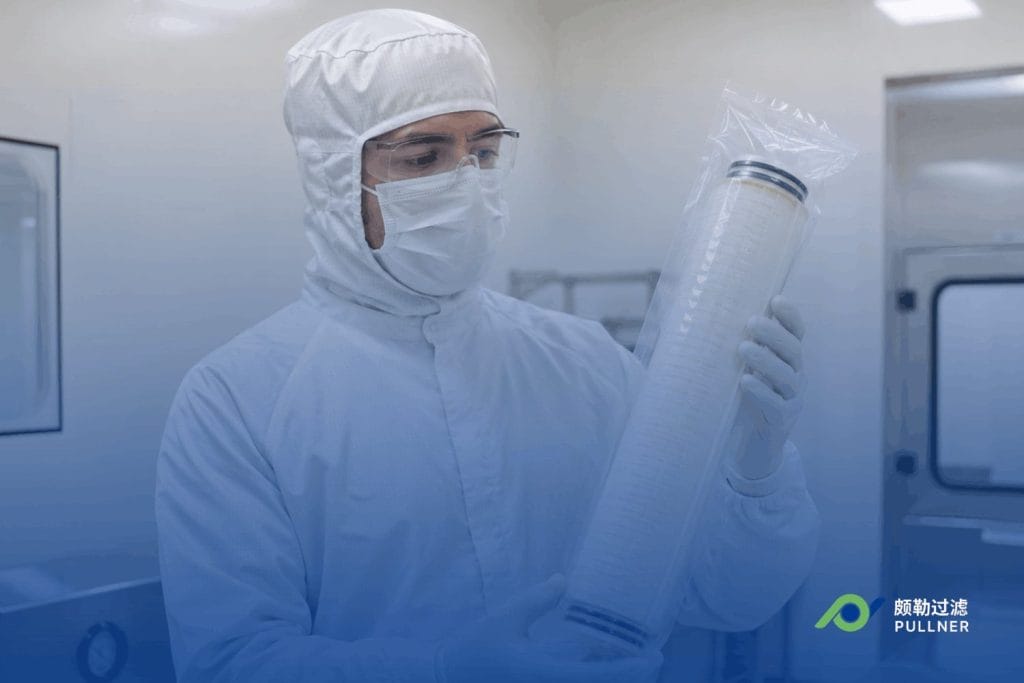
A semiconductor filter manufactured outside a controlled environment carries contamination risk before it ever contacts your process fluid. Unverified pore structure and untested metallic cleanliness are failure modes that begin at the manufacturing stage. Cleanroom production is a baseline requirement for semiconductor process filter supply, not an optional credential.
Pullner Filter produces filter cartridges inside Class 100, Class 1,000, and Class 10,000 cleanroom environments. Pore structure verification uses scanning electron microscope analysis at 3nm resolution, confirming membrane geometry at the scale that matters for submicron semiconductor applications.
Metallic contamination testing uses ICP-MS at a 20-parts-per-trillion detection limit, meeting the ionic cleanliness standards that semiconductor manufacturing processes require. Ion chromatograph testing covers anion and cation analysis for ionic contamination evaluation across process fluid types. Every production lot is backed by ISO 9001 certification and 100% batch testing with documented traceability.
Buyers evaluating the full range of semiconductor filter options can review Pullner’s dedicated microelectronics filtration applications page here.
Pullner Lab Capability Overview
| Test Method | Equipment | Pullner Capability | Why It Matters |
|---|---|---|---|
| SEM Analysis | Scanning electron microscope | 3 nm resolution pore verification | Confirms membrane structure for submicron filtration |
| ICP-MS | Metallic contamination testing | 20ppt detection limit | Supports fab-level metallic ion control |
| Ion Chromatography | Anion and cation analysis | Ionic contamination testing | Evaluates extractables and process-fluid cleanliness |
| Cleanroom Manufacturing | Class 100, 1,000, and 10,000 | Controlled filter production | Reduces contamination risk during manufacturing |
| Batch Testing | Quality control program | 100% factory tested | Supports consistency across production lots |
Ultrapure Water (UPW) Filtration
Ultrapure water has more process steps than any other fluid in a semiconductor fab. Wafer cleaning, chemical dilution, and tool support systems all depend on water purity maintained to specifications that exceed pharmaceutical-grade standards. An ultrapure water filter built from the wrong membrane material can introduce the contamination it was installed to prevent. For UPW polishing and distribution loops, Pullner supplies the electronic process water filter cartridge.
UPW Quality Requirements
UPW requires control across resistivity, particles, and total organic carbon. Metallic ions, silica, bacteria, and endotoxins, where sterile service applies, must also stay within defined limits. Resistivity must reach 18.2 MΩ·cm, the theoretical maximum for pure water at 25°C, indicating effectively zero dissolved ionic content.
Total organic carbon must stay below 1 part per billion to prevent organic residue from interfering with photolithography chemistry or gate dielectric formation. Any impurity that reaches the wafer surface during wafer cleaning becomes a potential defect source. SEMI F57 provides the reference framework for UPW quality expectations in semiconductor manufacturing.
UPW Quality Parameters
| Parameter | Target Value | Reference |
|---|---|---|
| Resistivity | 18.2 MΩ·cm | SEMI F57 |
| TOC | Less than 1 ppb | SEMI F57 |
| Particles | Fab-specific target | SEMI F57 |
| Metallic Ions | ppb to ppt range | SEMI F57 |
| Extractables | As low as practical | Filter validation |
Point-of-Entry vs. Point-of-Use Filtration
Point-of-entry filtration, commonly called POU filtration, protects the UPW filtration distribution loop by removing larger upstream contaminants before they reach recirculation piping or process equipment. POU filtration provides final protection at the tool or dispense point where the water contacts the wafer surface directly.
POU filters carry the tightest pore size requirements because they sit closest to the process. Typical POU ratings run from 0.05 µm to 0.2 µm for high-purity semiconductor applications. Capsule filters in compact formats suit lab, tool-level, and point-of-dispense installations where replacing a larger housing-and-cartridge assembly is not practical.
Membrane Selection for UPW Service
PTFE membrane filter cartridges offer high chemical compatibility and low contamination potential. They’re a common choice for UPW filtration at the point of use. PVDF membrane filter cartridges support high-purity water service where low extractables and broad chemical resistance are both required. PES and nylon membranes are applied in selected pre-filtration positions. They’re not typically specified for the most demanding ultrapure water applications where extractables control is tightest.
Extractables and leachables from filter membrane materials can introduce organic contamination or ionic species into the UPW stream. Pullner’s SEM pore verification and ICP-MS testing confirm membrane pore structure and metallic cleanliness meet semiconductor process water requirements before cartridge delivery.
CMP Slurry Filtration
Chemical mechanical polishing removes material from wafer surfaces by combining abrasive particles with chemical action. The filtration target in CMP slurry filtration is selective. The goal is to remove large particles and oversized agglomerates without stripping the functional abrasive population on which the polishing process depends.
What CMP Slurry Contains
CMP slurry carries silica or ceria abrasive particles in an aqueous carrier. The carrier is acidic or alkaline, depending on the polishing application. A silica slurry used for oxide polishing behaves differently from a ceria-based slurry used for shallow trench isolation. Both require filtration strategies matched to their specific particle size distribution and chemistry.
Why Slurry Agglomerates Cause Die-Level Defects
Oversized abrasive agglomerates act as large, hard particles against the wafer surface during polishing. A single agglomerate large enough to bridge the gap between the polishing pad and the wafer produces a scratch extending across multiple dies. The scratch causes local yield loss, die failure, or downstream patterning issues in subsequent photolithography layers.
A debris filter semiconductor application must balance defect reduction, slurry stability, and abrasive retention simultaneously. Preserving the functional abrasive distribution while removing unwanted particles requires careful pore size selection matched to the slurry chemistry and particle size distribution.
CMP Slurry Filter Specifications
Typical pore size ratings for CMP slurry filter applications run from 0.5 µm to 5 µm. Selection depends on slurry abrasive type, pH, and flow rate. Loop or recirculation filtration removes larger particles and agglomerates from the bulk slurry supply before slurry distribution to the tool. Point-of-use filtration at the polishing pad dispense point provides a final barrier against oversized particles immediately before wafer surface contact.
Depth filters suit CMP pre-filtration positions. Their tortuous internal structure captures agglomerates and debris across the full media thickness rather than only at the surface. Pleated filter cartridges provide higher surface area for upstream pre-filtration where dirt-holding capacity matters. For direct Entegris or OEM slurry filter replacement, cross-reference dimensions, end configurations, and pore size ratings against the Pullner electronic slurry filter cartridge before installation.
Photoresist Filtration
Photoresist filtration protects photolithography yield by removing particles, gel particles, and contamination from the resist stream at the dispense point. At advanced nodes, a single gel particle or oversized contaminant in the resist film can cause a pattern defect that propagates through subsequent process layers.
Contamination Mechanisms in Photoresist Delivery
Photoresist is a light-sensitive material used in photolithography to transfer circuit patterns onto the wafer surface. KrF, ArF, and extreme ultraviolet photoresist chemistries each carry distinct contamination risks, covering particles, gel defects, ionic contamination, and organic extractables from filter materials.
Particles and gel defects in the resist stream cause coating nonuniformity and pattern defects. Ionic contamination from filter-derived extractables can interact with the resist chemistry or affect wafer surface preparation in adjacent wet process steps. At EUV nodes, even low-level organic extractables from filter materials represent a contamination risk to the optical train and resist performance.
Photoresist Filter Specifications and Membrane Compatibility
Point-of-use pore size ratings for photoresist filter applications typically run from 0.05 µm to 0.2 µm. PTFE and nylon membranes are the most common choices, selected for compatibility with photoresist carrier solvents, including isopropyl alcohol, acetone, and N-methyl-2-pyrrolidone.
Low extractables are a primary selection criterion because filter-derived contamination enters the resist stream directly at the dispense point. SEMI F19 provides the reference standard for metallic contamination control in photoresist. Capsule filters suit point-of-use dispense applications where compact format and easy changeout matter.
Wet Chemical Process Filtration
Wet chemical process filtration in a semiconductor fab must match the chemical aggressiveness of the process fluid. For wet-etch and clean chemistry stations, see Pullner’s wet-process filter cartridge. Chemical compatibility between the filter membrane, hardware components, and the process chemistry is as important as pore size. A chemically incompatible filter can shed contamination, deform under temperature and pressure, or fail structurally in aggressive acid and base service.
Aggressive Acid and Base Circuits
Process chemicals in semiconductor wet process stations cover a demanding range. Common chemistries include:
- Hydrofluoric acid
- Sulfuric acid
- Hydrochloric acid
- Ammonium hydroxide
- Hydrogen peroxide
- Standard Clean 1 and Standard Clean 2
- Sulfuric peroxide mixture
Each chemistry presents a different combination of temperature limits, concentration ranges, and particle retention targets. Filter selection depends on membrane material, end cap material, and O-ring compatibility, as well as extractables profile and flow rate. Process gases used in etch and deposition steps carry analogous filtration requirements where process equipment protection and particle control both apply.
PFA filters for HF and concentrated acid service
Perfluoroalkoxy alkane, PFA, is the material of choice for aggressive semiconductor chemical filter service. Standard polymer filter components degrade, leach, or fail in hydrofluoric acid and concentrated acid circuits where PFA performs reliably. Pullner’s in-house PFA skeleton and end cap fabrication bring the most chemically demanding assembly components under the same cleanroom and quality controls as the membrane.
Membrane Material Chemical Compatibility
| Membrane | HF | H2SO4 | IPA | NMP | Photoresist Carrier | Alkaline CMP Slurry | Best-Fit Use |
|---|---|---|---|---|---|---|---|
| PTFE | Strong | Strong | Strong | Strong | Strong | Application-dependent | UPW, photoresist, solvents, chemicals |
| PVDF | Application-dependent | Application-dependent | Good | Application-dependent | Application-dependent | Application-dependent | UPW and selected chemicals |
| PES | Limited | Limited | Application-dependent | Limited | Limited | Application-dependent | Pre-filtration and selected water service |
| Nylon | Limited | Limited | Good | Good | Selected resist service | Application-dependent | Photoresist and selected solvent service |
| PFA | Excellent | Excellent | Excellent | Excellent | Excellent | Excellent | HF, concentrated acids and aggressive wet chemicals |
SEMI Standards Relevant to Fab Filtration
Standards define cleanliness expectations for semiconductor filtration technologies, but they don’t replace process-specific filter selection. The right filter still depends on your actual process fluid, tool configuration, and contamination target. Standards tell you the floor, not the full specification.
SEMI F57 governs UPW quality, covering resistivity, TOC, particle count, metallic ions, and microbial contamination. SEMI F19 addresses metallic contamination in photoresist delivery systems. ISO 14644 provides a cleanroom classification reference for the controlled manufacturing environments where semiconductor-grade filter cartridges are produced.
The International Roadmap for Devices and Systems provides a broader context for advanced-node process filtration requirements as feature dimensions continue to shrink. Porometry, the measurement of pore size distribution across a membrane, gives quantitative data for filter qualification against OEM specifications. SEM verification at 3nm resolution extends pore analysis to the nanometer scale for the most demanding semiconductor process applications.
How to Select a Semiconductor Process Filter
Filter selection for semiconductor process applications requires structured evaluation across fluid chemistry, pore size, and membrane material. A filter that meets one criterion but fails another can introduce the contamination risk it was specified to prevent.
Match the Filter to the Process Fluid
Each process fluid in a semiconductor fab carries a distinct contamination profile and compatibility requirement:
- UPW filtration requires low-extractable membranes with tight pore size ratings and verified metallic cleanliness.
- CMP slurry filtration requires media with sufficient mechanical strength to retain particles above the target agglomerate size without restricting functional abrasive flow.
- Photoresist filtration requires solvent-compatible membranes with gel and particle removal capability at sub-0.2 µm ratings.
- HF and acid chemical service requires fluoropolymer construction throughout the filter assembly.
- Solvents, SC-1, SC-2, and sulfuric peroxide mixture each require compatibility verification specific to concentration, temperature, and exposure time.
Confirm Pore Size and Retention Requirements
Absolute-rated membranes with documented retention efficiency provide more defensible specification data for fab qualification than nominal ratings alone. Wet chemical filtration applications use process-specific ratings matched to the particle retention target and fluid viscosity. Confirm the exact rating against the tool configuration and fluid chemistry before finalizing the specification.
Verify Membrane and Hardware Compatibility
Membrane material, end cap material, core construction, and O-ring selection must all be verified against the process fluid. A PTFE membrane with a polypropylene end cap suits UPW filtration but can fail in aggressive acid service where the end cap is incompatible. Compatibility verification covers solvents, acids, bases, and oxidizers across the full range of operating temperatures and concentrations your application presents.
Review Extractables, Leachables, and Ionic Cleanliness
Filter-derived contamination is a primary semiconductor production concern that general industrial filter specifications rarely address adequately. Metallic ions leached from the membrane or hardware materials can reach the wafer surface through the process fluid.
Anion and cation extractables contribute to ionic contamination in UPW and resist streams, while TOC from polymer additives can affect photolithography chemistry and surface preparation. ICP-MS at parts-per-trillion sensitivity and ion chromatograph testing for ionic species verify cleanliness at fab-relevant detection thresholds.
Require Batch Testing and Cleanroom Manufacturing
Class 100 or Class 1,000 manufacturing environments provide meaningful contamination control for semiconductor process filter production. 100% factory testing on every production lot confirms that pore structure, integrity, and performance meet specification before the cartridge ships. Batch documentation covering test results, material certifications, and traceability records supports the procurement audit requirements that semiconductor wafer fab filtration programs typically require.
Pullner’s Semiconductor Filtration Products
Photoresist Filter Element
Pullner’s dedicated photoresist filter element supports point-of-use filtration for photolithography chemical service. The product addresses particle, gel, and extractable contamination in KrF, ArF, and EUV resist delivery. Fab teams can cross-reference dimensions and pore size ratings against existing Entegris and OEM photoresist filter specifications.
Microelectronics Semiconductor Filter Cartridge
Together these cover point-of-use and bulk filtration across the fab. For a single high-purity cartridge spanning electronics, semiconductor and UPW service, see the microelectronics semiconductor filter cartridge.
Electronic Slurry Filter Cartridges
Pullner’s electronic slurry filter cartridges target CMP slurry filtration where agglomerate control protects the wafer surface from scratch defects. The range supports loop or recirculation filtration and point-of-use positions in CMP modules, covering the pore size window from 0.5 µm to 5 µm. Cross-referencing against Entegris slurry filter part numbers allows qualification teams to confirm dimensional and performance compatibility before switching supply.
Membrane Filter Cartridges
Pullner membrane filter cartridges cover UPW filtration, solvent, photoresist, and wet chemical process filtration positions in PTFE, PVDF, PES, and nylon. Membrane selection spans the pore size range from submicron high-purity service down to 0.05 µm absolute ratings. SEM pore verification and ICP-MS batch testing back the cleanliness claims relevant to high-purity filter cartridge procurement.
PFA Filter Cartridges
Pullner’s PFA filter cartridges cover aggressive acid and base semiconductor chemical filter service. Fluoropolymer construction runs throughout the assembly, not just the membrane. HF, concentrated sulfuric acid, and oxidizing chemical circuits fall within the rated service range. The same batch testing and traceability program that covers the full semiconductor filter range applies to every PFA lot.
Capsule Filter Cartridges
Capsule filters in Pullner’s range suit lab, tool-level, and point-of-dispense filtration applications where compact format and low dead volume matter. Placing final UPW filtration or resist filtration closer to the process point reduces the distribution piping length between the last filter and the wafer surface. The format is common in photoresist and chemical dispense applications where per-tool installation is preferred.
Pleated Filter Cartridges
Pleated filter cartridges serve pre-filtration and system protection positions ahead of final membrane stages in UPW filtration and wet chemical systems. Higher surface area and dirt-holding capacity protect downstream high-purity filter cartridge elements by capturing larger particles before the final pore size barrier. Pullner’s pleated range covers the upstream positions where depth filters and pleated media complement final membrane filtration in multi-stage semiconductor process systems.
Comparison: Semiconductor-Grade Filters vs. General Industrial Filters
Evaluating semiconductor process filter supply on price or nominal pore size alone misses the criteria that most directly affect yield. Entegris and other established semiconductor filtration suppliers are evaluated on contamination documentation, cleanroom manufacturing, and extractables control, not just flow performance.
A general industrial filter may meet the dimensional and flow specifications of a semiconductor application while failing every contamination criterion that protects the wafer surface.
| Requirement | General Industrial Filter | Semiconductor-Grade Process Filter |
|---|---|---|
| Manufacturing Environment | Standard production | Cleanroom manufacturing required |
| Contamination Testing | Basic quality checks | ICP-MS, ionic testing, and batch documentation |
| Pore Verification | Supplier-stated rating | SEM or validated pore analysis |
| Extractables Control | Application-dependent | Primary selection factor |
| Chemical Compatibility | Broad industrial use | Specific to UPW, photoresist, CMP slurry, acids and solvents |
| Procurement Priority | Cost, flow and availability | Yield protection, contamination control and audit readiness |
Common Specification Mistakes in Fab Filtration
Semiconductor wafer fab filtration failures often trace back to specification decisions made before the filter was installed. The most frequent mistakes include:
- Selecting by pore size alone without checking membrane chemical compatibility
- Using a general chemical filter in a high-purity semiconductor process position
- Over-filtering the CMP slurry and removing functional abrasive particles
- Under-filtering photoresist at the point of dispense
- Failing to verify metallic ion contamination through ICP-MS testing
- Replacing an Entegris or OEM filter without confirming dimensions, end configuration, flow rate, pressure drop, and chemical compatibility
Work With a Semiconductor-Grade Filtration Partner
Semiconductor manufacturing processes at advanced nodes leave no margin for filtration that hasn’t been verified at the chemistry, pore size, and contamination level your process requires. Pullner Filter is a technical partner for semiconductor filtration programs, not a general filter supplier. With 20+ years in industrial filtration and manufacturing inside Class 100, Class 1,000, and Class 10,000 cleanrooms, Pullner brings ISO 9001 certification, 100% factory testing, and batch-level traceability to every production lot.
In-house PFA fabrication supports semiconductor chemical filter service across HF and aggressive acid circuits. Up to two free sample filter cartridges are available for process validation—customers cover shipping—so your team can confirm dimensional fit, pore performance, and extractables profile before a full qualification run.
Contact Pullner Filter to speak with a filtration engineer about your UPW, CMP slurry, photoresist, or wet chemical application.
Semiconductor Wafer Fab Filtration FAQs
How do fabs qualify a replacement semiconductor process filter?
Fabs typically qualify a replacement filter by reviewing dimensional fit, pore rating, membrane compatibility, extractables data, ionic cleanliness, flow performance, pressure drop, and batch traceability before testing it in the actual process.
Why do extractables matter in semiconductor filtration?
Extractables matter because compounds released from filter materials can enter UPW, photoresist, or chemical streams and create defects, ionic contamination, or process instability at the wafer surface.
What is the difference between pre-filtration and final filtration in a wafer fab?
Pre-filtration removes larger particles upstream to protect final filters, while final filtration sits closer to the tool or dispense point to control contamination immediately before the fluid contacts the wafer.
Back to Top: Semiconductor Wafer Fab Filtration: A Complete Guide to UPW, CMP Slurry, and Photoresist Filters
 English
  Spanish
  Arabic