
Sediment filtration is the first line of defense in any water treatment system, capturing sand, silt, and scale before particulates reach sensitive downstream equipment. Without that barrier, pumps, valves, and water heaters absorb the mechanical wear instead.
Unprotected equipment fails more quickly, resulting in unplanned downtime across the facility. Sediment filters also shield high-cost secondary systems, because filters and reverse osmosis membranes degrade quickly under heavy sediment load.
In pharmaceuticals and food production, sediment in water can lead to batch contamination and costly product recalls. Effective sediment filtration keeps discharge compliant with GMP and environmental standards while improving overall water quality across the facility.
What is a Sediment Filter?
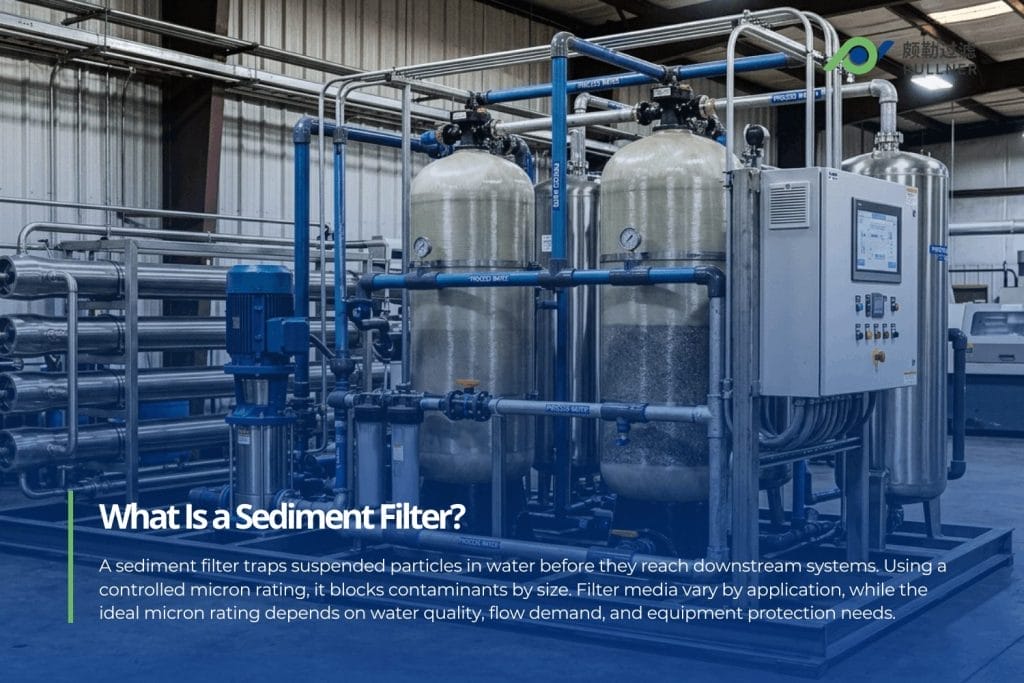
A sediment filter is a physical barrier installed in a water system to intercept suspended particles before they enter downstream stages. Sediment filters work by trapping material at a controlled micron rating, so only water meeting that size threshold passes through.
A 5 micron rating, for example, blocks particles invisible to the naked eye. Filter media ranges from spun polypropylene to pleated synthetic material, with each construction suited to different water quality requirements. The right micron rating depends on water source chemistry, flow demand, and the downstream equipment the filter protects.
Choosing the wrong micron rating doesn’t just reduce filtration efficiency – it accelerates downstream membrane fouling, increases pump energy demand, and forces unplanned changeouts that ripple across the entire production schedule.
Main Types of Sediment Filters
Industrial facilities use several sediment filter types to balance flow rate, pressure drop, micron rating, and service life. Each design targets a specific particle size range and loading pattern.
Bag filters
Bag filters use fabric or mesh bags inside a steel housing to remove suspended solids from high-flow water filtration streams. Polypropylene or polyester felt bags suit depth capture, while mesh construction handles coarser sediment removal.
High dirt-holding capacity lets bag filters manage heavy sediment load with fewer changeouts than small cartridge filters. Top-loading housing keeps changeout fast and downtime low for batch and continuous industrial water treatment systems.
Pleated cartridge filters
Pleated filters fold polyester, polypropylene, or cellulose filter media into a compact housing, packing more surface area into each cartridge. Micron ratings from 0.5 to 50 make pleated filters effective fine sediment polishers after coarser pre-filters.
Surface capture across the outer layers supports high water flow with a low initial pressure drop. Longer service intervals and easy differential pressure monitoring make pleated filters practical in applications with tight maintenance windows.
Melt-blown polypropylene cartridges
Melt-blown filters form a graded-density depth matrix that traps particles throughout the media thickness. Most designs cover a nominal 1 to 50 micron range, with specialty products reaching sub-micron ratings.
The uniform fiber structure spreads dirt throughout the cartridge, extending run time under high-sediment-load conditions. Polypropylene construction resists aggressive process chemistry, making melt-blown filters a reliable pre-filter in multi-stage water treatment trains.
String wound filters
String-wound filters wrap polypropylene, cotton, or glass yarn around a perforated core to build a multi-layer depth filter. The winding pattern and yarn type set the micron rating, typically 1 to 100 microns for water filtration applications.
Larger void spaces near the outer layers and tighter spacing toward the core increase dirt-holding capacity for turbid, variable-quality water supplies. Wound filters protect downstream equipment from rapid fouling in high-sediment systems.
Multi-media backwash filters
Multi-media backwash filters use layered anthracite, sand, and garnet to deliver depth filtration for continuous, large-volume flows. Properly sized units remove suspended solids in the 5-15 micron range, depending on media selection and bed depth.
Automatic backwashing, triggered by a timer or pressure signal, flushes captured solids to the drain without manual media replacement. High flow capacity makes multi-media filters a standard front-end step before reverse osmosis membranes or finer polishing stages.
Centrifugal sand separators
Centrifugal sand separators inject water tangentially into a chamber, creating a vortex that flings heavy particles outward. Sand and grit migrate to a collection chamber below, while clarified water exits through the center without a screen or disposable media.
Water pressure drops remain low because there is no fixed media bed to restrict flow through the separator. Periodic purging protects downstream filters, nozzles, and heat exchangers from abrasion and plugging caused by well water and cooling loop contaminants.
Common Industrial Applications of Sediment Filters
Sediment filters play a front-line role in industrial water treatment, removing suspended solids before they reach sensitive downstream stages. The right sediment filter protects equipment, membranes, and process quality across every water system.
Reverse osmosis pre-filtration
Filters and reverse osmosis membranes depend on each other, as sediment cartridges remove particulates that would otherwise foul RO membranes prematurely. A 5-micron filter ahead of an RO stage extends membrane life and reduces cleaning frequency across industrial water filtration systems.
Manufacturing and process water
Cooling towers, boilers, and industrial machinery rely on sediment filters to keep water supplies free of suspended solids. Sediment buildup inside cooling circuits and water heater systems accelerates corrosion, reduces heat transfer efficiency, and drives up energy consumption.
Food and beverage processing
Drinking water filtration and ingredient water quality must meet strict food safety standards in beverage, dairy, and bottling operations. Sediment filters remove particulates that affect product clarity and microbial stability before water treatment reaches finer purification stages downstream.
Chemical and pharmaceutical industry
Fine particulates in process chemistry and pharmaceutical intermediates compromise product purity and batch consistency. Cartridge filters rated to tight micron tolerances intercept contaminants before they reach sensitive reaction or filling stages.
Petrochemicals and fuels
Sediment filtration removes contaminants from oils, coolants, and fuels that would otherwise damage high-pressure pumps and valves. Filter media selection depends on fluid chemistry and the specific particle size range the process stream carries.
Construction and site water
High-capacity bag filters handle the heavy sediment load typical of construction site runoff and industrial wastewater. Water filtration at the point of discharge keeps effluent within regulatory limits and protects receiving waterways from suspended solids.
Electronics and microelectronics
High-purity water purification in semiconductor manufacturing demands fine sediment removal at sub-micron levels. Sediment filters act as the first barrier in multi-stage water system trains, blocking particulates that would otherwise compromise ultrapure water quality downstream.
Choosing the Right Sediment Filter for Your Industrial Application
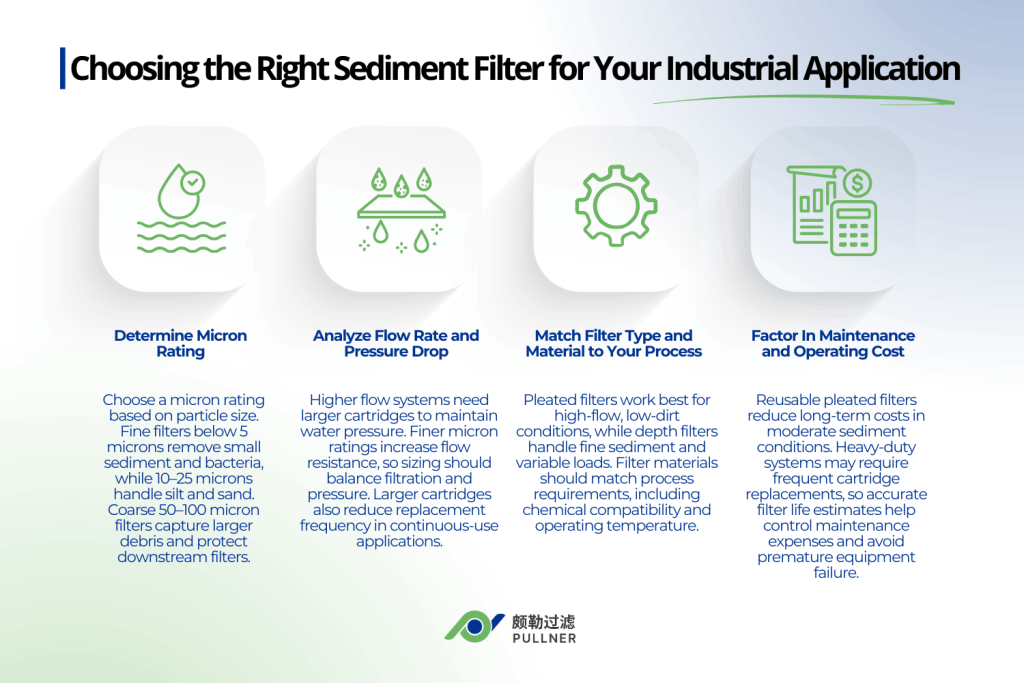
Choosing the right sediment filter starts with knowing your particle size range, flow rate, and fluid chemistry. Selecting a sediment filter without that data leads to premature fouling and early cartridge failure.
Determine micron rating
The micron rating defines what a sediment filter captures, so matching it to the actual particle size is the first decision. Ratings below 5 microns target fine sediment and bacteria, while 10 to 25 microns suit general silt and sand.
Coarser ratings from 50 to 100 microns handle large debris and heavy sand loads. Staging a coarse filter ahead of a fine polishing cartridge extends filter life and protects downstream equipment.
Analyze flow rate and pressure drop
High-flow applications require larger cartridges to maintain stable water pressure throughout the system. Tighter micron ratings improve sediment removal but increase flow resistance, so filter sizing must balance both. A 20-inch cartridge reduces changeout frequency compared to a 10-inch model under the same flow conditions.
Match the filter type and material to your process
Pleated filters suit high-volume, low-dirt applications in the 30 to 50 micron range and offer reusability when feed quality remains consistent.
Depth filters perform better at 1 to 5 microns for fine sediment and handle heavier, more variable loads. Filter material must match the process fluid, as stainless steel is suitable for high-temperature service and polypropylene handles aggressive chemical environments.
Factor in maintenance and operating cost
Reusable pleated filters lower long-term costs when the sediment load remains moderate and predictable.
Cartridge filters in heavy-duty service need more frequent changeouts, so filter life projections must reflect actual feed conditions. Matching the filter type to real operating data keeps maintenance costs under control and prevents premature system failure.
Pullner Filter is an ISO 9001-certified manufacturer and technical partner for industrial sediment filtration, supplying B2B buyers across water treatment, power, petrochemical, and food and beverage sectors. With 20+ years in filtration engineering, 30+ production lines producing 4,000+ filter elements per day, and in-house lab capabilities including PMI pore size analysis, SEM verification, and IFTS single-pass testing, Pullner helps facilities match micron rating, filter media, and housing configuration to verified operating data.
Pullner’s range covers pleated, melt-blown, and string-wound filters, with custom and OEM configurations available across micron ratings to suit municipal, well water, and process feed conditions. Up to two free sample cartridges are available so facilities can validate performance before committing to a bulk order.
Request a quote or speak to a Pullner Filter engineer to review your sediment filtration requirements.
Types of Sediment Filters for Industrial Use FAQs
How does water quality testing affect sediment filter selection?
Lab- or onsite-water analysis identifies particle size, turbidity, and fluid chemistry before filter selection begins.
Water quality data drives the choice of filter media, micron rating, and housing material. Without that baseline, facilities risk selecting a sediment filter that clogs prematurely or passes contaminants that damage downstream equipment.
How often should industrial sediment filters be replaced or backwashed?
Sediment filters should be replaced when the differential pressure reaches the manufacturer’s limit, not on a fixed schedule.
Auto-backwash units should trigger on a pressure rise or a timed interval matched to the actual sediment load. Condition-based changeout extends filter life and avoids unnecessary downtime between service intervals.
What happens if I oversize or undersize the micron rating?
A rating that is too fine clogs rapidly, raises pump energy demand, and forces unplanned downtime across the water system. A rating that is too coarse allows harmful solids to pass through.
This can lead to fouling of reverse osmosis membranes, erosion of piping, and compromised water quality at sensitive process stages. Matching the micron rating to actual particle-size data is the most direct way to avoid both failure modes.
Back to Top: Types of Sediment Filters for Industrial Use
 English
  Spanish
  Arabic