
Power plant filtration controls contamination across boiler feedwater, condensate return, and cooling systems simultaneously. A failure in one loop migrates into the others. Suspended solids, dissolved ions, and corrosion products enter the steam-water cycle through makeup water, internal corrosion, and condenser leakage.
Without staged filtration covering pretreatment, membrane separation, and cartridge-based polishing, those contaminants deposit on heat transfer surfaces, attack turbine blades, and force unplanned outages. Power generation filtration isn’t a utility function. It’s the mechanical foundation that keeps boilers, turbines, and condensers running within spec.
Why Filtration Failures Cost More than the Filter
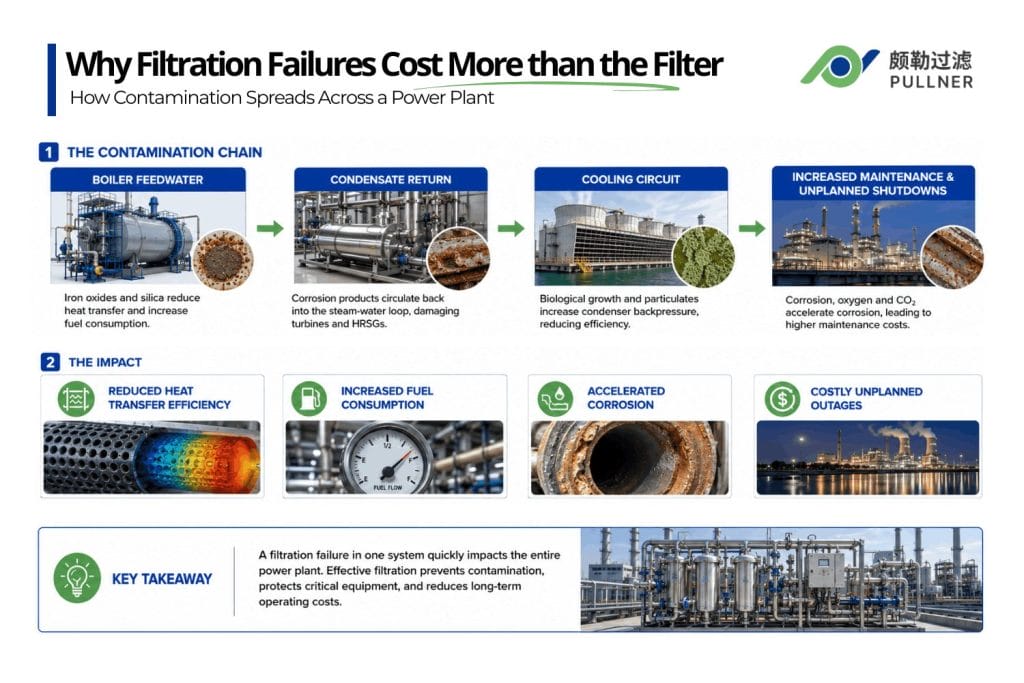
Filtration failure in a power plant rarely stays contained to the system where it starts. Each loop contaminates the next, and the cascade accelerates quickly.
- Boiler feedwater: Iron oxides and silica settle on boiler tubes, reducing heat transfer and increasing fuel consumption before any alarm fires.
- Condensate return: Corrosion products re-enter the steam-water loop on every cycle, compounding deposition on turbine blades and HRSG surfaces.
- Cooling circuit: Under-filtered biological and particulate loads steadily increase condenser backpressure, reducing thermal efficiency until a forced cleaning shutdown becomes unavoidable.
Dissolved gases, specifically oxygen and carbon dioxide, intensify corrosion across feedwater and condensate systems when filtration and chemical control aren’t coordinated.
CO₂ converts to carbonic acid in the condensate, lowering pH and accelerating corrosion of the return piping. Maintenance costs compound when these gaps allow contamination to migrate unchecked between loops.
The Four Fluid Systems that Require Filtration in a Power Plant
Power generation draws on four distinct fluid systems, each with its own contamination profile and filtration requirement.
- Boiler feedwater system: Blends treated makeup water and condensate return before steam generation, requiring ultra-low dissolved solids and fine particulate control.
- Condensate system: Continuously recycles steam water and accumulates iron oxide corrosion products on every pass through the loop.
- Cooling water system: Operates at high flow rates with continuous exposure to external biological and particulate contamination.
- Turbine oil system: Provides lubrication and hydraulic control for rotating machinery and degrades through water ingress and particulate buildup.
Water-Steam Cycle Interaction
The steam-water cycle links all four systems, so contaminant control in one directly affects the others. Makeup water passes through pretreatment stages, including filtration and ion exchange, before entering the membrane systems and then the feedwater loop. Steam generation carries trace contaminants forward into turbine and condenser systems, and condensate return brings corrosion products back into the feedwater circuit.
Boiler Feedwater Filtration
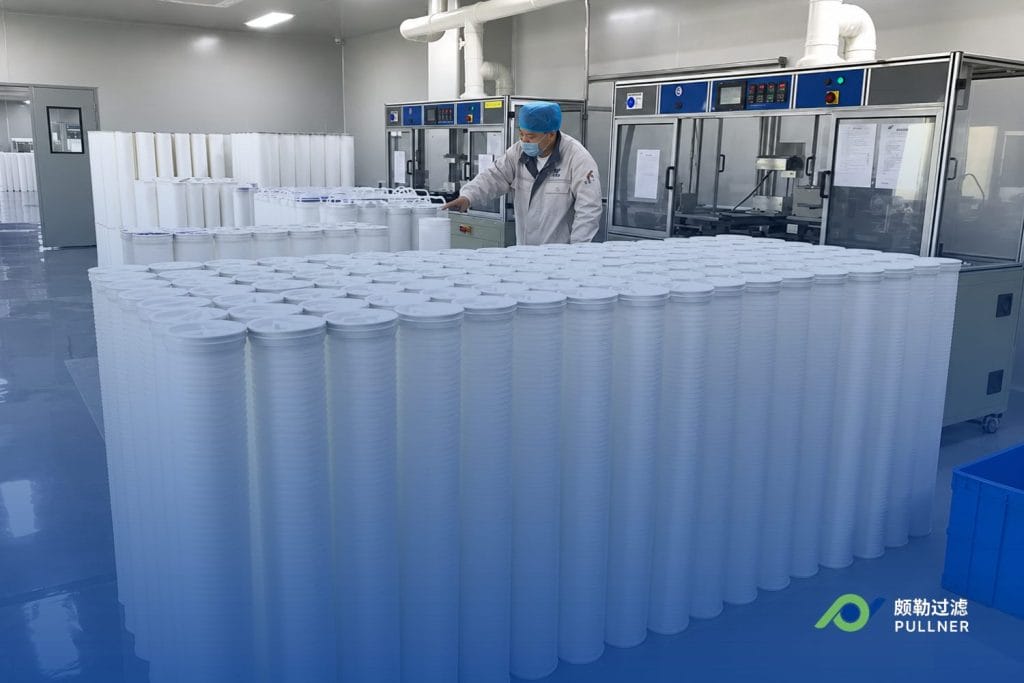
Boiler feedwater filtration protects high-pressure boiler tubes, economizers, and superheaters from the contamination types that trigger the most expensive failures in power generation.
Iron, silica, and hardness ions deposit on heat-exchange surfaces under sustained thermal loading. Dissolved gases drive corrosion in the piping upstream, and poor boiler water quality at the inlet compounds both problems simultaneously.
What BFW Contamination Does to Boiler Performance
Four contamination types drive boiler degradation, each through a different mechanism. Together, they shorten tube life, raise fuel consumption, and increase cleaning frequency across the boiler island.
- Iron deposits: Accumulate on boiler tubes under sustained thermal load, reducing heat transfer efficiency.
- Silica: Forms hard, insoluble scale at high temperature and pressure, insulating tube walls from the water side.
- Calcium and magnesium: Form carbonate and sulfate deposits that compound the silica scale energy penalty.
- Dissolved gases: Oxygen attacks feedwater piping and boiler internals through pitting corrosion.
Poor boiler water quality accelerates all four mechanisms simultaneously. Boiler efficiency drops measurably as scale accumulates. A 1mm silica layer increases fuel consumption by several percent. Dissolved solids above specification levels carry over into the steam produced, depositing on turbine blades and reducing stage efficiency in the high-pressure sections.
Filtration Specifications for BFW Service
Boiler feedwater treatment runs through defined stages. Each step targets a specific contamination type before the water enters high-pressure service. Skipping or undersizing any stage allows the contamination it controls to reach the boiler intact.
- Multimedia filtration: Removes suspended particles and turbidity from raw water and surface water sources ahead of finer treatment stages.
- Activated carbon: Removes organic compounds and residual oxidants that would damage downstream membranes or ion exchange resin.
- Ion exchange softening: Eliminates calcium and magnesium hardness, preventing scale formation in the boiler.
- Reverse osmosis: Removes dissolved solids with high rejection efficiency, reducing ionic load before polishing stages.
- Cartridge filtration: Operates in the 1–5 micron range to capture residual particulate before the water enters the feedwater circuit.
Relevant filter types and products:
- Pleated filter cartridges: Remove fine particulate at 1–5 micron ratings ahead of membrane systems, with high surface area and low pressure drop.
- String-wound cartridges: Handle high-contaminant loads when feeds carry heavy solids from raw or surface water sources.
- Stainless steel cartridges: Serve high-temperature and chemically aggressive service where polymer media reaches its operating limits.
- High-flow cartridges: Available in 20”, 40”, and 60” lengths, reducing element count and change-out frequency across large-volume feedwater polishing systems.
Condensate Polishing Filtration
Condensate polishing removes iron oxides, copper oxides, and ionic contamination from the return stream before the water re-enters the boiler feedwater circuit. Without filtration, corrosion products generated during each cycle are carried directly onto boiler tubes and turbine blading. The contamination load varies sharply between start-up and steady-state operation, which drives different filter specifications for each phase.
Iron Oxide and HRSG Systems
Iron and copper oxides circulate through the steam-water loop as corrosion products from every wetted surface. HRSG systems are especially sensitive to deposition because thin-wall tubing loses thermal performance faster than conventional boiler tubing under equivalent deposits.
Mixed bed resin systems remove dissolved ionic contamination downstream of particulate filters, but resin degradation can release fines directly into the condensate water stream. Start-up conditions result in the highest iron loading in the cycle, as accumulated oxides are released the moment circulation begins after downtime.
Condensate Filter Specifications
Condensate polishing filter service runs at fine filtration ratings during steady state and shifts to coarser depth filtration during high-load start-up phases.
- Steady-state polishing: Operates in the 1–10 micron range, removing iron oxide particles before the condensate reaches ion exchange resin beds.
- Depth filtration: Captures transient particulate surges during start-up without premature blinding.
- Ion exchange polishing: Removes dissolved ionic species downstream, bringing conductivity within boiler water quality specifications.
High-Temperature Filter Requirements
Condensate polishing filter systems in high-pressure plants operate at elevated temperatures, and polymer media must sustain them continuously without degrading.
Pullner’s PP pleated filter cartridges for condensate service use heat-welded construction to prevent backwash-induced secondary contamination or fiber shedding. String-wound designs rely on CNC-controlled winding onto stainless-steel porous frames, preventing deformation under sustained flow and high water temperatures.
Relevant Filter Types and Products
Power plant filters for condensate service cover four distinct roles within the polishing train. The right selection depends on iron loading, temperature, and whether the system is in start-up or steady-state operation.
- High-flow cartridges: Pullner’s PHF-L series replaces 30–35 standard 2.7″ elements per housing, cutting element count and change-out labor in large condensate-polishing systems.
- Pleated filter cartridges: Deliver steady-state fine filtration in the 1–10 micron range.
- String-wound cartridges: Manage high iron loading during start-up with depth filtration capacity rated for transient surges.
- Stainless steel cartridges: Cover high-temperature condensate service where polymer media reaches its temperature ceiling.
Cooling Water Filtration
Cooling water filter cartridge selection governs condenser efficiency, exchanger service life, and biological control on the heat-rejection side of the plant.
Cooling systems continuously pull sediment, biological material, and airborne particulates into high-flow circuits, unlike closed feedwater loops. Scale and corrosion products then accumulate under the concentrated operating conditions created by continuous circulation.
Cooling Tower Chemistry and Filtration Role
Cooling systems draw in airborne particulate, algae, and biological contamination continuously through the tower fill and basin. Rust and corrosion products from carbon steel pipework accumulate in the circulation loop, and scale from hardness ions reduces condenser performance under concentrated operating conditions.
Bicarbonate alkalinity in cooling tower makeup water converts to carbonate scale as water concentrates through evaporation. Alkalinity control through chemical additions, including scale inhibitors and biocides, works in conjunction with filtration to manage both biological and scale-forming loads.
An alkaline pH in the 7.5–8.5 range protects copper alloy heat exchanger tubing while keeping scale inhibitors fully effective. Water filtration in the cooling circuit removes suspended material that would otherwise embed in biofilm or serve as nucleation sites for scale.
High-Flow Filtration for Large Cooling Circuits
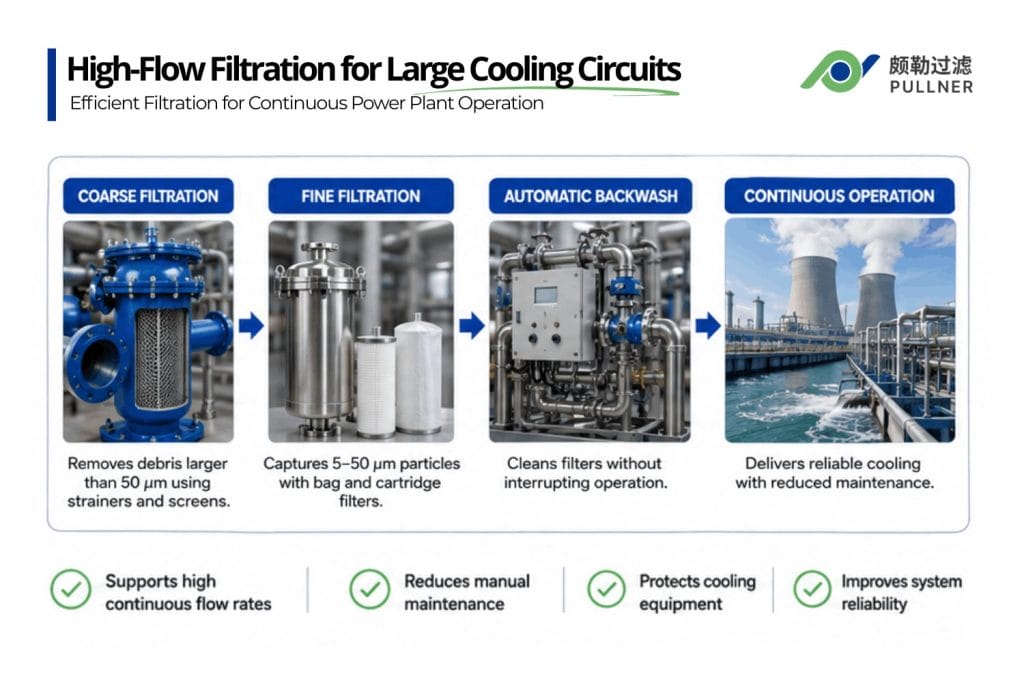
Large combined-cycle plant filtration systems require cooling-circuit filtration rated for high continuous flow and uninterrupted operation without manual intervention. At the volumes these plants move, automatic operation and minimal element count per housing are the primary design targets.
- Coarse filtration: Removes debris above 50 microns using strainers and screens ahead of the fine filtration stage.
- Fine filtration: Operates in the 5–50 micron range using bag-and-cartridge systems matched to the particulate profile of the cooling water source.
- Automatic backwash: Maintains uninterrupted cooling system operation without manual intervention.
- Mechanical cleaning systems: Cut maintenance costs by reducing the manual intervention required in continuous-flow circuits.
Relevant Filter Types and Products
Cooling water circuits at large plants move volumes that standard cartridge housings can’t handle efficiently. Filter selection for these circuits focuses on flow capacity, housing compatibility, and minimizing the number of elements in service.
- High-flow cartridges: Handle large cooling water circulation volumes at flow rates unsuitable for standard cartridge housings.
- Multi-diameter cartridge designs: Support high-capacity flow handling across different housing configurations and circuit sizes.
- High-throughput elements: Reduce the number of elements per housing and lower replacement frequency in continuous-duty cooling circuits.
Pullner’s high-flow cartridges handle large cooling water volumes in a compact housing footprint, with the 40” element rated for flow rates exceeding 60 m³/h under standard conditions. Multi-diameter designs at 152mm, 157mm, and 160mm match different housing configurations across combined cycle plant filtration systems.
Lube Oil and Turbine Oil Filtration
Turbine oil contamination degrades bearing performance and reduces oil service life. Left unaddressed, it causes bearing failure in rotating machinery, resulting in extended outages.
Oil Contamination Mechanisms
Three contamination types degrade turbine oil performance, each compounding the others:
- Water ingress: From steam gland leakage or condensation, it weakens the lubrication film strength and accelerates bearing wear under load.
- Particulate contamination: Wear metals and external ingress score bearing surfaces and journal faces over operating hours.
- Oxidation byproducts: High-temperature exposure reduces viscosity stability and generates acidic compounds that attack bearing metals and seals.
Filtration Requirements
- Depth filtration: Removes fine particulate from oil circuits at ratings matched to bearing clearances.
- Water separation cartridges: Remove emulsified moisture before water-in-oil concentration reaches levels that collapse the oil film.
- Stainless steel cartridges: Cover high-temperature service where polymer media softens under sustained heat.
- Oil-water separation cartridges: Protect bearing systems from moisture ingress caused by thermal cycling and steam gland wear over long intervals.
Relevant Filter Types and Products
- Stainless steel cartridges used in high-temperature oil environments.
- Depth filtration elements remove fine particulate contamination.
- Oil-water separation cartridges protect turbine bearing systems.
Cross-Reference Guide: Replacing Pall, Parker, 3M, and HYDAC Filters
Power plant filters from Pall, Parker, 3M, and HYDAC cross-reference to Pullner equivalents across condensate, feedwater, process water, and turbine oil applications. Replacement qualifications need documented performance parity and compatible housing dimensions. Both are supported through Pullner’s in-house lab testing and up to two free sample cartridges—customers cover shipping—so maintenance teams can confirm dimensional fit and performance before full procurement.
| OEM Brand | Application Area | Filtration Type | Typical Micron Range | Functional Equivalence (Generic) | System Use Case |
|---|---|---|---|---|---|
| Pall | High-purity condensate and process water | Pleated / high-efficiency cartridge | 1–10 µm | High-efficiency particulate removal | Condensate polishing, boiler protection |
| Parker | Industrial hydraulic and process filtration | Pleated / depth/cartridge | 3–25 µm | Hydraulic + process fluid filtration | Turbine auxiliaries, process water |
| 3M | Fine filtration and industrial liquids | High-efficiency cartridge | 0.5–10 µm | Fine particulate and chemical filtration | Process water, polishing stages |
| HYDAC | Hydraulic and turbine oil systems | Depth/oil cartridges | 1–10 µm (oil) | Oil cleanliness and water separation | Turbine lubrication systems |
Pullner’s Power Plant Filter Solutions
Power plant filtration across the boiler feedwater and condensate circuit and across cooling and oil systems requires a coordinated cartridge selection strategy. Pullner Filter works as a technical partner in that process—not just a cartridge supplier. With 20+ years in industrial filtration, ISO 9001 certification, 100% factory testing, and 30+ production lines, Pullner backs every element with the quality credentials that power generation procurement programs require.
High-flow PHF-L series cartridges cover large-volume condensate and cooling duties. Pleated filter cartridges, string-wound and stainless steel elements cover staged BFW and condensate polishing trains.
Every element ships with full lab documentation: PMI pore-size analysis, SEM verification at 3 nm resolution, and IFTS single-pass bench data. That documentation supports boiler water quality validation and water treatment process change records.
Contact Pullner Filter to speak with a filtration engineer about your boiler feedwater filtration, condensate polishing filter, or cooling water filter cartridge requirements. For Middle East power generation projects, Pullner’s status as the only Chinese supplier approved by Saudi Aramco for filter elements provides an additional qualification reference for procurement review.
Power Plant Filtration FAQs
What is the difference between start-up and operating filters in power plants?
Start-up filters run at coarser micron ratings to handle elevated iron loads from system corrosion during downtime. Operating filters shift to 1–10 microns for steady-state condensate polishing. Most plants use the same pleated filter cartridge platform for both phases, switching ratings rather than filter types.
How does high-flow filtration reduce costs in power generation?
A single 40″ high-flow cartridge replaces 30–35 standard 2.7” elements per housing. Fewer elements mean faster change-outs and lower disposal costs. For plants running condensate polishing at 1,000+ m³/hr, the switch can cut total element count by over 90%.
Why is filtration important in power generation?
Without removal of dissolved gases and particulate control, contaminants deposit on heat transfer surfaces and turbine blades, raising fuel consumption and forcing unplanned outages. Proper power generation filtration keeps condensate water within the boiler water quality specifications and helps plants extend equipment life.
What is ultrafiltration used for in power plant water treatment?
Ultrafiltration removes colloids and organics from surface water, well water, and makeup water sources before those feed streams reach reverse osmosis membranes. At the RO feed point, it lowers the silt density index and significantly reduces internal treatment chemical demand. Consistent quality water output across the full water treatment process depends on this stage.
What internal treatment chemicals are used alongside filtration?
Internal treatment uses oxygen scavengers and the addition of chemicals such as hydrazine to remove residual dissolved gases. Alkalinity builders maintain an alkaline pH to reduce corrosion. Boiler feed water treatment chemistry manages bicarbonate alkalinity to prevent carbonate scaling.
Back to Top: Power Plant Filtration Guide: Boiler, Condensate & Cooling
 English
  Spanish
  Arabic