
Industrial process water carries suspended solids, dissolved ions and biological organisms from most industrial feed sources. Removing them typically involves physical separation, membrane treatment and disinfection unit operations matched to the measured contaminant load.
Each contaminant class can drive distinct failure modes when left unaddressed. Fouled membranes, permit violations and unplanned shutdowns compound operating costs beyond what routine maintenance can offset.
Poor water quality doesn’t just affect the end product. Scale on heat exchangers cuts thermal efficiency and biological growth in cooling towers accelerates microbiologically influenced corrosion.
Dissolved metals can push effluent outside permit limits. Selecting the right treatment sequence for each contaminant type is how facilities remove contaminants from water and maintain controlled contaminant levels.
Identify What’s in Your Water
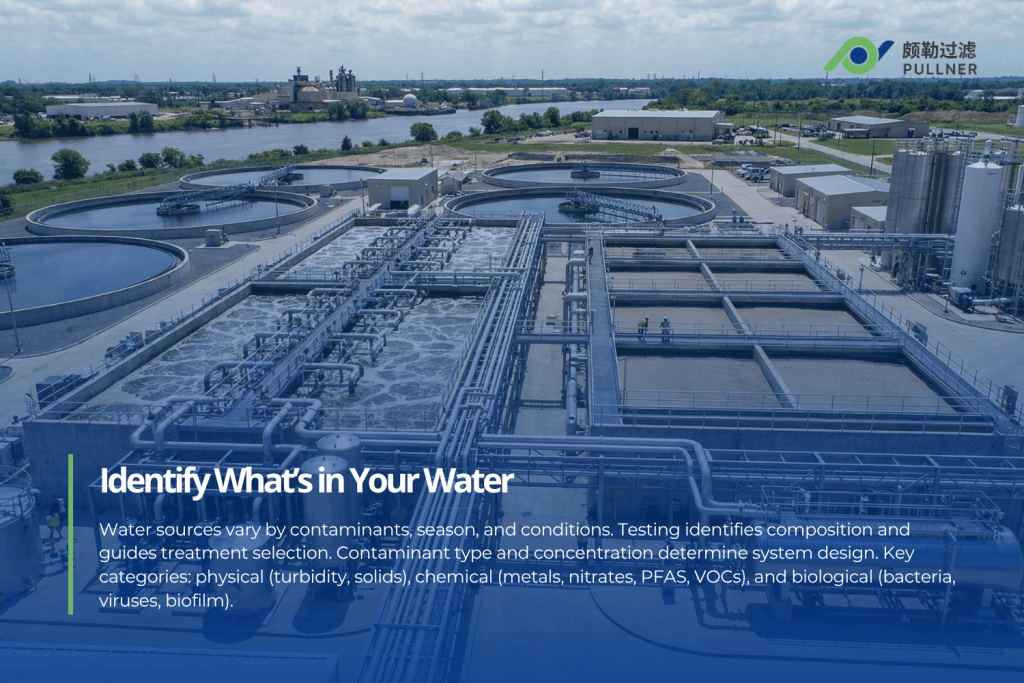
Municipal supply, surface water, water from a well, and process reuse streams each carry distinct contaminant profiles that vary by source, season, and operating conditions. A water test is the most reliable way to establish what’s in the feed and determine which physical separation, membrane, or disinfection steps apply.
Contaminant type and concentration together drive every downstream media and equipment selection decision. Without that data, systems are sized based on assumptions rather than on actual fouling, breakthrough, or compliance risk.
Contaminant categories to identify in a lab report:
- Physical: Turbidity, suspended solids, and sediment loading.
- Química: Hardness, heavy metals, nitrates, PFAS, and VOCs.
- Biological: Bacteria, viruses, and biofilm-forming organisms.
Common Industrial Water Contaminants
Drinking water contaminants and industrial process water contaminants overlap, but recirculation, evaporation, and process contact concentrate contaminant classes, accelerating equipment degradation. Each sub-section below targets a specific category and its operational impact on water quality.
Suspended Solids and Sediment
Sand, silt, and production debris are among the most common physical contaminants in industrial feed streams.
Rust and scale particles compound the problem by driving abrasion against wetted components. Clogged nozzles and increased differential pressure are common outcomes, with membrane and resin service life shortening under sustained particle loading.
Dissolved Minerals and Hardness
Calcium, magnesium, and bicarbonates dissolve readily into source water and concentrate as recirculation increases.
Silica deposits on boiler and heat exchanger surfaces are harder to remove and form more quickly at elevated temperatures. Energy efficiency drops. More frequent chemical cleaning cycles can follow, increasing both reagent spend and the risk of unplanned downtime.
Heavy Metals and Corrosive Ions
Aging infrastructure and geological contact introduce iron, manganese, and arsenic into the process water supply.
Lead and chlorides, particularly aggressive to stainless and copper alloys, add corrosion risk across wetted surfaces. Heavy metals can contaminate products and expose sensitive streams, and effluent concentrations exceeding regulatory thresholds can trigger discharge permit violations.
Organic Contaminants and VOCs
Oils, greases, and process organics foul membrane surfaces rapidly when pre-treatment is insufficient.
VOCs and solvents appear in food and beverage product streams at concentrations well below sensory detection thresholds. Source control becomes a process requirement, not an afterthought. Organic loading creates environmental compliance exposure when levels reach reportable thresholds.
Microorganisms and Biofilm
Bacteria, algae, and fungi colonize piping and cooling systems wherever biological control is absent, but biofilm is the more persistent operational threat.
Contaminated water carrying biofilm reduces heat transfer efficiency and drives microbiologically influenced corrosion (MIC) across metal surfaces. Hygiene risks increase when water systems come into direct contact with the product stream.
Methods to Remove Water Contaminants
Understanding how to remove contaminants from water starts with matching each treatment technology to a specific contaminant class.
Multi-stage filtration systems outperform single-barrier approaches because each stage targets a different particle size range while protecting downstream equipment. No single water filter addresses every contaminant type. Industrial feed conditions vary too widely for any one technology to cover the full contaminant load.
Pre-filtration: Strainers, Screens and Media Filters
Coarse basket strainers and multimedia filters remove larger particles, sediment, and suspended solids before the feed reaches sensitive downstream equipment. Sand filtration reduces turbidity and TSS loading at the intake stage.
Standard practice places pre-filtration ahead of membranes, ion exchange, and UV systems to protect downstream performance. Skipping pre-treatment accelerates fouling and shortens equipment service life.
Cartridge and Depth Filtration
Fine particulate control requires cartridge and depth filtration after pre-treatment stages have reduced bulk solids loading. Pleated cartridges and high-flow depth filters achieve specific micron ratings, protecting RO and UF membranes from premature fouling.
Differential pressure monitoring across cartridge housings signals when change-out intervals are approaching. Pullner’s glass fiber depth filter cartridges target high colloid, grease, and protein loading, where standard pleated media reaches capacity early.
Activated Carbon Filtration
Activated carbon filters absorb chlorine, chloramine, and VOCs through direct surface contact with the feed stream. Free chlorine can damage membranes and affect product quality at low concentrations in food, beverage, and pharmaceutical operations.
Carbon filtration is the most reliable way to remove contaminants of this class before the feed reaches sensitive process equipment. Protecting downstream membrane stages with the right pre-filter reduces total consumable spend across the treatment train.
Membrane Technologies: UF, NF and RO
Ultrafiltration removes suspended solids, colloids, and bacteria and serves as pre-treatment to reverse osmosis in high-purity applications. Nanofiltration reduces hardness and larger organics while passing some monovalent salts.
A water filtration system based on reverse osmosis removes up to 99% of dissolved solids and many organic compounds, making RO the primary tool for purifying water in demanding industrial processes.
Pullner’s PES and PVDF membrane filter cartridges cover a range of 0.02 µm to 90 µm and are broadly compatible with pH 1–14.
Ion Exchange and Softening
Ion exchange systems target dissolved ions through resin beds sized to the feed chemistry and regeneration cycle requirements. Hardness, nitrates, and specific metals are reduced depending on the resin type. Integration with RO or NF is standard in boiler feed and ultra-pure process water applications.
Disinfection and Microbial Control
UV systems inactivate microorganisms in water without introducing chemical residuals, making UV the preferred post-filtration step when clean, low-turbidity feed is available. Chemical methods, including chlorination and oxidizing biocides, are used for disinfecting distribution and cooling systems where biofilm control is ongoing.
Particle removal upstream matters. Suspended solids shield microorganisms from UV exposure, reducing inactivation efficiency when pre-filtration is inadequate.
Pullner’s DHPS sterilizing-grade PES cartridges withstand up to 50 steam sterilization cycles for farmacéutica and beverage applications where repeated SIP is standard.
Building an Effective Multi-Stage Treatment Train
A multi-barrier water treatment system treats each contaminant class at the stage where removal is most efficient. Every step protects the equipment downstream.
Emerging contaminants like PFAS, increasingly referred to as “forever chemicals,” have strengthened the case for staged design as EPA guidance lowers acceptable levels in drinking water. No single technology removes the full range of contaminants present in most industrial feed streams.
PFAS and the Case for Multi-Barrier Design
PFAS in drinking water and process water require dedicated treatment stages, as standard pre-filtration alone cannot remove them from the feed. Activated carbon adsorption, ion exchange, and reverse osmosis are the primary technologies confirmed to reduce PFAS concentrations to regulated limits.
The EPA has set enforceable limits on several PFAS compounds. Facilities drawing from affected tap water or surface water sources need treatment systems designed to meet those limits. Removing PFAS from drinking water and process streams requires confirmed removal data.
Example Treatment Train:
The treatment sequence varies by application, but the underlying logic remains consistent. Each stage removes what the next stage can’t handle. Two common industrial configurations illustrate how contaminant class drives train design.
Boiler Feed Water:
- Screening and multimedia filtration strip suspended solids from the raw feed.
- Softening or nanofiltration reduces hardness before the RO system.
- Mixed-bed ion exchange polishing delivers the final conductivity specification.
Food and Beverage Process Water:
- Carbon filtration removes free chlorine and VOCs ahead of the membrane stages.
- Ultrafiltration reduces colloidal and biological loading before RO.
- UV disinfection delivers safe drinking water and process-grade output without chemical residuals.
Operational Monitoring and Maintenance
Consistent operational monitoring ensures filtered water quality throughout the train. Turbidity and conductivity readings signal fouling or breakthrough before water contamination reaches downstream equipment.
Differential pressure data across each stage are more reliable than fixed-time schedules for setting filter change-out intervals. Maintenance intervals tied to actual performance data extend the life of consumables and reduce unplanned downtime.
How to Choose the Right Filtration Partner
Industrial contaminant removal demands more than off-the-shelf equipment. Suppliers who design filtration methods around feed chemistry and compliance targets deliver more predictable outcomes than those offering standard configurations alone.
Coverage across the full project lifecycle, from water analysis and pilot testing through to ongoing technical support, reduces the total cost of ownership and limits unplanned downtime.
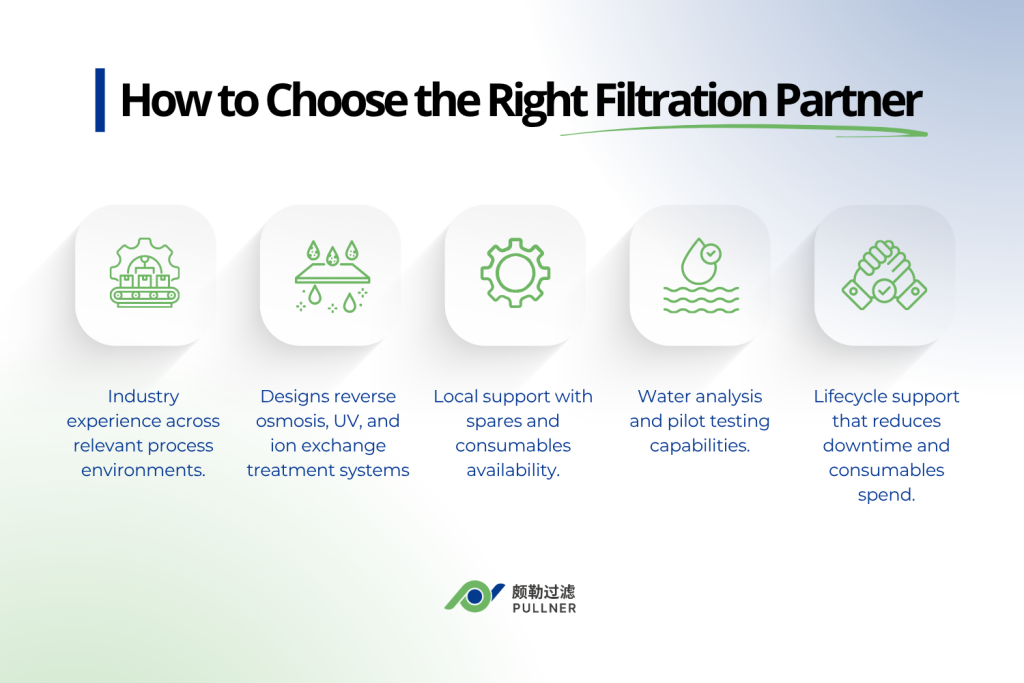
Buyers working through supplier evaluation often look for:
- Verified industry experience across relevant process environments.
- In-house lab testing capabilities, including flow, pressure drop, and material compatibility testing.
- Local technical support with spares and consumables availability.
- Water analysis and pilot testing offered before commitment.
- Lifecycle support that ties change-out intervals to actual performance data rather than fixed schedules.
Pullner Filter brings 20+ years of industrial filtration experience and an ISO 9001-certified facility running 100% batch inspection across every product line. In-house lab capabilities, including PMI pore analysis, SEM verification, and ICP-MS testing, give engineers the documented performance data they need for procurement sign-off.
Up to two free samples are available for evaluation before any purchasing commitment, and Pullner’s technical teams operate across the Middle East, Europe, Southeast Asia, and South Korea, with on-the-ground support rather than distributor-only coverage.
Suministros para filtros Pullner engineered industrial filter cartridges that integrate into multi-stage treatment trains. Carbon, ion exchange, and RO configurations targeting PFAS in water and other priority contaminants are all supported.
Contact us to discuss your application and confirm the right filtration configuration for your system.
How to Remove Contaminants From Water FAQs
How often should an industrial facility retest its water quality?
Source variability and process sensitivity together determine the retesting frequency. Facilities with a stable municipal supply and low-risk processes often schedule quarterly lab analyses.
More variable sources, such as surface water or recirculated process streams, warrant monthly testing. Supplemental water tests after upstream events, source switchover, or new chemical programs catch shifts in contaminant loading before they reach downstream equipment.
What data should I collect before talking to a filtration supplier?
Recent lab reports covering metals, hardness, organics, microbiology, and PFAS give suppliers the contaminant profile needed to size equipment accurately.
Typical and peak flow rates, operating temperature ranges, and existing treatment equipment round out the baseline picture. Current pain points, including fouling frequency, cleaning intervals, and compliance excursions, help suppliers identify where the existing treatment train is underperforming.
Can I integrate new filtration stages with my existing treatment system?
Pre-filtration, polishing, and PFAS-specific stages can be added upstream or downstream of existing units in most industrial configurations.
A hydraulic and compatibility review confirms that pressures, flows, and materials of construction stay within safe operating limits before any new stage is commissioned. Skipping that review risks mismatched operating pressures and accelerated wear on existing equipment.
Volver arriba: How to Remove Contaminants From Water
 English
  Spanish
  Arabic