
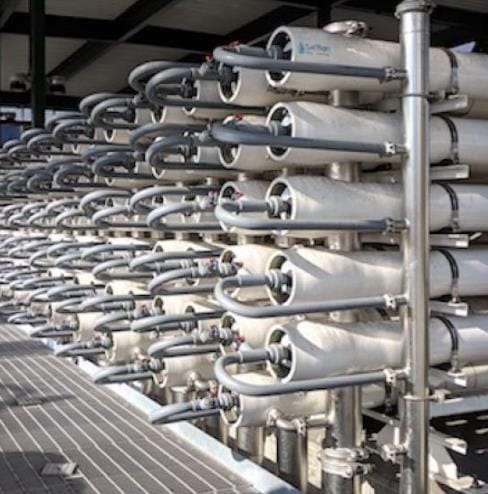


Seawater Desalination RO Pre-Filter High Flow Cartridge — PHFL Series
The PHFL is a high flow RO pre-filter cartridge for seawater desalination and brackish water RO, installed ahead of the membranes to protect them from particulate load. In a seawater filtration package it forms the cartridge stage upstream of the RO skid. Media options are deep pleated or melt polypropylene, glass fiber and polyester, with micron ratings of 0.1–100 µm. Each 6″ (152.4 mm) single-open-end element comes in 20″, 40″ or 60″ lengths and handles 50–200 GPM. PP is rated to 82°C and glass fiber to 121°C, each at 3.44 bar maximum differential pressure. Send your intake conditions, RO train flow and current cartridge model for a sizing check and quote.
- Clasificación Micron
- 0.1–100 µm
- Caudal
- 50–200 GPM
- Temperatura máxima
- Up to 121°C by media
- SKU
- PHFL
- High flow per element — 50–200 GPM on a 6" (152.4 mm) body, so the pre-filter stage runs on fewer, larger elements.
- Single open end — SOE design sealed with silicone, NBR, Viton or EPDM O-rings.
- Media for intake conditions — deep pleated or melt polypropylene, glass fiber or polyester.
- Grade range — 0.1–100 µm, so the grade can be set to the membrane feed requirement and the intake loading.
- Length options — 20", 40" and 60".
- Rated limits — max. differential pressure 3.44 bar at 82°C (PP), 121°C (GF) and 120°C (PET).
| Serie | PHF-L / PHFL |
| Medio filtrante | PP (deep pleated / melt) · glass fiber · polyester |
| Micron rating | 0.1–100 µm |
| Outer diameter | 6" (152.4 mm) |
| Length options | 20" · 40" · 60" |
| Tapa | SOE (single open end) |
| O-ring / gasket | Silicone · NBR · Viton · EPDM |
| Flow rate | 50–200 GPM |
| Max. differential pressure | PP 3.44 bar @ 82 °C · GF 3.44 bar @ 121 °C · PET 3.44 bar @ 120 °C |
| Max. temperature | PP 82 °C · GF 121 °C · PET 120 °C |
| Certificaciones | ISO 9001 |
| Minimum order | 4 pieces |
| Lead time | 10 working days |
- Seawater desalination: RO pre-filtration on the intake train.
- Brackish water RO: membrane protection ahead of the skid.
- Industrial water: high flow prefiltration at volume.
- Variable intakes: grade and length selected for seasonal loading.
Seawater RO pre-treatment is a volume problem before it is a filtration problem. A train moves enough water that the cartridge count sets the cost of the stage, not the cartridge rating. One 6" high flow element at up to 200 GPM replaces a bank of standard 2.5" cartridges, and with them most of the seals that could bypass.
The PHF-L is built for that stage. A 6" (152.4 mm) body in 20", 40" and 60" lengths, single open end, grades from 0.1 to 100 µm, in polypropylene, glass fiber or polyester depending on intake temperature and loading.
The job of this stage is not clarity. It is SDI — holding the silt density index low enough that the membranes behind it foul at a predictable rate instead of an expensive one.
On an open intake the load varies with weather, season and tide, so the grade that works in January is not always the grade that works in July. Plants running variable intakes generally specify a coarser grade with more length rather than a fine grade that blinds during an algal bloom. The differential pressure trend across the stage is the number to watch, not the change-out count.
Size on the worst month, not the average. A stage sized on annual mean loading spends part of every year in distress.
Polypropylene is the standard specification on seawater intake and covers most installations. Two cases move it:
- Heavy or highly variable loading — glass fiber, for the additional dirt-holding capacity at the same differential pressure.
- Long continuous hot duty — polyester, for hydrolytic stability that polypropylene does not have over extended service in warm water.
All three carry a 3.44 bar differential pressure rating and cover 0.1 to 100 µm, so the media decision does not constrain the grade decision.
Up to two samples ship worldwide free of charge, with freight paid by the customer.
Who it is for
Desalination plant operators, RO system integrators and EPC contractors who build or maintain seawater and brackish water RO trains, and the O&M teams who change the pre-filter stage. See also Pullner desalination plant filtration.
Typical operating conditions
- Flow: 50–200 GPM per element
- Micron rating: 0.1–100 µm
- Max. temperature: PP 82°C · GF 121°C · PET 120°C
- Max. differential pressure: 3.44 bar at each media's temperature limit
- Format: 6" (152.4 mm) OD · 20", 40" or 60" · single open end
- Seals: silicone, NBR, Viton, EPDM
Recommended Pullner product family
PHFL series, part of Pullner cartuchos filtrantes de alto caudal. Polypropylene is the standard choice on seawater intake; glass fiber or polyester is reviewed for heavier loading or warmer duty. Minimum order is 4 pieces; lead time is 10 working days.
What to send before quotation or sample
- Fluid / media
- Flow rate
- Micron rating
- Temperature
- Pressure
- Existing housing or current model (housing make and model, element length, and the cartridge you run today)
- Maintenance / change-out cycle
- Validation requirement
Obtener presupuesto · Request Sample · Send Current Model · Ask Engineering
Can it replace the cartridges in my current RO pre-filter stage?
If your housing takes 6" (152.4 mm) single-open-end high flow elements in 20", 40" or 60" lengths, the PHFL is a replacement option. Send the current model and housing details for a fit check. Other housing formats need an engineering review before quotation.
How is it validated before switching?
Start with a fit check on your housing and current model, then install a sample. Run it on your intake and log differential pressure across the stage and silt density index (SDI) downstream against your current cartridge. Scale the order after the trial.
What data or documentation is available?
The full specification is published on this page: media, micron rating, diameter, lengths, end cap, seals, flow, differential pressure and temperature limits. Pullner manufactures under ISO 9001. Tell engineering which documents your project or owner approval needs and request them with the sample.
What are the temperature, pressure and chemistry limits?
PP is rated to 82°C, glass fiber to 121°C and polyester to 120°C, each at 3.44 bar maximum differential pressure. Flow is 50–200 GPM per element. Media and seal compatibility with your seawater chemistry and any dosing chemicals is reviewed from your intake data.
Where does this cartridge sit in a seawater filtration package?
It is the cartridge pre-filter stage, installed upstream of the RO membranes and after any screening or media filtration in the package. Its job is membrane protection. Send the package layout and design flow so the stage can be sized in 50–200 GPM elements.
 English
  Spanish
  Arabic