
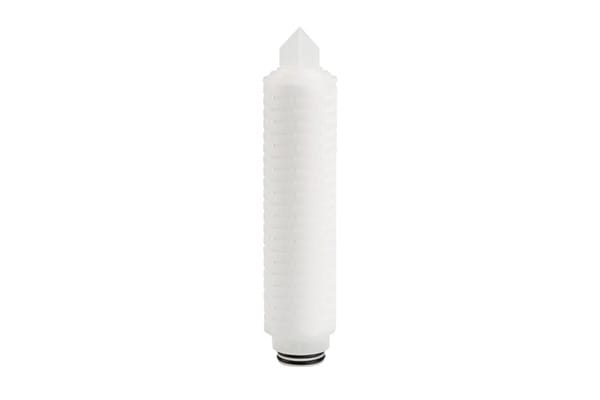

Filtros de agua plegados de polipropileno
Two numbers describe this cartridge’s pressure rating: 4 bar at 21 °C, and 2.4 bar at 80 °C. Most specifications publish only the first. The second is the one that decides whether a housing is sized correctly, because a polypropylene pleat pack gives up roughly 40 percent of its differential pressure capability across that span.
The PPM element is a depth-loading pleat pack rather than a surface-loading one, so particles are captured through the thickness of the media instead of across its face. Ten grades from 0.1 to 100 µm, on a 2.7″ (69 mm) body in 10″, 20″, 30″ and 40″ lengths, with five seal materials.
- Clasificación Micron
- 0.1–100 µm
- Caudal
- 1–5 GPM per 10"
- Temperatura máxima
- 80°C
- SKU
- PPM
- Depth-loading pleat pack — captures through the media, not across its face
- Pressure published at two temperatures — 4 bar at 21 °C, 2.4 bar at 80 °C
- Five seal materials including encapsulated FEP
- Ten grades from 0.1 to 100 µm
- Integrity tested, cleanroom produced
- ISO 9001 with batch documentation on request
| Serie | PPM |
| Medio filtrante | Polypropylene — depth-loading, pleated |
| Micron rating | 0.1 · 0.22 · 0.45 · 1 · 3 · 5 · 10 · 20 · 50 · 100 µm |
| Outer diameter | 2.7" (69 mm) |
| Length options | 10" · 20" · 30" · 40" |
| Tapa | DOE · SOE (226 fin, 226 flat, 222 fin, 222 flat) |
| O-ring / gasket | Silicone · NBR · Viton · EPDM · FEP |
| Flow rate | 1–5 GPM per 10" element (suggested) |
| Max. differential pressure | 4 bar at 21 °C · 2.4 bar at 80 °C |
| Max. temperature | Up to 80 °C |
| Certificaciones | Cleanroom production · integrity tested per element · ISO 9001 |
| Minimum order | 25 pieces |
| Lead time | 7 working days |
- Process water: particle control on treated water systems.
- Prefiltración por ósmosis inversa: membrane protection ahead of the skid.
- Fine chemical: duty where the fluid attacks exposed elastomers.
- Elevated temperature service: sized against the 80 °C figure.
Size the stage against the pressure rating at the temperature the process actually runs, not the headline number at 21 °C.
| Working temperature | Max. differential pressure |
|---|---|
| 21 °C | 4 bar |
| 80 °C | 2.4 bar |
An element specified on the cold figure and run hot will reach its limit at a differential pressure the system was never designed to stop at. That is the failure that gets diagnosed as a bad batch of cartridges, and almost never is.
Where the process cycles between the two, size on the hot number and treat the cold performance as headroom.
A surface-loading pleat traps everything on the upstream face. It blinds when that face is covered, which can happen while the media behind it is untouched.
A depth-loading pack is graded through its thickness. Larger particles are held near the surface, finer ones progressively deeper, and the whole thickness of the media contributes before the element is spent. On the same duty that produces a longer and flatter differential pressure curve, and fewer change-outs for the same throughput.
The practical consequence is that stepping to a finer grade costs less service life here than it would on a surface-loading element, because the upstream layers are unchanged and still doing most of the work.
Five seals are available, and FEP is the one worth understanding. It is an encapsulated seal: an elastomer core inside a fluoropolymer jacket. The jacket takes the chemical exposure, the core supplies the compression the housing needs.
Specify it where the fluid would attack an exposed elastomer but the housing still requires a compressible seal — the usual answer on aggressive chemistry where Viton alone is marginal. Silicone, NBR, Viton and EPDM cover everything below that.
Up to two samples ship worldwide free of charge, with freight paid by the customer.
 English
  Spanish
  Arabic