
When sediment, chlorine, and organic compounds all threaten process water quality, the wrong cartridge filter shortens equipment life and inflates operating costs.
Activated carbon filters and pleated filter cartridges each target a distinct contamination profile – pairing the wrong type with a process stream wastes budget and leaves downstream equipment exposed. Understanding how each filter works at the media level helps engineers match filtration to actual water quality data
Carbon vs. Pleated Water Filters: Head-to-Head Comparison
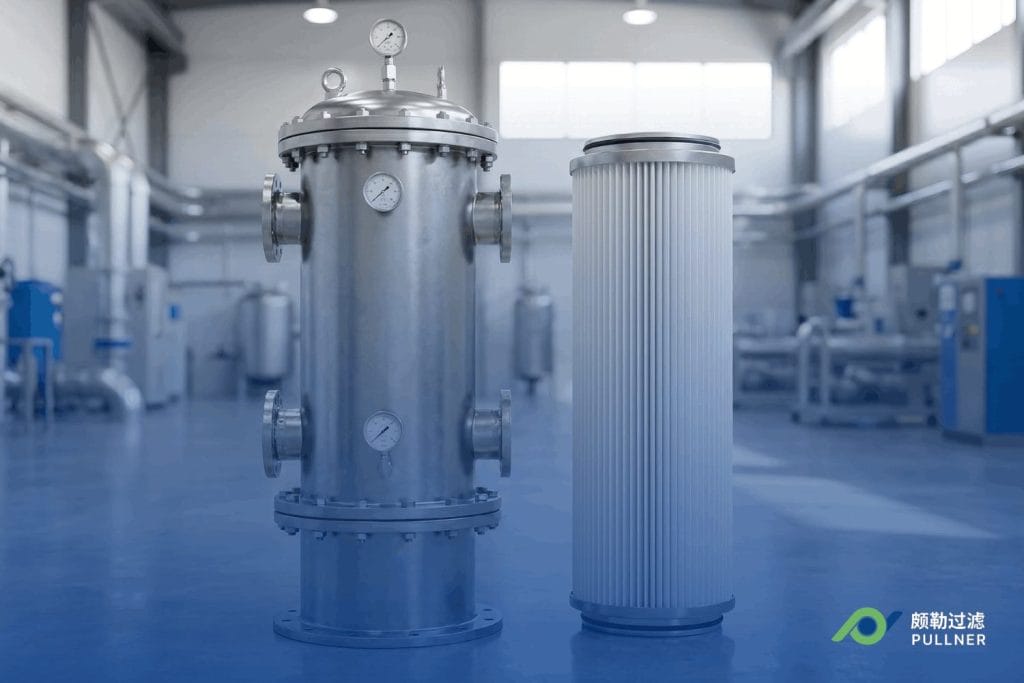
Carbon filter cartridges and pleated water filters target different types of contamination. Direct comparison helps engineers identify which filter type fits each process stage and where staged filtration closes the gap.
| Factor | Carbon Filter | Cartucho filtrante plegado |
|---|---|---|
| Contaminant target | Chlorine, VOCs, organics | Sediment, solid particles, particulates |
| Pressure drop | Higher as bed loads | Lower, stable across service life |
| Lifespan | A few months to 1+ year depending on chlorine load; media replaced when spent | Longer, stainless steel versions are washable |
| Mantenimiento | Backwash plus media replacement | Cartridge inspection and replacement |
| Best fit | RO pre-treatment, chemical polishing | High-solids streams, aggressive fluids |
What are Carbon Filters?
A carbon filter is a vessel-based water filter that removes dissolved chemical contaminants through adsorption, bonding chlorine and dissolved species to porous carbon media.
Unlike a pleated filter or depth filter, it targets what mechanical sieving can’t capture. Activated carbon filters are a standard fixture in RO pre-treatment and municipal water systems. Any industrial process where dissolved contaminants affect downstream equipment or product quality depends on carbon filtration.
How activated carbon filters work
Activated carbon works through adsorption, in which contaminants bind to the vast internal surface area of its porous particles. It doesn’t capture dissolved species mechanically; it binds them chemically to the carbon media.
Carbon media from coconut shells, bituminous coal, or lignite removes chlorine, volatile organic compounds, and hydrogen sulfide in a single pass. Mesh size is matched to source water quality, with 8×30 granules suited to high-turbidity surface water and 12×40 suited to cleaner municipal water feeds.
Carbon filter system components and operation
Industrial carbon filter systems pair FRP or steel mineral tanks with control valves scaled to flow rate demand. Service flow runs at approximately 5 GPM per square foot. Backwash requires 10 to 12 GPM per square foot to fully fluidize the bed.
The media bed can’t exceed 50% of the tank height, leaving room for 30-40% expansion during backwash. Preventing channeling during that expansion maintains consistent adsorption capacity across the bed. Once capacity is exhausted and effluent quality drops, carbon media needs to be replaced rather than cleaned.
Common applications for carbon filters
Reverse osmosis pretreatment is one of the most common applications for activated carbon filters, as free chlorine rapidly degrades thin-film composite membranes. Carbon filtration removes chlorine reliably before the feed stream reaches the membrane stage.
Food and beverage plants and pharmaceutical facilities also use carbon filtration to remove chlorine, odor, and organic compounds. Municipal water systems depend on activated carbon filters, where water quality affects product safety or process compliance.
Activated carbon filters also suit volatile organic compound remediation and total organic carbon reduction in wastewater streams.
What are Pleated Filters?
A pleated filter is a cartridge-style surface filter that captures solid particles through mechanical sieving. Pleated media folds pack a large surface area into a compact housing. Pleated filters don’t adsorb dissolved species the way carbon filters do.
They outperform carbon and standard depth filters on particulate removal and pressure drop stability. The right pleated cartridge handles coarse sediment filtration at 100 microns down to fine particle control at 1 micron.
How pleated filter cartridges work
A pleated filter cartridge captures solid particles through mechanical sieving, with the pleated media holding larger particles at the filter surface as liquid passes through.
Polipropileno is the most common media material for general liquid filtration. Polyester and 304/316L stainless steel pleated elements are suitable for higher temperatures and chemically aggressive process streams.
Flow runs from inside to outside in most pleated cartridge filters, keeping captured particulate matter contained within the element and reducing spillage during cartridge changeouts.
Pleated filter design and performance
The large surface area of each pleated filter cartridge results in a lower initial pressure drop than a comparable depth filter.
The pleated media structure provides the element with excellent dirt-holding capacity, extending the run time between replacements. Micron ratings range from 1 micron for fine-particle control to 100 microns for coarse-sediment filtration.
Absolute-rated options are available when precise pore-size control affects downstream process quality. Stainless steel pleated filters are washable and reusable, reducing long-term filter replacement cost where cartridge changeout frequency is high.
Common applications for pleated filters
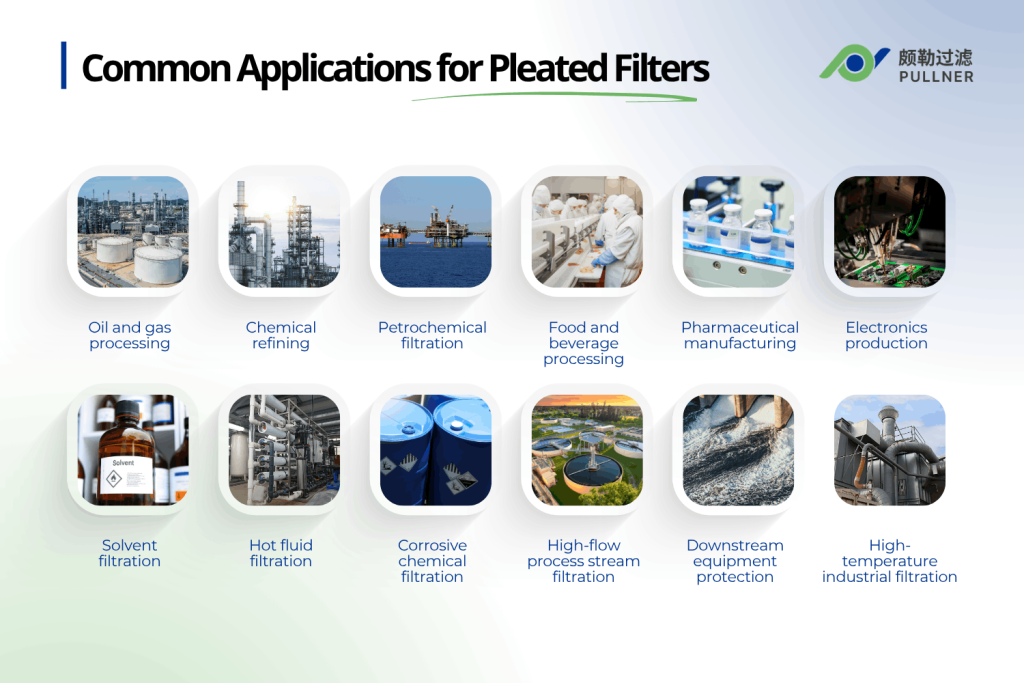
Pleated filter cartridges are suitable for oil and gas, chemical refining, and petrochemical applications where solid particles must be removed from process streams. Depth filtration imposes a pressure drop penalty at high flow rates that pleated media doesn’t.
Pleated cartridges also protect food and beverage, pharmaceutical, and electronics processes, where controlled pore size and consistent particulate removal protect sensitive downstream equipment.
Stainless steel pleated elements handle corrosive process fluids and elevated temperatures that polypropylene cartridges can’t tolerate. That makes them reliable across solvent filtration and hot fluid service.
Choosing the Right Filter for Your Process
Matching the right cartridge filter to your process starts with knowing what the feed stream contains and what the outlet spec demands. Use the criteria below to identify the correct filter type before committing to a configuration.
Look at using a carbon filter cartridge when your process needs to:
- Remove chlorine or chloramine before a membrane stage.
- Reduce volatile organic compounds or hydrogen sulfide.
- Control taste, odor, or total organic compounds in potable or processed water.
- Lower total organic carbon in wastewater streams.
Opt for a pleated filter cartridge when your process needs to:
- Remove sediment, rust, or solid particles from a liquid stream.
- Maintain a stable flow rate with a low pressure drop.
- Handle fine particles down to 1 micron or coarse particulate matter up to 100 microns.
- Filter corrosive or high-temperature fluids with a polypropylene or stainless steel element.
Select both filter types in sequence when your process needs to:
- Protect a carbon bed from sediment loading with a pleated pre-filter.
- Meet outlet specs that cover both particulate and dissolved contaminant removal.
- Extend filter replacement intervals across the full water filtration train.
Pullner Filter manufactures pleated filter cartridges matched to process chemistry, micron rating, and operating conditions. All products ship under ISO 9001 quality management with 100% factory testing. With 20+ years in filtration engineering supplying B2B buyers across the food and beverage, pharmaceutical, electronics, chemical, and petrochemical sectors, in-house lab capabilities including PMI pore size analysis, SEM verification, and IFTS single-pass testing.
Pullner’s pleated cartridge range includes polipropileno, polyester, and stainless steel pleated elements, with custom and OEM configurations available across micron ratings from 0.1 to 70 microns and lengths from 10″ to 40″. For high-volume applications, Pullner’s cartuchos filtrantes de alto caudal deliver flow rates exceeding 60 m³/h per 40″ element. Up to two free sample cartridges are available so process teams can validate filter performance under real conditions before committing to a bulk order.
Request a quote or speak to a Pullner Filter engineer to review your liquid filtration requirements and identify the right cartridge configuration.
Carbon vs. Pleated Water Filters FAQs
¿Cuál es la diferencia entre micras nominales y absolutas?
Nominal ratings remove a percentage of particles at the stated size. Absolute ratings mean the filter retains all particles at the rated size under defined test conditions. Absolute-rated filters are the correct choice when precise pore-size control affects downstream process quality.
How often should industrial pleated filters be replaced or cleaned?
Replace or clean based on pressure drop and contaminant load rather than a fixed schedule. Many systems target inspection or changeout intervals ranging from weeks to a few months under typical industrial service. Condition-based replacement protects filter performance and avoids unnecessary cartridge cost.
Can carbon and pleated filters share the same housing?
They’re usually installed in separate vessels or stages. Housings or skids designed to hold both pleated particulate and carbon elements in sequence are available when the manufacturer supports that configuration. Running both filter types in sequence delivers broader contaminant control than either filter achieves alone.
Volver arriba: Carbon vs. Pleated Water Filters for Industrial Use
 English
  Spanish
  Arabic