
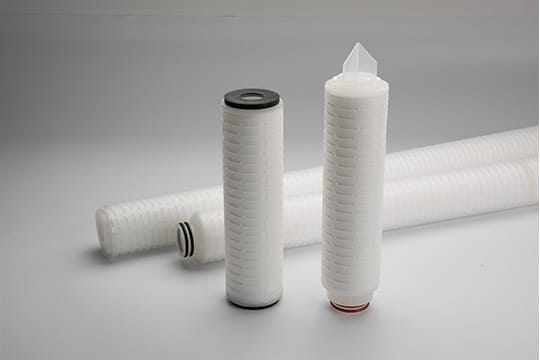
Elemento filtrante plisado de fibra de vidrio
Laid flat, ultrafine glass fibre gives excellent retention and almost no usable area. Pleating it into a 2.7″ body multiplies that area several times over, which is the only reason the media is practical on a process line at all. The pleat is not a packaging decision here. It is what makes the specification possible.
Inside the pack the fibres are graded: coarser on the upstream face, progressively finer through the depth. Large particles are caught early and never reach the fine layer, so the fine layer stays open far longer than it would in a uniform media. Seven grades from 0.1 to 10 µm, in five lengths from 5″ to 40″.
- Clasificación Micron
- 0.1–10 µm
- Caudal
- 1–5 GPM per 10"
- Temperatura máxima
- 80°C (176°F)
- SKU
- PLGF
- Graded-density pack — coarse to fine through the depth, not across the face
- Seven grades from 0.1 to 10 µm
- Five lengths — 5" through 40"
- Hydrocarbon-rated seals — Viton and FEP available
- Rated 80 °C with pressure published at two temperatures
- ISO 9001 with batch documentation on request
| Serie | PLGF |
| Medio filtrante | Ultrafine glass fibre, pleated, graded density |
| Micron rating | 0.1 · 0.2 · 0.45 · 1 · 3 · 5 · 10 µm |
| Outer diameter | 69 mm (2.7") |
| Length options | 5" · 10" · 20" · 30" · 40" |
| Tapa | DOE · SOE (226 fin, 226 flat, 222 fin, 222 flat) |
| O-ring / gasket | EPDM · silicone · Viton · FEP |
| Flow rate | 1–5 GPM per 10" element (suggested) |
| Max. differential pressure | 4 bar at 21 °C · 2.4 bar at 80 °C |
| Max. temperature | Up to 80 °C (176 °F) |
| Certificaciones | ISO 9001 |
| Minimum order | 25 pieces |
| Lead time | 7 working days |
- Oil and gas: amine, glycol and produced water service.
- Petrochemical: process clarification and polishing.
- High-load lines: where surface-loading elements blind early.
- Membrane protection: pre-filtration ahead of finer stages.
On a uniform media the nominal rating describes the whole pack, and every particle meets the same structure. Tightening the grade tightens everything, so service life falls sharply.
On a graded pack the rating describes the finest layer only. The upstream layers are unchanged when the grade is tightened, and they continue to remove the bulk of the load exactly as before. Stepping from 5 to 1 µm therefore costs far less life here than the same step would on a surface-loading element.
Where a polypropylene element would need a length increase to survive that change, this construction usually does not. That is worth checking before an existing stage is re-sized.
Work backwards from what sits downstream, not forwards from what is in the feed.
- Protecting a membrane: match the membrane manufacturer’s stated prefiltration requirement, then step one grade finer if the feed is variable.
- Protecting rotating equipment: the clearance sets the grade.
- Meeting a product specification: the specification sets the grade, and the stage is sized on capacity rather than retention.
Seals are EPDM, silicone, Viton or FEP. On hydrocarbon service specify Viton or FEP; EPDM is for aqueous duty on the same body.
Up to two samples ship worldwide free of charge, with freight paid by the customer.
 English
  Spanish
  Arabic