
Specify 304 for filtration vessels processing chemically stable water with verified low chloride content. Move to 316L when concentrated salts, low-pH cleaning residues, or elevated temperatures enter the operating stream. An unsuitable alloy can develop localized metal loss before routine inspection detects it, interrupting production and compromising filtered output.
The difference comes down to one element. Molybdenum gives 316L stronger pitting resistance, while its reduced carbon protects fabricated zones after welding heat. Both distinctions matter most around joined surfaces and narrow sealing recesses, which is precisely where filter housings and cartridges concentrate risk.
Supplier catalogues often label these grades SS304 and SS316L. This guide compares them for filtration service only, since the alloys behave differently in a drained, crevice-rich vessel than they do in open-surface applications.
What is the Composition Difference Between 304 and 316 Stainless Steel?
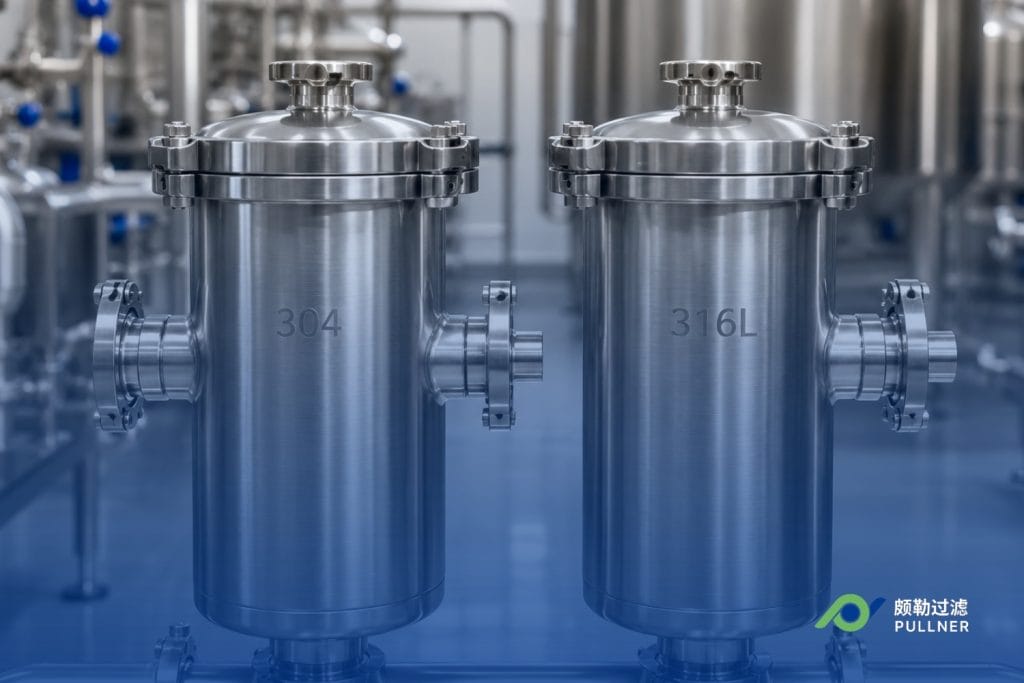
Both grades share chromium and nickel as base alloying elements, but 316 introduces molybdenum for greater localized corrosion resistance. The 316L variant retains that chemistry while reducing carbon for fabricated filtration hardware.
| Specification factor | 304 | 316/316L | Consequence for filtration equipment |
|---|---|---|---|
| Alloy family | Austenitic stainless steel | Same family | Formability supports cylindrical shells and rigid element frames |
| Nominal chemistry | Stainless steel 304 contains about 18% Cr and 8% Ni | Stainless steel 316 contains 16%–18% Cr and 10%–14% Ni | Nickel content supports fabrication and stable toughness |
| Molybdenum addition | Grade 304 has no intentional Mo addition | Stainless steel containing molybdenum at 2%–3% | Added Mo raises resistance near cartridge seats and gasket channels |
| Maximum carbon | Standard material permits up to 0.08% | 316L restricts carbon to 0.03% | Reduced carbon limits sensitization beside a weld |
| Relative PREN | Lower result | Grade 316 achieves a higher result | A higher value indicates stronger comparative pitting resistance |
The pitting resistance equivalent number (PREN) estimates relative performance in chloride-bearing environments based on alloy composition. Its published formula weights molybdenum more heavily than chromium, with nitrogen accounted for through a separate multiplier for applicable grades. That weighting is why 316 returns a higher calculated value than 304.
How does Chloride Exposure Affect Stainless Filter Housing Performance?
Choose 316L when salt concentration can rise around seals or incompletely drained internal surfaces. Use 304 only where current laboratory analysis confirms consistently mild process chemistry. Free chloride ions penetrate weak points in the passive film and form deep, narrow pits that carry little visible warning at the surface.
Crevice corrosion follows the same chemistry in a more concentrated form. Shielded gasket channels, cartridge seating faces, and lap joints restrict oxygen supply, which prevents the passive film from repairing itself and allows the trapped liquid to acidify. A vessel that performs acceptably on open wall surfaces can still fail at a seal groove for this reason, so crevice geometry deserves separate assessment from bulk alloy selection.
For managed freshwater duties, 304 resists corrosion adequately when deposits are removed before salts concentrate. A comparison of 304 vs. 316 carcasas de filtros de acero inoxidable at elevated salt concentrations favors 316L, whose molybdenum content sustains the passive layer under conditions that would breach 304.
Inspection programs should examine closure channels and element seating surfaces before wall penetration occurs. Orange rust marks can indicate transferred ferrous contamination rather than substrate failure. Electropolishing smooths microscopic peaks where residue could trap concentrated liquid after draining, and coupon testing distinguishes removable staining from active pits requiring corrective action.
Do 304 and 316 Differ in Temperature and Pressure Tolerance?
Neither grade automatically carries a higher pressure rating. Rated limits follow vessel calculations, wall construction, and code allowables rather than alloy grade alone.
Pressure and temperature ranges
Housings and cartridges carry different rated limits, so confirm both against the product datasheet before specifying.
- Pressure: Typical industrial configurations operate around 0.6–1.0 MPa (87–145 PSI). Rated limits vary by wall construction and design, so verify each datasheet.
- Temperature: Pullner’s stainless housings are rated for service up to 80°C. Some cartridge designs carry higher ratings, so never assume cartridge tolerance matches the housing limit without a documented comparison.
- High-temperature service: Prolonged operation at elevated temperatures requires creep review. Stainless provides a durable boundary without coating fragments, unlike lined vessels or carbon steel, though mechanical properties must still be verified against expected loads.
CIP and SIP considerations
Cleaning cycles, not normal production, usually impose peak thermal and chemical stress. A structural calculation must address both
- Clean-in-place (CIP): Heated chemical solutions circulate in direct contact with internal surfaces, often at chloride levels above the process fluid itself.
- Steam-in-place (SIP): Steam pressure generates differential expansion between the shell and sealing components.
- Elastomers: Qualify seals independently, as alloy grade does not determine seal compatibility.
Does 316 Stainless Steel Cost More than 304 for Filter Housings?
304 carries the lower purchase price, whereas 316L earns its premium by preventing failure and protecting plant availability. Planning estimates commonly place 304 at roughly 50–70% of 316 on raw-metal cost, though supplier quotations move with nickel markets and fabrication scope.
Electropolished surfaces or controlled joining widen that gap on finished equipment. Procurement teams should compare completed housings rather than applying a fixed multiplier to sheet cost, since required inspection documentation also affects the final quotation.
Build the ownership calculation from the expected service interval and scheduled maintenance labor. Value production losses using the affected line’s hourly margin, then add specialized disposal charges where contaminated hardware requires controlled handling.
Divide the incremental 316L expenditure by the estimated cost of one alloy-related shutdown. The result shows how many avoided events are needed to recover the premium, which converts an alloy preference into a documented commercial decision.
Grade Selection by Process Condition
Match the grade to the process condition using the table below. Confirm code allowables and obtain current supplier quotations before finalizing any specification.
| Process medium | Chloride condition | Operating temperature | Recommended alloy | Commercial implication |
|---|---|---|---|---|
| Treated municipal supply | Low and monitored | 5°C–80°C | 304 | Confirm cleaning-agent compatibility |
| Neutral beverage base | Low | CIP-defined maximum | 304 | Verify sanitation chemistry against alloy limits |
| Salted food liquid | Moderate or changing | CIP-defined maximum | 316L | An electropolished finish is typically specified |
| Brackish pretreatment feed | Elevated | Site-specific | 316L | Confirm SDI at the housing inlet before sizing |
| Seawater pretreatment | Commonly above 20,000 mg/L | Within design rating | 316L minimum | Review whether a stronger alloy is required |
| Heated acidic process fluid | Elevated with low pH | Above standard range | Engineered 316L or higher | Confirm code allowables before ordering |
Chloride concentration alone cannot predict service life because temperature and pH both alter corrosion behavior. Crevice design and oxidizer content require additional assessment during technical specification.
Which Industry Drives Stainless Grade Selection?
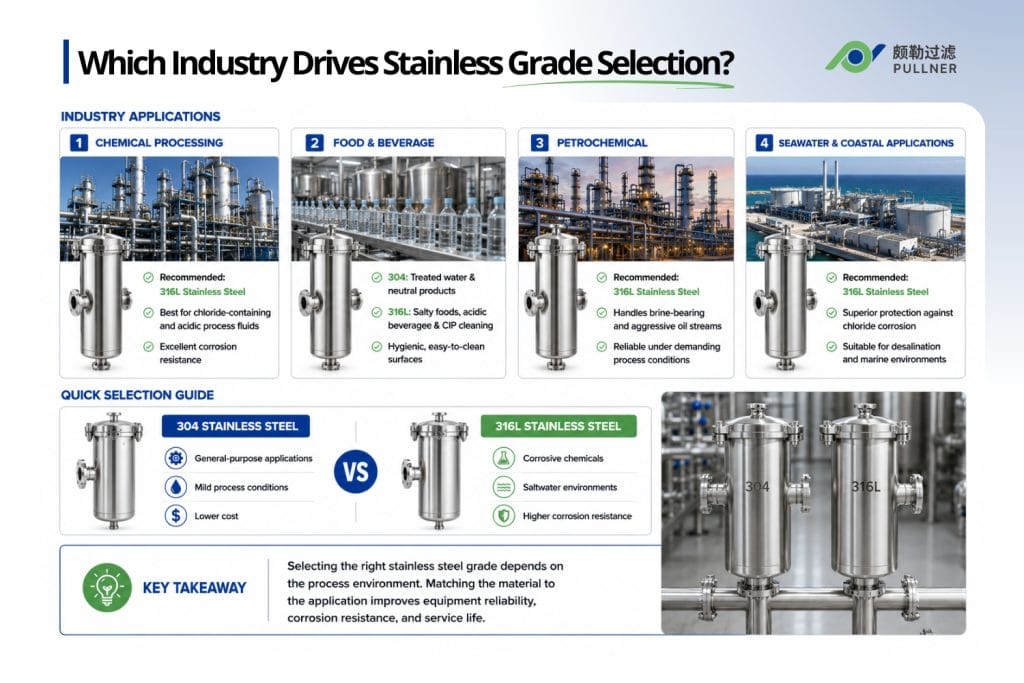
Filter housing demand is led by chemical processing and food production, followed by petrochemical service.
Tratamiento químico
Specify 316L for process liquids carrying chloride salts or low-pH reactants that weaken the passive layer. Seal compatibility is required for every solvent contacting the vessel, since an incompatible elastomer may swell and open a bypass route despite sound metal construction.
Food and beverage
Choose 304 for treated water or neutral formulations cleaned with mild sanitation chemistry. Select 316L for salted products or low-pH beverages subjected to repeated CIP exposure. Electropolished interiors improve drainage and limit retention near seating surfaces, which supports hygienic service.
Petroquímica
Use 316L for brine-bearing feeds or oil streams after reviewing the complete chemical analysis. Stainless steel elements used for fuel filtration require stable pore geometry through pressure fluctuations, and the shell alloy must match the process liquid independently of the element rating.
Seawater and coastal installations
Begin with a 316L assessment wherever continuous saltwater contact makes 304 vulnerable near connections. Where the duty combines full-strength seawater with elevated temperature, review whether a higher-alloy specification is warranted. Carcasas de membrana FRP are also worth comparing for reverse osmosis pretreatment, where the pressure boundary faces continuous chloride exposure.
Which Grade Should You Specify for Your Housing or Cartridge?
The decision comes down to four documented inputs: fluid chemistry, chloride concentration, operating temperature, and fabrication method. The housing sets the pressure boundary, while the cartridge sets filtration efficiency at the rated particle size, so both need separate confirmation.
Cartridges deserve their own alloy check rather than inheriting the housing specification. Stainless steel elements are usually selected for high temperature, viscous, or chemically aggressive duties where polymer media would fail, and their value depends on surviving repeated cleaning cycles. Because a sintered or mesh element presents far more internal surface area and far more crevice geometry than a vessel wall, an alloy adequate for the shell can still be marginal for the element it holds.
Connection dimensions should deliver the required throughput without excessive velocity or unnecessary pressure loss. A 316L specification may also require completed passivation and an electropolished internal surface. Include ASME Bioprocessing Equipment (BPE) documentation where the project adopts that standard.
Complete the following checks before releasing a quotation request:
- Describe the medium: Supply full laboratory chemistry instead of identifying only the carrier liquid.
- Record chlorides: Provide the normal concentration alongside the highest credible excursion.
- Establish thermal exposure: Document continuous temperature and the maximum cleaning-cycle value.
- Define pressure: State normal differential pressure beside the vessel’s design maximum.
- Confirm end-cap geometry: An incorrect seating format opens a bypass path regardless of alloy or micron rating.
- Confirm fabrication: Identify the joining procedure and required post-production passivation.
- Set surface condition: Match internal roughness to hygiene requirements or documented cleanability objectives.
- Calculate ownership: Compare projected maintenance expense against approved capital and service-life targets.
Get Engineering Guidance from Pullner
Pullner manufactures 304 and 316L carcasas de filtros de acero inoxidable and reusable stainless steel cartridges for industrial liquid and gas processes, under an ISO 9001 quality system with 100% factory testing and batch-level traceability.
In-house laboratory services include material-compatibility testing and pressure-drop analysis for project-specific evaluation. Buyers can request a custom system design or up to two free samples, with the recipient covering shipping. Send complete process chemistry and documented operating limits for configuration guidance.
Request a quote or speak to an engineer to specify the right stainless steel grade for your process.
FAQs On 304 Vs. 316 Stainless Steel: Which Grade for Filter Housings & Cartridges
Is 316 always better for filter housings?
No, grade selection reflects service exposure rather than a universal performance hierarchy. 304 remains economical under stable neutral conditions with low salt levels. Choose 316L when operating data indicate credible pitting or crevice risk.
When is 304 acceptable for cartridges?
304 is acceptable for clean-process water with consistently low chloride levels and compatible cleaning compounds. Verify pore stability at the maximum specified differential pressure before approval, and change to 316L when testing identifies corrosive additives or variable salt concentration.
Does 316L eliminate the need for passivation?
No, low carbon reduces sensitization after welding heat, while passivation removes free iron introduced during fabrication. These controls address separate failure mechanisms, so material selection cannot replace suitable surface finishing.
What is the difference between 316 and 316L?
The L designates lower carbon, restricted to 0.03% against 0.08% for standard 316. That reduction limits chromium carbide formation at grain boundaries during welding, which is why 316L is the usual choice for fabricated housings and welded element frames rather than machined parts.
Is 316L suitable for demanding process conditions?
316L is the starting specification for environments with elevated chlorides, low pH, or aggressive cleaning agents. Seawater immersion, sour petrochemical streams, and farmacéutica CIP cycles all fall within its established service range. A higher alloy may be required when two or more of those conditions occur together.
How can you test susceptibility in a process stream?
Immerse alloy coupons in a representative fluid at the maximum specified temperature for a defined exposure period. Measure the resulting mass change and the deepest pit after controlled exposure, then evaluate results against project acceptance criteria before committing to a final selection.
Back to Top : 304 vs. 316 Stainless Steel: Which Grade for Filter Housings & Cartridges?
 English
  Spanish
  Arabic