
Petrochemical refinery filtration keeps amine loops, hydrocarbon streams, process water, utility water, and final products within required cleanliness targets. A mismatched element—wrong micron rating, incompatible media, incorrect end cap profile—doesn’t just underperform. It creates bypass risk, accelerated fouling, or premature failure in a stream that may not tolerate unplanned downtime. Filter selection depends on stream type, flow rate, temperature, fluid chemistry, micron rating, and housing geometry.
The main categories include particulate filters, coalescing elements, high-flow cartridges, string-wound depth filters, and final-product polishing elements. A complete refinery filtration program pairs every process stage with the right cartridge type, rated for the stream conditions it will actually face.
Why Filtration is Critical in Refinery Operations
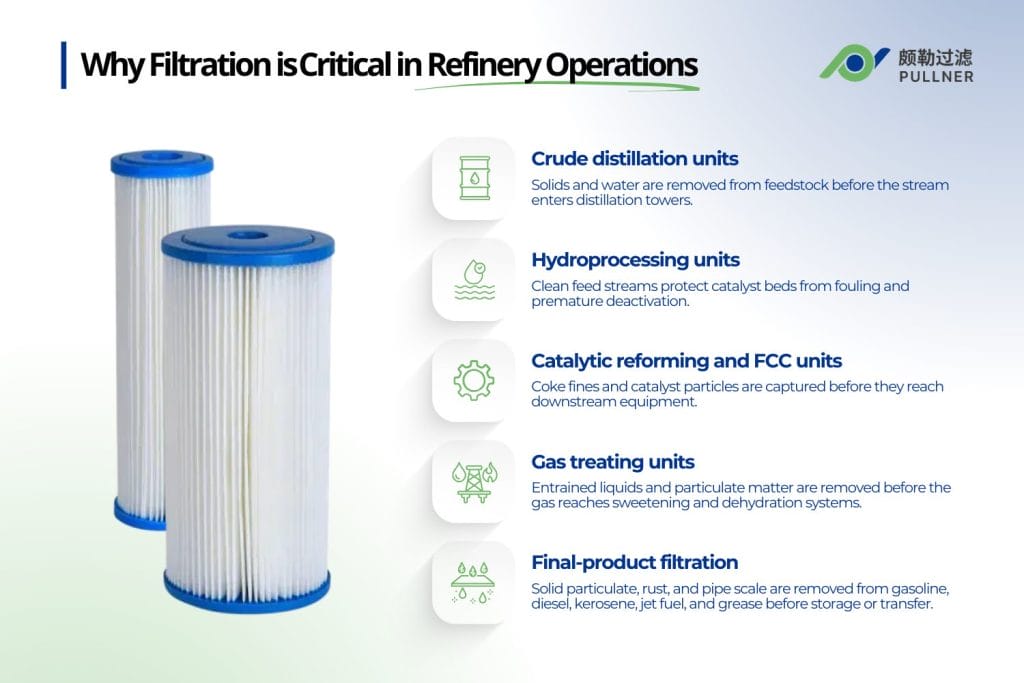
Petrochemical filtration failures don’t degrade gradually. Fouled catalyst beds, plugged contactors, and contaminated final products create unplanned downtime, reprocessing costs, and equipment damage that compound across the treatment train. Refinery filtration appears at every major process stage, and each stage presents a different contamination profile:
- Crude distillation units: Solids and water are removed from feedstock before the stream enters distillation towers.
- Hydroprocessing units: Clean feed streams protect catalyst beds from fouling and premature deactivation.
- Catalytic reforming and FCC units: Coke fines and catalyst particles are captured before they reach downstream equipment.
- Gas treating units: Entrained liquids and particulate matter are removed before the gas reaches sweetening and dehydration systems.
- Final-product filtration: Solid particulate, rust, and pipe scale are removed from gasoline, diesel, kerosene, jet fuel, and grease before storage or transfer.
Particle size, stream chemistry, and operating temperature vary at every stage. A filter specification built for one unit won’t meet the contamination demands of another. Petrochemical filter systems built around stage-specific cartridge selection control contamination where it actually originates.
Saudi Aramco Approval and Its Procurement Impact
Pullner Filter is the only Chinese supplier approved by Saudi Aramco for filter elements—a distinction that carries significant weight for procurement teams working on refinery and petrochemical projects connected to Saudi operating standards. Buyers sourcing from an approved vendor can concentrate on application fit, commercial terms, supply capacity, and documentation rather than starting vendor evaluation from zero. Qualifications reduce technical review time at every stage of the procurement cycle.
Approval alone doesn’t replace dimensional and performance verification. For replacement elements, procurement teams still need to confirm:
- Part number equivalence and housing fit
- Media compatibility and temperature range
- Pressure rating and gasket material
- Change-out criteria and service interval
The strongest submittals combine datasheets, cross-reference tables, material specifications, performance data, quality certifications, and sample-evaluation records. Maintenance teams get the most value from approval when they need technically equivalent cartridges for existing Pall, Parker, Jonell, or Peco housings. Redesigning the installed petrochemical filtration systems isn’t always an option during a scheduled turnaround. Verified cross-reference data closes that gap.
Amine Gas Treating Filtration
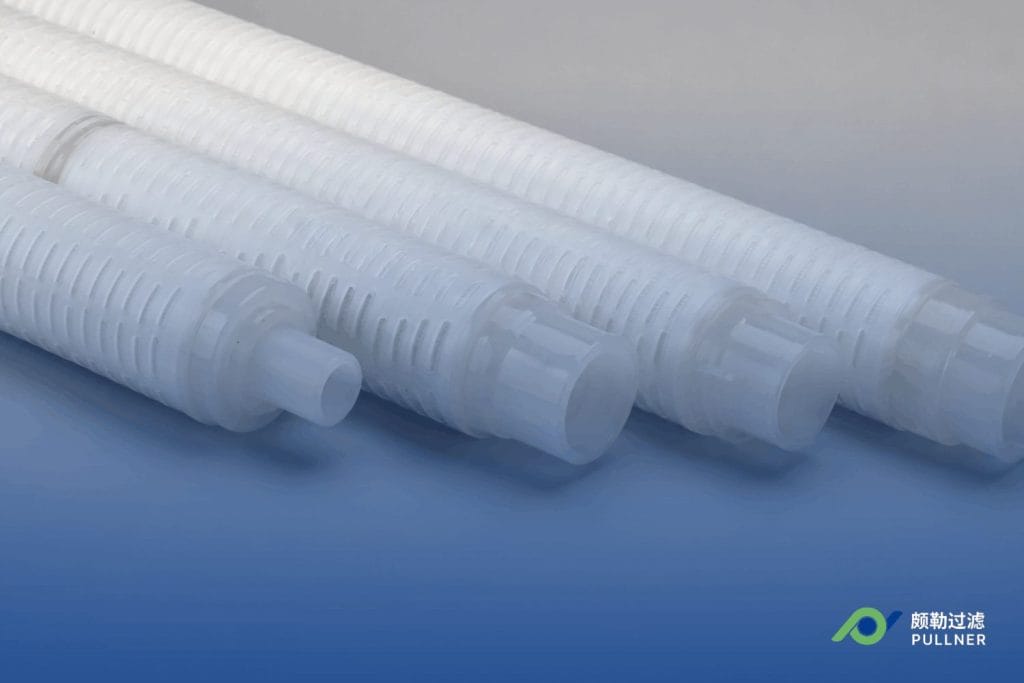
Amine filter cartridge performance determines whether rich and lean amine circuits stay clean enough for stable acid gas removal, efficient regeneration, and reliable contactor operation. In refinery gas treating, amines such as MDEA and DEA selectively absorb hydrogen sulfide from acid gas streams. Lean amine then circulates through the contactor, fractionation stage, and return loop before re-entering service. Fouling in the loop doesn’t stay contained. It migrates.
Carbon bed protection can be added upstream or downstream of the carbon bed to manage carbon fines and preserve adsorption capacity. Each position in the amine loop carries a different fouling risk, and cartridge selection should reflect that difference rather than applying a single element type across the entire circuit.
How Amine Systems Foul Through Heat Stable Salts and Degradation Products
Heat-stable salts and degradation products are the two fouling mechanisms that most directly change amine behavior over time. Heat-stable salts remain in the solvent loop and concentrate during continuous circulation rather than regenerating with the amine. Concentration climbs until solvent performance drops and corrosion risk increases across heat transfer surfaces and vessel internals.
Each fouling source creates a different problem in the loop:
- Concentrated heat-stable salts: Degrade solvent performance and increase corrosion risk over time as they build up in the active circulation zone.
- Degradation products: Add organic loading that affects foaming tendency, carbon bed service life, and exchanger cleanliness.
- Iron sulfide and pipe scale: Create solid loading across rich amine, lean amine, and sour water-adjacent treatment areas.
- Hydrocarbon carryover: Disrupts the gas-liquid interface in the contactor, directly affecting sour gas contact quality.
Amine Filter Specifications and Operating Ranges
Amine filter cartridge specifications should match the amine type and rich or lean service designation. Temperature, pressure, housing size, and flow rate all affect which media construction performs reliably in service. High-temperature cartridges support continuous operation up to 120°C, maximum differential pressure up to 0.6 MPa, and recommended change-out differential pressure from 0.4 MPa to 0.6 MPa.
Key cartridge specification fields include:
- Outer diameter, inner diameter, and length
- Filtration area and media type
- Core material and end cap material
- Gasket material and recommended change-out differential pressure
Micron ratings from 1 µm to 100 µm allow teams to specify coarse solids capture, intermediate loop filtration, or finer polishing service. Polyester, fiberglass, stainless steel, polypropylene, and selected elastomers should be matched to amine chemistry, sour service exposure, and temperature. Solids loading data from the active stream gives the most reliable basis for micron rating selection.
Cross-Reference for Jonell and Peco Amine Filter Elements
Jonell and Peco amine filter elements should be cross-referenced by dimensional fit, sealing design, filtration performance, and amine compatibility. A dimensional mismatch at any point creates bypass risk. Performance suffers immediately.
The dimensional review confirms:
- Length, outer diameter, and inner diameter
- End cap style and gasket profile
- Center core design and housing interface
The performance review compares:
- Micron rating, efficiency, and dirt-holding capacity
- Differential pressure behavior and expected service interval
Rich amine replacements should prioritize hydrocarbon and solids handling. Lean amine replacements should prioritize polishing consistency. A complete cross-reference includes the original part number, replacement part number, service location, operating range, and media construction. Sample confirmation is worth requesting when the installed housing has limited documentation or the original cartridge carries a specialized end cap configuration.
Hydrocarbon Filtration in Refinery Process Streams
Hydrocarbon filtration conditions crude oil, feedstocks, intermediate refinery streams, and final products so that each process stage receives fluid at the right cleanliness level. Petrochem liquid filter selection at each stage should reflect the specific contamination profile of that stream:
- Crude oil filtration: Removes water and solids before deeper refining stages
- Desalting: Separates dissolved salts and water before further processing, protecting downstream equipment
- Hydrotreater feed filtration: Conditions naphtha, kerosene, diesel, or gas-oil streams before reactor service to protect catalyst beds
- Catalytic reforming and FCC filtration: Captures coke fines, catalyst fines, and particulate matter moving with process streams
- Fuel oil filtration: Delivers cleaner fuel to boilers, furnaces, and burner systems, reducing nozzle erosion
- Final hydrocarbon filtration: Prepares gasoline, diesel, kerosene, jet fuel, and grease for specification-driven delivery
Alkylation and caustic treatment streams introduce additional chemical compatibility demands. Filter media and gasket materials in those services need to be rated for the specific fluid chemistry present, not just the particle size target.
Liquid-Liquid Coalescing in Desalting and Separation Systems
Liquid-liquid coalescing separates dispersed liquid phases by gathering smaller droplets into larger droplets for easier phase separation. In desalting, coalescing supports the removal of water and dissolved salts from crude oil before distillation. In oil-water filtration, treated media repels oil while allowing water to pass through, collecting oil on the outer surface as droplets grow and separate.
Oil and gas filter cartridge specifications for liquid-liquid service include:
- Operating pressure: 0.1 MPa to 1.6 MPa
- Operating temperature: -19°C to 80°C
- Filtration accuracy: 0.01 µm
- Sealing: O-ring
- Length: 1,020 mm
- Flow rate: 0.2 m³/h
Solid or liquid contaminant profiles should both be reviewed before coalescer selection. Media wettability, flow direction, and droplet size distribution all affect which coalescer construction performs reliably in a given stream.
Gas-Liquid Coalescing for Compressor and Instrument Protection
Gas-liquid coalescing removes liquid contaminants, liquid aerosols, and fine mist from gas streams before the gas reaches compressors, instruments, metering equipment, and fuel systems. Coalescing elements bring smaller liquid droplets together into larger droplets that separate from the gas stream. Mismatched coalescer selection increases maintenance frequency and reduces compressor service intervals.
Key gas-liquid coalescing applications include:
- Inlet gas separation: Clears solids and free liquids before downstream gas sweetening, dehydration, and produced-water handling
- Instrument gas filtration: Delivers cleaner natural gas to sensitive detection devices, valves, and meters
- Fuel gas filtration: Conditions gas before burners, valves, and transmission lines, reducing valve wear and burner tip plugging
Housing orientation, aerosol loading, and pressure class should all be confirmed before specifying a gas-liquid coalescer for compressor or instrument service.
Process Water and Oil Field Injection Water Filtration
Refinery process water filter selection covers boiler feed preparation, membrane pretreatment, feedstock filtration, pressure maintenance, and high-flow industrial service. Refineries commonly deploy reverse osmosis systems for boiler feed water. Pre-filtration positioned ahead of membranes protects against fouling and extends membrane service life. RO membranes that receive inadequately filtered water require more frequent cleaning and earlier replacement, which increases operating costs directly.
Common water treatment applications include:
- Point-of-use purification and potable water production
- Cooling and process water management
- Wastewater recovery and water removal
- Boiler feed water and membrane process pretreatment
Oil field injection water demands attention because fresh water and seawater carry algae, plankton, silt, and sediment into production systems. Process condensate polishing treats returned condensate from turbo generators, heat exchangers, and waste heat boiler equipment before reuse in hot wells or downstream processes. High-temperature process water filtration uses precision-wound polyester media, stainless steel reinforcement, and large-diameter cartridge construction for sustained thermal and hydraulic loads.
Cooling Water and Utility Filtration Systems
Cooling water and utility filtration support heat exchange, potable water, wastewater recovery, membrane pretreatment, and boiler feed systems. Utility systems benefit from high dirt-holding capacity because they handle continuous recirculation and broad particle-size variation. Membrane pretreatment needs filtration that stabilizes water quality before reverse osmosis or other separation systems.
Cooling water filter selection should account for:
- Circulation volume and suspended solids profile
- Water chemistry and operating temperature
- Pressure drop profile and service interval
Utility filtration should be planned separately from process-stream filtration because water quality targets, flow behavior, and maintenance cycles differ from hydrocarbon service.
Establishing a Refinery Filter Change Schedule
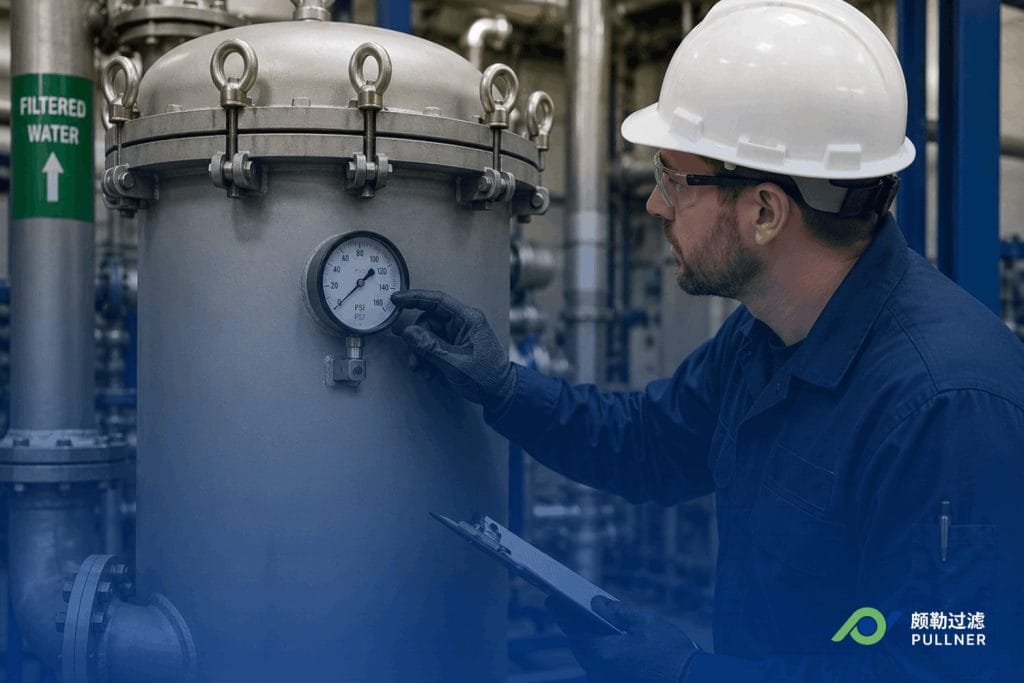
Refinery filter maintenance starts with differential pressure trending, not calendar intervals. Differential pressure shows how the element loads during actual operating conditions. A cartridge changed on a fixed schedule may come out with service life remaining, or stay in service too long and restrict flow.
High-temperature petrochemical filter cartridge designs carry a defined change-out differential pressure range that varies by construction and service conditions. Each filter category needs its own schedule because amine filters, hydrocarbon filtration coalescers, process water cartridges, gas-liquid coalescers, and final product filters load at different rates. Combining all filter categories into one change interval creates either premature replacement or overloaded elements.
Schedule records should include:
- Installation date and stream type
- Starting and ending differential pressure
- Flow rate and element model
- Micron rating and inspection notes
Turnaround planning should incorporate filter review so replacement elements, spare housings, and sample evaluations are ready before the next service window opens. Teams that track schedule records across multiple turnarounds build a cleaner picture of actual service life for each stream and filter type.
Cross-Reference Guide For Pall Parker Jonell And Peco Systems
Replacing filter elements in Pall, Parker, Jonell, and Peco housings requires dimensional confirmation before filtration performance or fluid compatibility can be evaluated. A mismatch in length, outer diameter, or end cap style creates bypass risk at the housing interface, and no amount of media performance can recover from that failure point.
| Cross-Reference Factor | Details to Match Across Pall, Parker, Jonell, and Peco Systems | Refinery Application Impact | Replacement Element Requirement |
|---|---|---|---|
| Housing Fit | Housing model, vessel layout, element count, cartridge length, outer diameter, inner diameter, and flow direction | Keeps the replacement element aligned with the installed filter vessel without changing the existing system | Match the original element’s dimensions and installation geometry exactly |
| End Cap Configuration | Open end, closed end, double open end, fin style, adapter style, spring seal, or proprietary end cap design | Maintains the cartridge’s seated position during high-flow refinery operation | Use an equivalent end cap profile that seals correctly under operating pressure |
| Material de la junta | Silicone, EPDM, Viton, BUNA-N, or another specified gasket material | Supports compatibility with amine, hydrocarbon, process water, or high-temperature service | Select the gasket material based on fluid chemistry, temperature, and refinery service conditions |
| Clasificación Micron | 1 µm, 5 µm, 10 µm, 20 µm, 40 µm, 100 µm, or a custom rating | Controls whether the element suits coarse particulate capture, polishing service, or high-contaminant process streams | Match the original filtration rating or specify a custom rating based on the stream’s cleanliness target |
| Medio filtrante | Polyester, polypropylene, fiberglass, micro-fiberglass, cotton, nylon, Teflon, Nomex, metals, or resin-bonded cellulose | Determines chemical compatibility, temperature tolerance, dirt-holding capacity, and particle retention behavior | Select media that match the process fluid, solids profile, and service temperature |
| Core and Support Structure | Polypropylene center core, stainless steel support, reinforced outer cage, or metal core | Preserves cartridge shape under hydraulic load, elevated temperature, and high contaminant loading | Use reinforced construction for high-temperature, high-flow, or high-pressure refinery applications |
| Temperatura de funcionamiento | Ambient, moderate, or high-temperature service up to 120°C, depending on material choice | Prevents material mismatch in hot process water, condensate polishing, and petrochemical processes | Confirm that media, core, end caps, and seals all match the full operating temperature range |
| Differential Pressure Range | Starting differential pressure, maximum differential pressure, and recommended change-out differential pressure | Helps maintenance teams set change-out points and track cartridge loading during operation | Align the replacement element with the system’s pressure rating and service-life expectations |
| Dirt-Holding Capacity | Filtration area, pleat or depth structure, contaminant load profile, and service interval target | Supports longer cartridge life in high-solids refinery streams, hydrocarbon service, and process water loops | Match or improve dirt-holding capacity without increasing pressure drop beyond the system’s operating range |
| Compatibilidad química | Amine chemistry, sour gas exposure, hydrocarbons, process water, fuel oil, condensate, or injection water | Keeps filtration performance stable across aggressive refinery process conditions | Verify material compatibility against the exact fluid, not just the brand or part number |
| Application Type | Amine filter cartridge, hydrocarbon filtration, liquid-liquid coalescing, gas-liquid coalescing, boiler feed water, fuel oil, or final product filtration | Connects the replacement element to the job it must perform in the refinery | Cross-reference by service role first, then confirm dimensions and materials |
| Performance Validation | Flow resistance, pressure drop behavior, filtration efficiency, pore size distribution, and particle retention | Confirms the replacement performs like the original element before full procurement | Use sample evaluation or field testing when the existing part has specialized construction or limited documentation |
| Procurement Documentation | Original part number, replacement part number, drawings, datasheets, seal material, media type, micron rating, and operating limits | Gives procurement, maintenance, and engineering teams one shared reference for ordering | Build the cross-reference around technical equivalence rather than the brand name alone |
| Customization Needs | Custom diameter, length, micron rating, media, seal, or end cap configuration | Supports replacement of legacy, proprietary, or refinery-specific elements without replacing the housing | Specify custom options when a standard Pall, Parker, Jonell, or Peco replacement doesn’t fully match the installed system |
Engineering Consultation And Sample Evaluation
Engineering consultation turns filter selection into a verified match between process conditions, cartridge construction, and installed housing. The evaluation starts with operating temperature, flow rate, fluid chemistry, system pressure, target micron rating, and cartridge dimensions. Proceeding from product specifications rather than assumptions reduces the risk of deploying an element that passes dimensional checks but fails under actual stream conditions.
Sample analysis reviews:
- Filter media composition and fiber characteristics
- Structural dimensions and end cap configuration
- Flow resistance, differential pressure behavior, and particle retention
Lab testing measures:
- Pore size distribution and air permeability
- Flow rate, filtration efficiency, and pressure drop
- Material compatibility under process conditions
Field trials add operating data by running the cartridge in the actual process stream before full procurement begins. Procurement teams that run field trials before committing to volume orders typically build a stronger performance case than those relying on datasheet review alone—particularly when the installed housing has specialized construction or limited change-out history. That operating data gives engineering and maintenance teams a verified basis for service-interval decisions and long-term procurement planning.
Work With Pullner Filter on Your Refinery Filtration Requirements
Petrochemical filtration systems handle chemically aggressive, thermally demanding streams across every stage of refining. Filtro Pullner works as a technical partner across the full evaluation and supply process—not just a cartridge supplier.
With 20+ years in industrial filtration, 30+ production lines, and in-house lab capabilities covering pore size analysis, pressure drop testing, and material compatibility verification, Pullner supports amine, hydrocarbon, refinery process water, and gas service from specification through to delivery.
ISO 9001 certification and 100% factory testing back every element. As the only Chinese supplier approved by Saudi Aramco for filter elements, Pullner is a qualified source for Middle East refinery and petrochemical projects. Up to two free sample cartridges are available for process validation before full procurement begins. Contacto Filtro Pullner to speak with a filtration engineer about your refinery applications.
Petrochemical Refinery Filtration FAQs
What filters are used in petrochemical refineries?
Petrochemical refineries use coalescing petrochemical filter cartridge elements, separation filter elements, high-flow cartridges, string-wound filter elements, self-cleaning filters, basket filters, gas filters, refinery process water filter cartridges, and final-product polishing filters.
Where are filters used in a refinery?
Filters are used in crude oil filtration, desalting, feedstock filtration, crude distillation units, hydroprocessing units, catalytic reforming, fluid catalytic cracking units, gas treating units, boiler feed water systems, and final product transfer.
What is amine filtration?
Amine filtration removes solids, semi-solids, hydrocarbon carryover, and carbon fines from amine loops so that rich and lean amine streams can circulate cleanly through contactors, regenerators, exchangers, and carbon beds.
How often should refinery filters be changed?
Change-out timing should be driven by differential pressure trend, flow behavior, and stream cleanliness data rather than fixed intervals. The cartridge’s construction and service type determine the specific trigger point.
Why use sample evaluation before ordering replacement cartridges?
Sample evaluations confirm dimensions, materials, pressure behavior, flow performance, and filtration efficiency before the cartridge moves into full refinery procurement. Lab data and field trial results together provide stronger evidence than a datasheet review alone.
Volver arriba: Petrochemical Refinery Filtration Guide: Amine, Hydrocarbon & Water
 English
  Spanish
  Arabic