
Aramco Approved Vendor List (AVL) approval is Saudi Aramco’s formal acceptance of a supplier for specific material or service categories, granted after registration and technical qualification. It applies to the accepted supply scope, not to every product a company makes—a supplier approved for one filter category isn’t automatically approved for another.
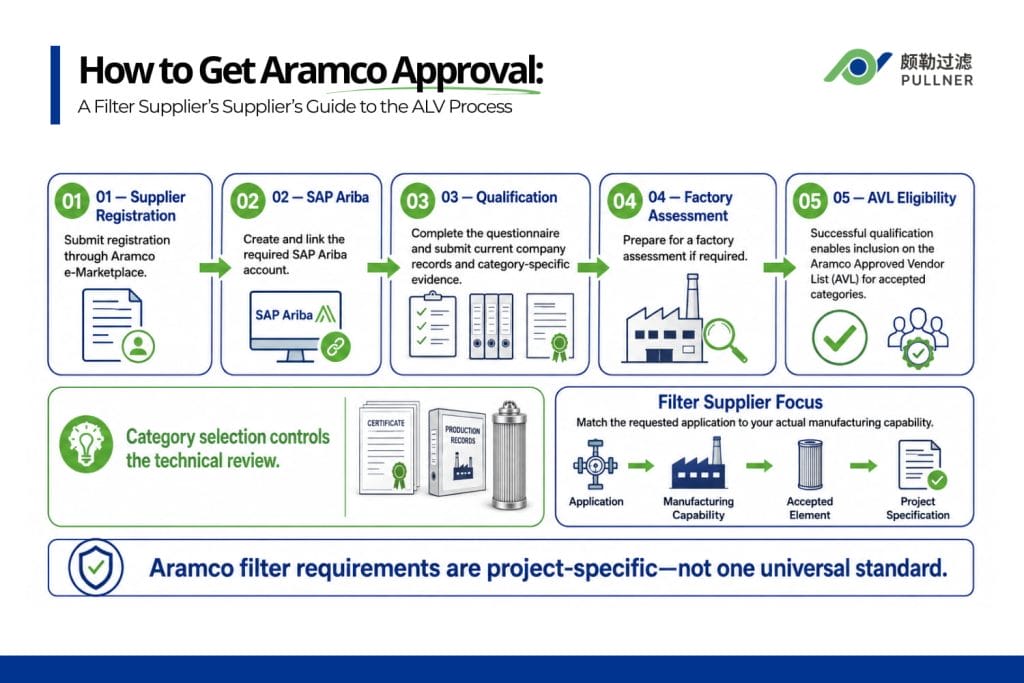
For filter suppliers, how to get Aramco approval starts with a registration request through Aramco e-Marketplace and a linked SAP Ariba account, followed by a questionnaire covering current company records. From there, suppliers provide evidence for the specific material categories they’re seeking qualification in—quality certificates, production records, and product data tied to the actual manufacturing site.
Saudi Aramco may require a factory assessment before accepting the submitted scope. Category selection controls the outcome: a manufacturer can complete corporate registration and still stall in qualification if its certificates and records don’t match the requested filtration scope.
Each accepted element also has to meet the project’s specific filter specification. In this guide, “Aramco filter specification” refers to those project-specific requirements, not a single universal standard—the distinction matters throughout the process below.
What Aramco Approval (AVL) Means
AVL approval identifies an accepted supply scope, not a blanket endorsement. Buyers should compare the proposed filter against the approved category and the project’s purchasing requirements—the phrase “Aramco AVL filter” should mean an AVL listing for that specific filter category, not a general approval status.
Initial registration creates a vendor record for commercial interaction. Further qualification applies before the supplier can serve specific material categories—a vendor ID supports platform access, but it doesn’t confirm technical acceptance for every filtration product. Buyers should verify the listed manufacturer and approved material scope before relying on the credential.
Why AVL Approval Matters for Filtration Products
AVL approval gives procurement teams verified evidence before they assess a filter element for a refinery or petrochemical system. Filtration performance depends on media construction, retention rating, and structural integrity under the stated operating conditions; weak control over any one factor raises differential pressure or lets damaging particles through. Supplier qualification reduces exposure to manufacturers whose records don’t support their stated production capability.
Saudi Aramco projects run through several decision groups: engineering assesses technical fit, quality examines traceability and inspection evidence, and procurement checks commercial eligibility against the approved listing. Category approval gives each group a shared reference during evaluation.
Approval doesn’t replace project review, since operating duties vary across oil and gas facilities. Injection water, refinery process fluids, and petrochemical streams expose filters to different contaminants, and temperature or chemical compatibility can narrow the acceptable construction further. An approved manufacturer still has to show that the offered element matches the requested duty.
The SAES/SAMSS Standards Landscape
Saudi Aramco Engineering Standards (SAES) define engineering requirements for facilities and systems within their scope. Saudi Aramco Materials System Specifications (SAMSS) set requirements for covered materials or equipment.
International codes can still apply, but Aramco requirements govern wherever project documents invoke them—check the applicable purchasing description before assigning any standard to a filter product.
How SAES and SAMSS serve different functions
SAES requirements address engineering decisions such as system design or installation where the cited standard applies. SAMSS documents describe material, fabrication, and inspection requirements for the equipment covered by a given specification. The terms aren’t interchangeable, even when both appear in one purchasing package. Accurate review starts by identifying whether a clause governs the filtration system or the supplied element.
“SAES filter standards” as a general label can wrongly imply that one universal filter-element standard covers every application. What actually applies depends on the material number and project documents; a supplier should get the current revision through the authorized project channel, since an extracted copy from an unrelated package doesn’t establish compliance for a different filtration duty.
Where filtration package requirements appear
Material numbers 6000011206 and 6000018461 cite SAES-A-017 and 32-SAMSS-038 for their specified filtration packages. The covered equipment includes a hydrocarbon filtration package and a backwashing or self-cleaning filter package. Both entries concern assembled packages rather than individual replacement cartridges. Applying either document to every filter element would exceed the stated equipment scope.
An Aramco filter specification for an element can instead appear through the material description and purchase-order documentation. Drawings or data sheets may define construction details within the approved category. Inspection requirements can then establish the evidence required before release. Suppliers need the issued project documents before confirming compliance.
The Approval Process Step By Step
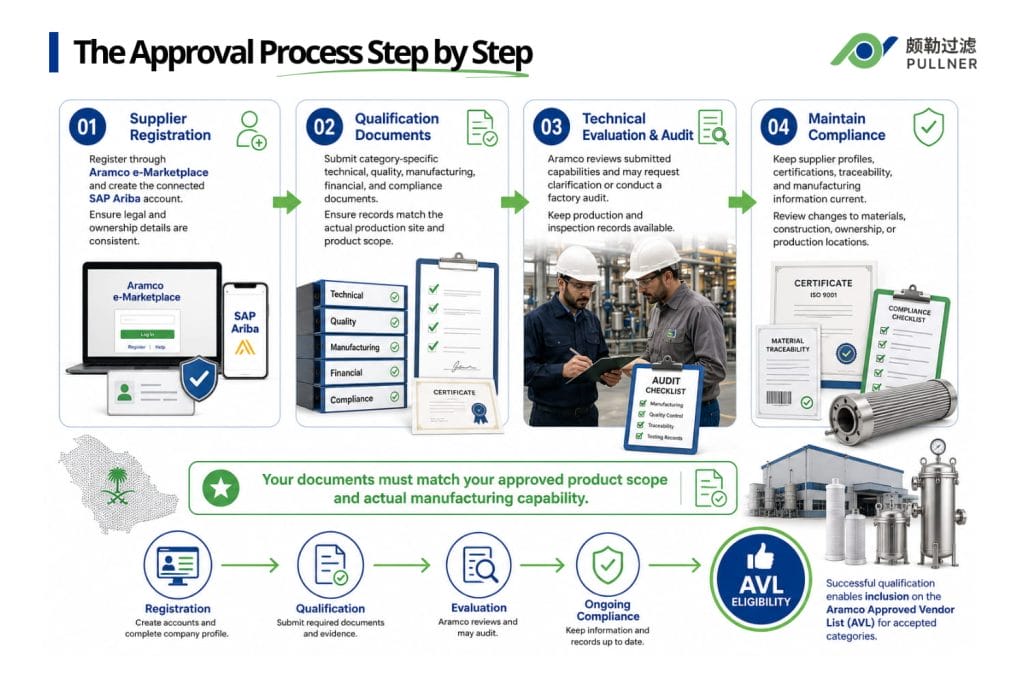
Filter suppliers can work through Aramco e-Marketplace registration in four stages.
Complete supplier registration
Begin by entering the company’s legal name and registered address through the e-Marketplace registration request. The contact person needs authority to manage the supplier profile and respond to clarifications. Accepted details trigger SAP Ariba account creation; inconsistent legal records can delay profile validation before technical qualification even starts.
In-kingdom applicants complete fields for Saudi commercial and government records; out-of-kingdom suppliers follow the route assigned to their location. Every applicant provides ownership details and an authorized signatory, plus Aramco’s declaration and cybersecurity questions.
Submit qualification documents
Organize technical evidence around the exact material category requested—quality certificates and manufacturing records describing the actual production site, product data identifying the media and dimensional configuration offered, and reference records traceable to completed supply experience.
Financial documentation supports the commercial review, and the Supplier Code of Conduct needs formal acknowledgment: an authorized representative submits the authenticated acknowledgment through the registration questionnaire and periodically re-acknowledges it when Aramco updates the code. Missing authentication leaves an otherwise complete application stuck.
Complete technical evaluation and audits
Reviewers compare the submitted scope against documented capability and can request clarifications when certificates or product records don’t support the selected category. A factory audit may examine production control and inspection practice, so keep source records available at the manufacturing location named in the submission.
Reference SAES or SAMSS requirements only when the project documentation actually identifies them; unsupported claims of broad compliance blur the approved scope and weaken the evidence package. Precise statements let reviewers connect each document to the relevant product.
Maintain ongoing compliance
Approval creates continuing obligations, not a one-time certificate. Existing suppliers maintain records through profile-management requests in Aramco e-Marketplace, and changes to ownership or manufacturing locations can affect the basis of qualification.
Updated certifications need to stay consistent with the approved supplier profile. Production controls should preserve batch traceability after approval, with inspection records connecting shipped elements to the accepted manufacturing process. A change in filter media or construction may need customer review before supply, and ongoing conformity protects AVL status for future procurement.
What to Look for In an AVL-Approved Supplier
Confirm the manufacturer’s listed category before comparing product data—an entry on the Aramco-approved vendor list only has value where it covers the filtration product under consideration. Ask the supplier to identify the accepted scope and manufacturing site; a distributor’s commercial access doesn’t substitute for the original manufacturer’s qualification.
Review the proposed element against the current Aramco filter specification and process conditions: media compatibility against fluid composition and operating temperature, retention performance backed by evidence tied to the supplied construction, and dimensional fit covering the sealing interface and flow direction.
Traceability shows whether production control continues after qualification. Request inspection records that link the delivered batch to its raw materials, confirm change-control procedures for any modification to media or component sources, and check whether regional technical support is available to resolve specification questions across engineering and procurement.
Pullner’s Approval
Filtro Pullner is the only Chinese manufacturer on Saudi Aramco’s Approved Vendor List for filter elements. The credential applies to the accepted scope and doesn’t remove the need for project-specific review—every proposed element still needs evaluation against the process fluid and required retention rating.
Pullner supports filtration duties in Saudi Arabia through its regional presence and approved manufacturing capability, relevant to petrochemical filtration y oil and gas filtration applications. An AVL listing provides the qualification signal; technical selection determines suitability for the operating point.
Speak to a Filtration Expert
Pullner Filter holds Saudi Aramco AVL approval for filter elements. Procurement teams can review Pullner’s Aramco-approved filters before assessing a proposed element.
Provide the operating fluid and required retention rating when you speak to a filtration expert. Pullner’s engineers can then address the relevant product scope and supporting documentation.
How to Get Aramco Approval FAQs
Does AVL approval cover every filter product?
AVL approval covers the accepted material category and manufacturing scope, not every product in the supplier’s catalog. Verify that the proposed filter sits within the listed category, then confirm product data satisfies the project’s technical requirements—category approval doesn’t replace a duty-specific review of materials and performance.
How long does Aramco supplier registration take?
There’s no fixed approval period stated in the supplier registration steps (https://www.aramco.com/-/media/downloads/working-with-us/sap-ariba-suppliers-technical-guide (2.pdf). Timing depends on submission completeness and how much clarification the review requires, and product category evaluation can extend the process well beyond corporate registration. Suppliers should respond through the e-Marketplace workflow and avoid unsupported schedule claims.
Can buyers rely on AVL status alone?
Use AVL status as an initial qualification signal, then complete a technical comparison for the proposed duty. The current purchasing documents identify the governing requirements for each order—confirm the applicable SAES requirements against the issued documents and make sure inspection evidence corresponds to the element offered for the project.
What documents does Aramco require for supplier registration?
A complete submission needs quality certificates and manufacturing records tied to the actual production site, product data identifying the media and dimensional configuration offered, and reference records traceable to completed supply experience. Financial documentation supports the commercial review, and an authorized representative needs to submit the Supplier Code of Conduct acknowledgment through the registration questionnaire—missing that authentication leaves an otherwise complete application unresolved.
What is the difference between SAES and SAMSS?
SAES (Saudi Aramco Engineering Standards) governs engineering decisions for system design or installation. SAMSS (Saudi Aramco Materials System Specifications) covers material, fabrication, and inspection requirements for the equipment a given specification names. The two aren’t interchangeable, even when both appear in the same purchasing package. The applicable one depends on the material number and project documents, not the filter category alone.
Does an Aramco-approved distributor count as an approved manufacturer?
No, a distributor’s commercial access to Aramco’s platform doesn’t substitute for the original manufacturer’s qualification. Buyers should confirm the listed manufacturer behind the product, not just the company presenting it, since AVL approval attaches to the manufacturing site and accepted material category, not to whoever is selling it.
Back to Top : How to Get Aramco Approval: A Filter Supplier’s Guide to the AVL Process
 English
  Spanish
  Arabic