
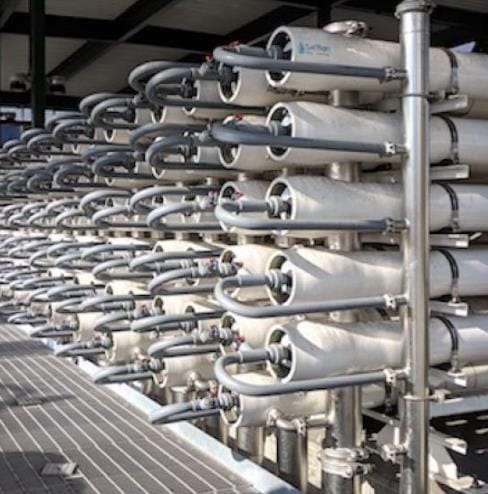


Cartucho de prefiltro de ósmosis inversa para desalinización de agua de mar (serie PHF-L)
Seawater RO pre-treatment is a volume problem before it is a filtration problem. A train moves enough water that the cartridge count sets the cost of the stage, not the cartridge rating. One 6″ element at 200 GPM does the work of roughly twenty 2.5″ cartridges, and removes nineteen seals that could bypass while it is at it.
The PHF-L is built for that stage. A 6″ (152.4 mm) body in 20″, 40″ and 60″ lengths, single open end, grades from 0.1 to 100 µm, in polypropylene, glass fibre or polyester depending on intake temperature and loading.
- Clasificación Micron
- 0.1–100 µm
- Caudal
- 50–200 GPM
- Temperatura máxima
- Up to 121°C by media
- SKU
- PHFL
- 50–200 GPM per element — roughly twenty 2.5" cartridges replaced by one
- Fewer seals — single open end, less bypass risk across the stage
- Three media — PP, glass fibre, polyester
- Three lengths — 20", 40", 60"
- Grades 0.1 to 100 µm for variable intake loading
- ISO 9001 with batch documentation on request
| Serie | PHF-L / PHFL |
| Medio filtrante | PP (deep pleated / melt) · glass fibre · polyester |
| Micron rating | 0.1–100 µm |
| Outer diameter | 6" (152.4 mm) |
| Length options | 20" · 40" · 60" |
| Tapa | SOE (single open end) |
| O-ring / gasket | Silicone · NBR · Viton · EPDM |
| Flow rate | 50–200 GPM |
| Max. differential pressure | PP 3.44 bar @ 82 °C · GF 3.44 bar @ 121 °C · PET 3.44 bar @ 120 °C |
| Max. temperature | PP 82 °C · GF 121 °C · PET 120 °C |
| Certificaciones | ISO 9001 |
| Minimum order | 4 pieces |
| Lead time | 10 working days |
- Seawater desalination: RO pre-filtration on the intake train.
- Brackish water RO: membrane protection ahead of the skid.
- Industrial water: high flow prefiltration at volume.
- Variable intakes: grade and length selected for seasonal loading.
The job of this stage is not clarity. It is SDI — holding the silt density index low enough that the membranes behind it foul at a predictable rate instead of an expensive one.
On an open intake the load varies with weather, season and tide, so the grade that works in January is not always the grade that works in July. Plants running variable intakes generally specify a coarser grade with more length rather than a fine grade that blinds during an algal bloom. The differential pressure trend across the stage is the number to watch, not the change-out count.
Size on the worst month, not the average. A stage sized on annual mean loading spends part of every year in distress.
Polypropylene is the standard specification on seawater intake and covers most installations. Two cases move it:
- Heavy or highly variable loading — glass fibre, for the additional dirt-holding capacity at the same differential pressure.
- Long continuous hot duty — polyester, for hydrolytic stability that polypropylene does not have over extended service in warm water.
All three carry a 3.44 bar differential pressure rating and cover 0.1 to 100 µm, so the media decision does not constrain the grade decision.
Up to two samples ship worldwide free of charge, with freight paid by the customer.
 English
  Spanish
  Arabic