
The wrong filter cartridge selection can lead to unplanned downtime and inflate operating costs across the entire treatment train. The choice between string-wound vs. pleated water filters determines particle removal consistency, service intervals, and equipment protection across the treatment train.
A string-wound filter used where a pleated filter cartridge is Fneeded produces inconsistent particle removal at the stated micron rating. Service intervals shorten and replacement frequency climbs. A pleated filter used where a string-wound depth design is needed causes rapid surface blinding and pressure spikes under high solids loads.
For plant engineers specifying industrial filtration equipment, understanding the differences between string-wound and pleated filters is the foundation of a stable, cost-controlled filtration system.
What is a String-Wound Cartridge?
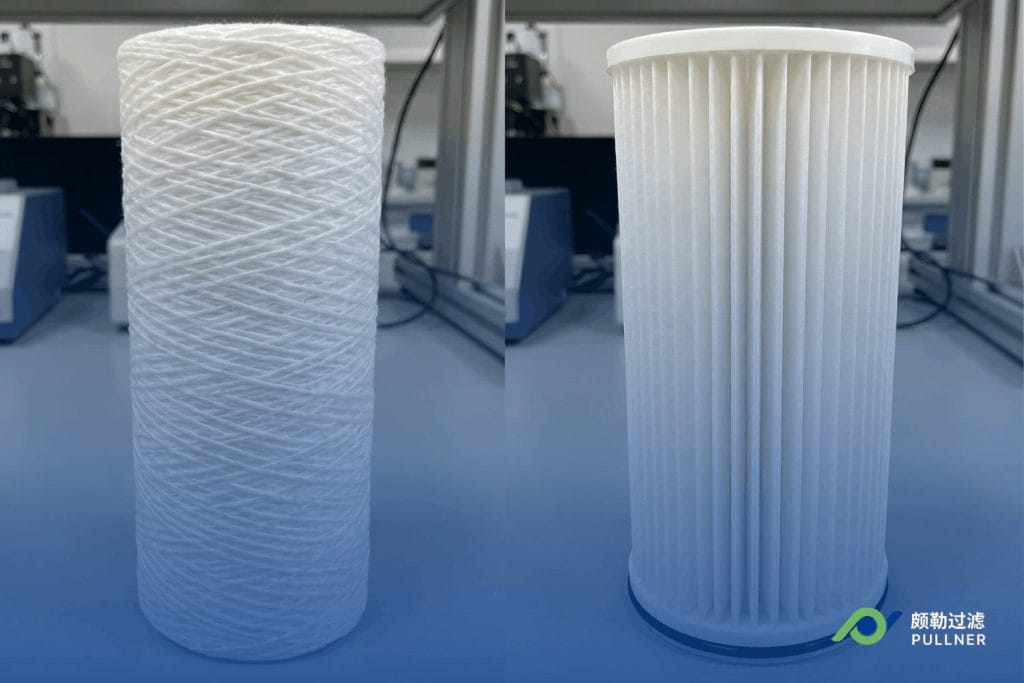
A string-wound filter is a depth filter that captures particles and sediment throughout its full media thickness rather than just at the surface.
Graded-density winding pulls finer particles from water deeper into the core, extending service life and delaying pressure rise. High dirt-holding capacity and broad temperature tolerance make string-wound filters a reliable choice for demanding industrial water and chemical filtration duties.
How String wound cartridges work
String-wound filter cartridges are made by wrapping polypropylene, cotton, or glass fiber yarn around a central core. The winding creates a graded-density depth filter matrix that becomes progressively denser toward the center.
Near the outer surface, larger particles collect first, and finer contaminants lodge deeper within the media. Standard string wound designs cover nominal micron ratings from 1 to 50 microns. Common filter housing lengths run from 10 to 40 inches.
A PLX-type string-wound filter with a stainless steel core handles flows around 500 GPM. Differential pressures for PLX-type cartridges reach up to 3 bar at 190°F, with media-dependent temperatures up to 480°F.
Dirt holding capacity is a key advantage in feeds with heavy or irregular solids. High-temperature tolerance makes string-wound filter cartridges a strong fit for demanding pre-filtration in industrial water and chemical processing.
What is a Pleated Filter?
A pleated filter is a surface filter that maximizes surface area through accordion-style folds of polypropylene or similar filter media. A greater surface area allows the pleated filter to capture more particles at a given micron rating without increasing the pressure drop.
High filtration efficiency and longer service intervals make pleated filter cartridges a strong fit for industrial filtration where consistent water quality and low replacement frequency matter most.
How pleated cartridges work
Pleated filter cartridges use sheets of polypropylene media folded into pleats around a rigid core. The folded structure maximizes surface area in a compact footprint and keeps the flow rate stable as solids accumulate.
Many pleated filter designs combine multiple PP layers or nano-fiber structures, so coarser outer zones intercept larger particles first. Finer inner-layer zones then capture smaller contaminants at high efficiency, delivering greater depth filtration than a standard surface filter.
HPPV-type pleated filter cartridge elements use multi-layer nanofiber filter media with a gradual reduction in pore size from the outer to the inner zones. Filtration efficiency for polypropylene pleated cartridges typically reaches up to 99.9% at specified particle size ratings.
PP pleated designs generally operate up to 176°F and withstand differential pressures of 4 bar, though exact limits vary by design.
String Wound vs. Pleated: Key Performance Differences
Choosing between wound filters and pleated filters comes down to filtration mechanism, pressure drop, and dirt-holding behavior. Each design carries a structural advantage that maps directly to specific feed conditions and process targets.
Filtration mechanism and efficiency
String-wound cartridges function as true depth filters, capturing contaminants throughout the full media thickness. Depth filtration suits feeds with broad particle size distributions and high, variable solids loads.
خراطيش الفلتر المطوية rely on surface and near-depth action across multiple layers of pleats, delivering tighter particle control at a given micron rating. Documented filtration efficiency for pleated designs reaches 95–99.9% removal at specified particle sizes.
Flow, pressure drop, and dirt‑holding
Compared to string-wound, pleated filter designs offer very high dirt-holding capacity, especially in feeds with heavy or irregular solids.
Pleated cartridges deliver a lower initial pressure drop because their folded filter media provides far more surface area than a cylindrical-wound cartridge. A higher flow rate is achievable with pleated designs for the same reason.
HPPV-type pleated cartridges resist rapid face-plugging by distributing captured solids throughout the full media pack, extending run times beyond those of simpler surface filter cartridges.
Operating window and compatibility
String-wound filters with stainless-steel cores handle significantly higher temperatures than all-PP pleated filters. Hot condensate and boiler feed streams fall within their operating range, where pleated cartridges would fail.
All-polypropylene pleated and non-pleated filter cartridges each deliver clean, low-extractable performance in water-based applications up to their rated limits. Plants running at moderate temperatures that need documented efficiency curves often find that pleated filters vs. purely nominal-depth filter selections deliver better lifecycle value.
Application Scenarios for Each Filter Type
Feed conditions, temperature, and effluent targets determine which filter cartridge type is best suited to each stage. String-wound cartridges dominate high-load and high-temperature duties, while pleated designs lead where filtration efficiency and service life drive the decision.
High‑temperature and heavy‑solids pre-filtration
Power generation condensate polishing and boiler feed streams run at elevated temperatures with fluctuating particulate loads. String-wound cartridges with stainless-steel cores excel as sediment filters under these conditions.
In water filtration systems serving these duties, depth filter cartridges absorb high levels of solids while withstanding thermal and mechanical stress. Stainless-steel cores and high-tensile yarn winding protect downstream equipment and finer filter stages from premature wear under thermal and mechanical stress.
High suspended solids, colloids, and viscous liquids
Chemical and process liquids with high suspended solids or colloidal contamination can be filtered quickly through simple surface filter cartridges. Short changeout intervals and unstable filtration system performance follow.
PP pleated filters in HPPV-style designs handle these duties by combining gradient pores with a high surface area. Loading spreads through the depth of the pleat pack, slowing the pressure rise and reducing replacement frequency. Slower pressure rise stabilizes downstream water quality.
High‑purity water, electronics, and inks
Electronics rinse water filtration and photoresist solutions demand tight particle control and low extractables. High-efficiency PP pleated filter cartridges are the preferred choice for industrial filtration in electronic-grade service.
Efficiency tables for pleated sediment and particle-control cartridges help engineers select nominal pore ratings that hit required retention levels. Removal of 99.8–99.9% at defined particle sizes is achievable with the right pleated cartridge selection.
General industrial and food/beverage pre-filtration
Industrial water treatment and string-wound depth cartridges, such as PLX-type filter elements, offer a cost-effective first stage to capture coarse and mid-range sediment. Food and beverage water filter applications benefit from the same approach before tighter polishing stages.
Upgrading to PP pleated cartridges, such as PPM-type designs, improves clarity and reduces replacement frequency. Water pressure stability improves across the train, particularly ahead of membranes or point-of-use polishing equipment.
How to Choose the Right Filter for Your Application
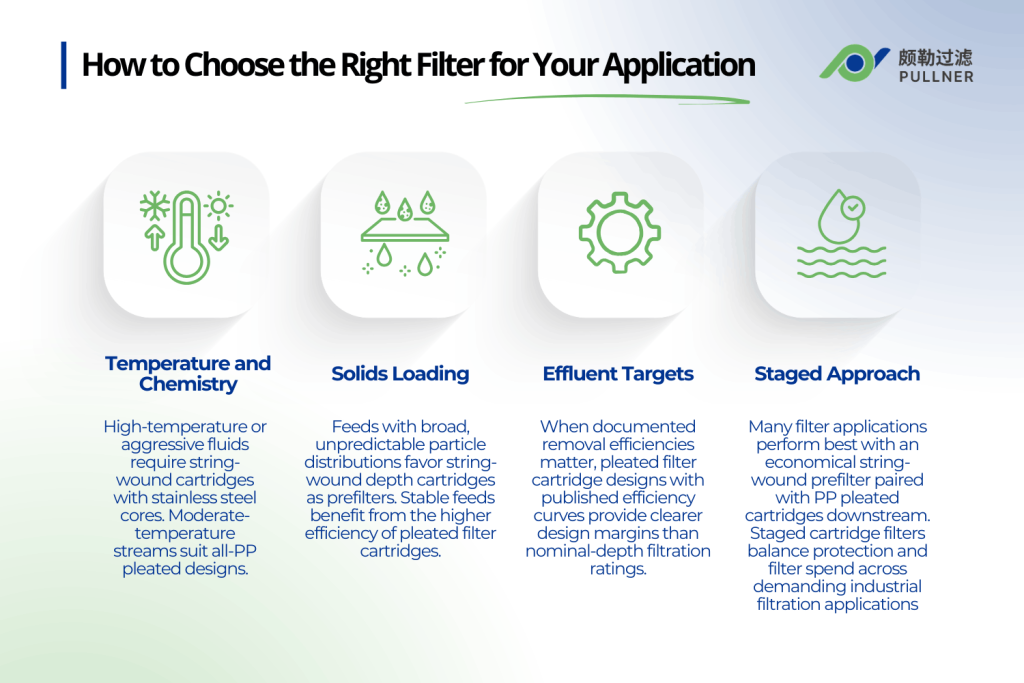
Start by confirming temperature and chemical compatibility, then evaluate solids loading and effluent targets. Match the appropriate filter cartridge to each stage based on feed chemistry, temperature, and target effluent spec. Use these decision factors to choose the right filter for your system:
- Temperature and chemistry: High-temperature or aggressive fluids require string-wound cartridges with stainless steel cores. Moderate-temperature streams suit all-PP pleated designs.
- Solids loading: Feeds with broad, unpredictable particle distributions favor string-wound depth cartridges as pre-filters. Stable feeds benefit from the higher efficiency of pleated filter cartridges.
- Effluent targets: When documented removal efficiencies matter, pleated filter cartridge designs with published efficiency curves provide clearer design margins than nominal-depth filtration ratings.
- Staged approach: Many filter applications perform best with an economical string-wound pre-filter paired with PP pleated cartridges downstream. Staged cartridge filters balance protection and filter spend across demanding industrial filtration applications.
Selecting the right cartridge type – and pairing them correctly across stages – is where مرشح بولنر works most closely with engineering and procurement teams. Pullner manufactures both PLX-style string-wound cartridges and PPM and HPPV pleated families in-house at a 15,200 m² ISO 9001 facility, with PMI pore analysis, SEM verification, and IFTS single-pass testing applied to every filter line. That depth of testing matters most when a filtration train mixes depth and surface designs across temperature, solids loading, and effluent targets that don’t tolerate guesswork.
For staged systems, Pullner supplies PLX string-wound cartridges for high-temperature and heavy-solids pre-filtration alongside PPM and HPPV خراطيش مطوية for downstream particle control at 0.1 to 70 microns. High flow filter cartridges extend the same range for large-volume duties, with bulk and OEM orders shipped under 100% factory testing and batch-level traceability. Custom yarn, end-cap, and core configurations are available where standard cartridges don’t match the feed.
Contact Pullner Filter’s engineering team to request a quote, free filtration testing, custom filter design, and up to two free samples for your application.
String Wound vs. Pleated Water Filters FAQs
How often should these filters be changed?
Change a filter cartridge when differential pressure rises 20–25% above baseline or reaches the cartridge’s rated change-out limit. Under normal solids loading, most industrial filtration systems reach that point every few months. Condition-based replacement protects downstream equipment and avoids premature changeouts.
Can pleated and string wound filters be used together?
Yes. A string-wound filter upstream serves as a depth filter pre-filter, handling high solids loading, while pleated filter cartridges downstream deliver finer particle control and longer service intervals. Staged filter elements in a multi-stage industrial water train balance protection and filter spend across the system.
Do these filters remove bacteria or microorganisms?
No, standard string-wound and polypropylene pleated sediment filters remove particles by size. Bacteria and viruses pass through both designs. Industrial filtration systems requiring microbial control need a dedicated disinfection stage or a sterilizing-grade membrane rated at 0.2 microns or finer.
العودة إلى الأعلى String Wound vs. Pleated Water Filters: What’s the Difference?
 English
  Spanish
  Arabic