
A common challenge when specifying membrane filter cartridges is choosing between two materials that look similar on a spec sheet but behave very differently in service. PTFE and PES are the two most widely used membrane materials in industrial filtration, and the decision comes down to one property: wetting behavior.
The short answer: PTFE is hydrophobic and repels water, while PES is hydrophilic and wets on contact with aqueous liquids. Hydrophobic PTFE requires pre-wetting with a validated fluid before it will pass through an aqueous stream or complete an integrity test—hydrophilic PTFE exists, but it’s a separate product type and isn’t covered here. PES needs no such step; it wets immediately.
That single difference in wetting behavior is where a PTFE vs. PES filter decision starts, not where it ends. PTFE membranes are the standard choice for gas venting and aggressive solvents, while PES membranes handle aqueous and biological streams, often with an advantage in low protein binding. From there, the final selection still has to reflect the specific membrane and complete cartridge configuration—published product data, not the material class alone, confirms the fit.
Hydrophobic vs. Hydrophilic Explained
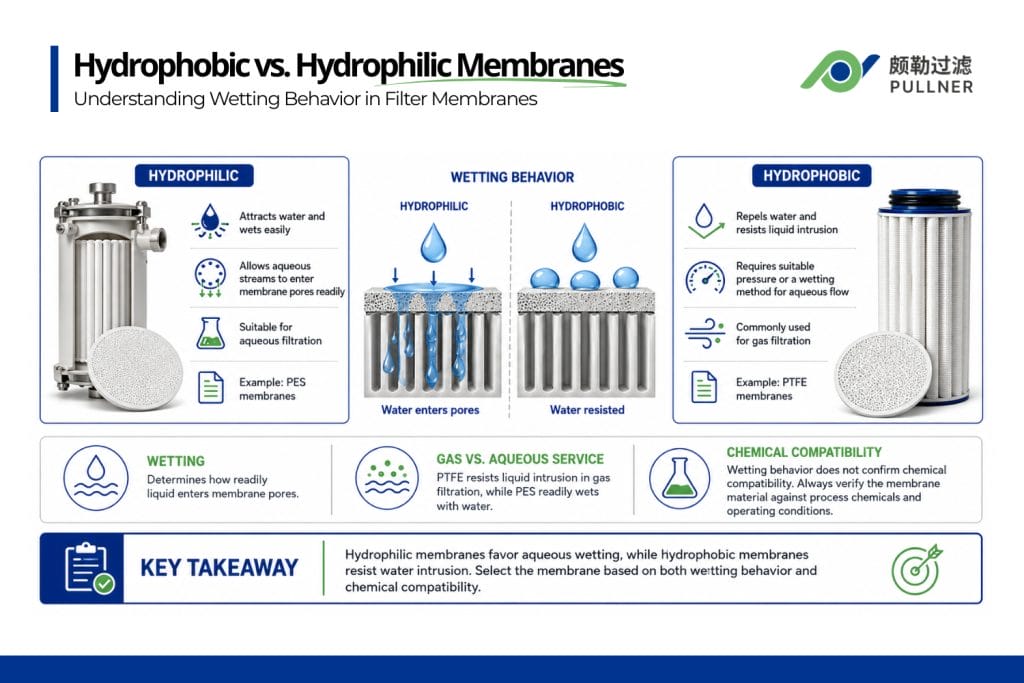
Wetting is whether a liquid spreads across a membrane and enters its pores under the available pressure. A hydrophilic surface attracts water, so an aqueous stream displaces pore air without a separate conditioning step. A hydrophobic surface resists spontaneous aqueous wetting; liquid entry needs a conditioning method or enough pressure to overcome water-intrusion resistance.
This distinction changes more than the startup procedure. In gas filtration, hydrophobic PTFE passes gas while resisting high-surface-tension liquid intrusion within its specified operating conditions. In aqueous processing, PES wets on contact and establishes flow across the full membrane area right away.
Wetting behavior isn’t the same as chemical compatibility. A solvent that passes through PTFE readily can still attack another cartridge component, and an oxidizer or strong acid can push PES outside its qualified range even though it wets instantly. Always check compatibility for the whole cartridge, not just the membrane.
PTFE Membrane Profile
PTFE handles the most chemically demanding duties in membrane filtration, but chemistry class alone doesn’t guarantee low extractables—that has to come from finished-cartridge data.
- Gas venting: Hydrophobic PTFE passes gas while resisting liquid intrusion within its specified operating conditions, making it the standard choice for sterile vents and pressure-relief applications.
- Chemical processing: PTFE handles a broad range of solvents, acids, and alkalis. Confirm compatibility at the actual concentration and temperature – seals and support layers can set a lower limit than the membrane itself.
- Steam exposure: PTFE tolerates repeated sterilization, but qualify the complete assembly; seals and welds often age faster than the membrane.
- Integrity testing: Use the manufacturer-specified wetting fluid, typically a validated alcohol-water mixture or a water-intrusion method for hydrophobic media.
PES Membrane Profile
PES is inherently hydrophilic, so aqueous liquids wet it immediately with no conditioning step. Ultimate performance still depends on the specific construction and finished device, not the material alone.
- Asymmetric construction: Larger upstream pores intercept coarse material ahead of a finer downstream layer, supporting higher throughput before the membrane loads up.
- Protein recovery: Low protein binding limits product loss – a real advantage for biologics, vaccines, and other adsorption-sensitive formulations.
- Chemical exposure: PES handles most aqueous streams well, but compatibility data needs to reflect actual contact time and concentration; a short bench test won’t represent a full production campaign.
- Steam treatment: Match cycle temperature and duration to the qualified assembly, not the membrane material alone.
- Integrity measurement: Water-based test fluids wet PES readily, and bubble-point or diffusion limits still depend on membrane area and pore structure.
PTFE vs. PES Membrane Comparison Table
The main PTFE vs. PES membrane difference is wetting behavior: PTFE repels water, while PES wets directly with aqueous media. That hydrophobic vs. hydrophilic split points PTFE toward gas and aggressive chemical service, and PES toward water-based filtration with low protein binding.
| Selection factor | PTFE | بيس | Process result |
|---|---|---|---|
| Wetting behavior | Native PTFE is hydrophobic | PES is inherently hydrophilic | PTFE resists aqueous wetting, whereas PES wets directly |
| التوافق الكيميائي | Commonly broad across many solvents and corrosive fluids | Commonly broad across many aqueous formulations | Product data and exposure conditions control approval |
| Main applications | Commonly selected for gas venting and aggressive liquid service | Commonly selected for aqueous and biological liquid service | Validation must cover the specific filter and process |
| Protein binding | Product-specific | Low | PES can help preserve proteins in sensitive formulations |
| الهيكل | Product-specific. Membrane symmetry can’t be assumed from PTFE alone | Product-specific. Some PES membranes are asymmetric | An asymmetric PES pore gradient can improve throughput |
| Sterilizing-grade liquid filtration | Often 0.2 or 0.22 µm when the finished filter is validated for bacterial retention | Often 0.2 or 0.22 µm when the finished filter is validated for bacterial retention | The designation alone doesn’t establish sterilizing performance |
| التعقيم | Assembly-specific steam capability | Assembly-specific steam capability | Cycle limits must cover the entire cartridge |
| Integrity testing | Needs a suitable wetting fluid | Wets readily with water-based fluids | Test method and limit must match the product |
| Bubble point | Depends on wetting liquid and pore structure | Depends on wetting liquid and pore structure | Use the manufacturer’s validated product specification and test conditions |
A 0.22 µm rating alone doesn’t establish bacterial-retention performance for a finished filter cartridge – that needs bacterial-retention validation and correlated integrity-test limits for the specific device. Bubble point gives an indirect integrity measure by linking gas pressure to the largest wetted pore pathway.
Which Membrane For Your Application?
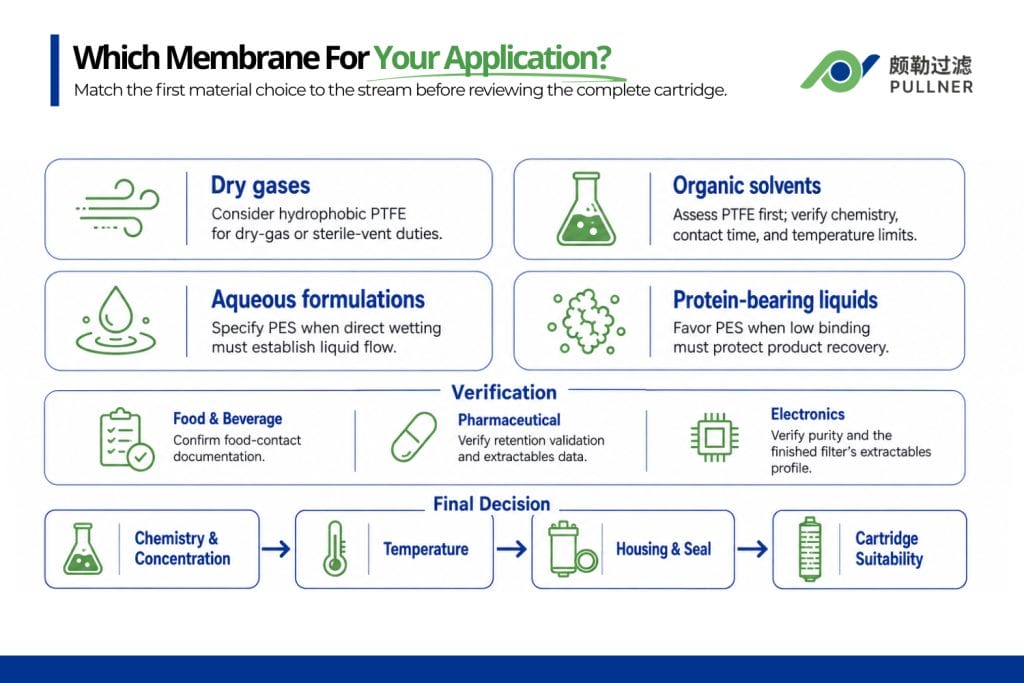
Match the first material choice to the stream before reviewing the complete cartridge:
- Dry gases: Consider hydrophobic PTFE for dry-gas or sterile-vent duties, subject to water-intrusion resistance, airflow, and sterilization data.
- Organic solvents: Assess PTFE first, then verify chemistry and contact time against temperature limits for every wetted cartridge component.
- Aqueous formulations: Specify PES when direct wetting must establish liquid flow without an alcohol conditioning step.
- Protein-bearing liquids: Favor PES when low binding must protect recovery from biological products or pharmaceutical buffers.
Food and beverage teams should confirm food-contact documentation for each product-contact component. Pharmaceutical QA teams need retention validation and extractables data. Electronics engineers should verify purity, since chemical compatibility alone doesn’t establish a finished filter’s extractables profile.
Neither membrane wins across every duty. Chemistry and concentration set one operating boundary, temperature determines whether that range still applies, and housing fit and seal material complete the decision—the weakest compatible component governs cartridge suitability.
Sterilization and Integrity Testing
Sterilization qualification has to cover the membrane and the assembled cartridge under the planned cycle, including welds and the housing interface. Repeated steam cycles need product-specific qualification for the cartridge and its seals, which often set the limit before the membrane does.
Integrity testing gives a non-destructive check against the installed filter’s validated integrity specification and its correlation to retention performance. In a bubble-point test, gas pressure rises against a fully wetted membrane until gas breaks through the largest open pore path. Read the result against the manufacturer’s product-specific test conditions and acceptance limit.
The approved validation strategy and site SOP should define:
- Wetting method: the manufacturer-specified fluid or water-intrusion method for the selected membrane and test.
- De-aeration step: remove trapped gas whenever the validated procedure requires complete membrane wetting.
- Test timing: run pre-use or post-use testing according to the approved process strategy.
- Result handling: record acceptance limits and batch documentation under the applicable site procedure.
Work With Pullner Filter
Pullner manufactures both PTFE and PES membranes in-house and verifies their pore structure with scanning electron microscopy at 3-nanometer resolution before cartridge qualification – the same in-house capability that backs every membrane cartridge Pullner ships.
Review Pullner’s PTFE membrane filter range for gas or chemical service or the asymmetric PES membrane filter element for aqueous and biological streams. For electronics chemicals, compare the wet-process PTFE cartridge against your process conditions. Use Pullner’s membrane compatibility chart before requesting a configuration review.
Speak to a Filtration Expert to match a membrane to your application, or get a quote for a compatible cartridge design.
PTFE Vs. PES Filter Membranes FAQs
What specifies a membrane filter cartridge?
Start with the process fluid and required retention rating. Then define flow demand and allowable pressure drop. Finish the specification with operating temperature and sterilization conditions, followed by housing dimensions and connection type.
Does membrane compatibility confirm cartridge compatibility?
Membrane compatibility covers only the filtration layer. Support media and end components can respond differently to the same fluid. Approve the cartridge only after every product-contact material passes review under the intended exposure.
Which validation documents should buyers request?
Request microbial-retention evidence for sterile service and integrity-test limits for the selected configuration. Obtain material certificates and lot traceability records. Extractable data or food-contact declarations may apply depending on the regulated process.
How should teams assess a replacement membrane?
Compare the proposed cartridge against the qualified device specification before installation. Review membrane material and effective area, then assess flow and pressure behavior. Any changed attribute should enter formal change control before production use.
Can manufacturers tailor membrane cartridge configurations?
Manufacturers can adapt membrane grade and support construction within their qualified design capability. End connections can be matched to an existing housing once dimensions are verified. Customization still needs compatibility review and documented performance testing.
How do membrane verification and filter validation differ?
Membrane verification confirms physical attributes, such as pore structure or material identity. Filter validation demonstrates that the finished cartridge meets a defined process requirement. A verified membrane is one input within a broader validation package.
What does SEM inspection verify?
Scanning electron microscopy (SEM) shows membrane surface structure at high magnification, revealing pore form and manufacturing consistency at the inspected location. SEM alone doesn’t verify pore-size distribution or bacterial retention, and it can’t prove complete cartridge integrity on its own.
When should QA join membrane selection?
Quality assurance should join before the final material decision affects a regulated process. Early review identifies documentation gaps before procurement or validation begins and lets QA align acceptance criteria with change-control and batch-record requirements.
What defines a sterile filtration cartridge?
For liquid sterile filtration, a sterilizing-grade cartridge is a finished device validated to retain the specified bacterial challenge under defined process conditions. Its specification should cover process chemistry and sterilization, with integrity-test limits and material traceability applying to the finished cartridge.
How should regulated facilities document filter traceability?
Record the manufacturer and product code for every installed element. Capture the lot number and integrity-test result in the batch record, and link certificates and change-control references to the same traceable entry.
Back to Top : PTFE vs. PES Filter Membranes: Hydrophobic vs. Hydrophilic Explained
 English
  Spanish
  Arabic