
Coastal regions and island communities facing water scarcity turn to seawater desalination when traditional water sources run dry. The global water desalination market is valued at USD 20.76 billion in 2026. Growing at a CAGR of 9.1%, the market is forecast to reach USD 38.20 billion by 2033.
Desalination removes dissolved salts from seawater or brackish water to produce potable water, with reverse osmosis now being the most widely used technology. Seawater filtration protects RO membranes and stabilizes clean water output, lowering operating costs across the plant’s service life.
Overview of the Seawater Desalination Process
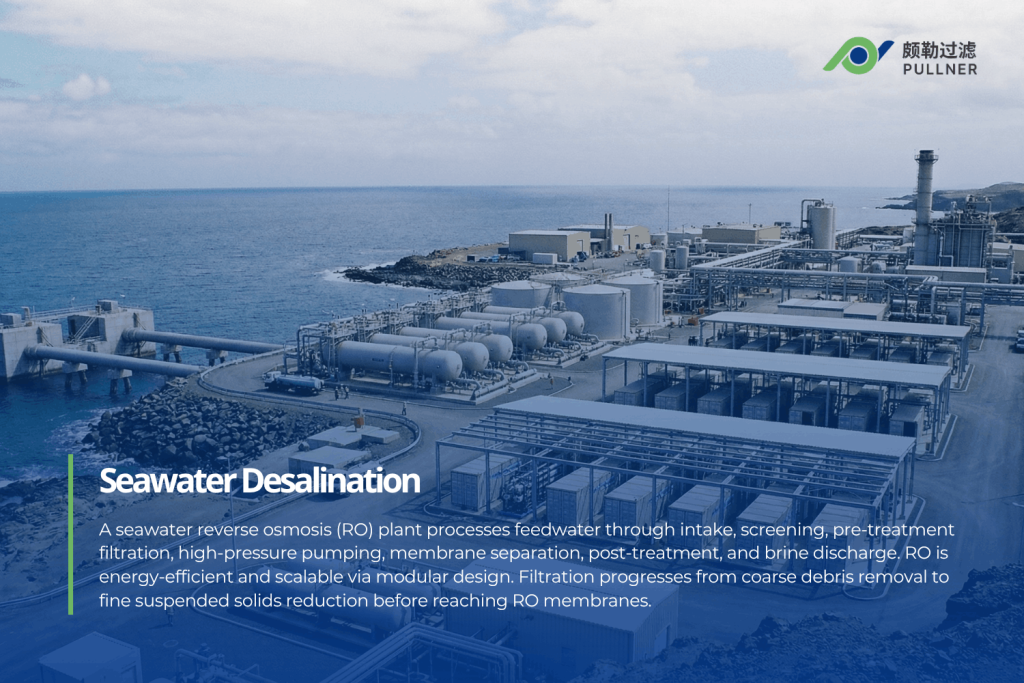
A typical seawater reverse osmosis (RO) plant moves feed water through a defined sequence before it contacts the RO membranes.
Reverse osmosis dominates thermal alternatives in terms of energy and scalability. Modular design allows RO systems to scale from small community plants to large desalination plants without fundamental process changes.
A standard RO desalination train can follow this sequence:
- Seawater intake
- Coarse screening
- Pre-treatment filtration via media filters and cartridge or ultrafiltration units
- High-pressure pumps feeding the RO membranes
- Post-treatment remineralization and disinfection
- Brine discharge back to the sea
Seawater filtration occupies the pre-treatment zone, bridging raw ocean water intake and the RO skids. Removal progresses from coarse to fine. Trash racks and drum screens handle large solids first, while downstream media and cartridge filters reduce suspended solids to RO-compatible levels.
Why Pre-Filtration Matters for RO Performance
Raw seawater contains suspended solids and biological contaminants, making unfiltered feedwater incompatible with direct membrane contact. Silt and algae contribute to turbidity and accelerate biofouling on the RO membrane surface. Without adequate seawater filtration, feed water cannot meet membrane inlet requirements.
Inadequate pre-treatment causes the differential pressure across the RO membrane to increase and the permeate flow to decrease. Clean-in-place cycles increase in frequency, and membrane replacement intervals shorten. Every seawater reverse osmosis system depends on stable, predictable feed water quality to operate at its design recovery and flux.
Pre-filtration targets a silt density index and turbidity level that fall within the RO membrane manufacturers’ specified limits. Staged removal reliably delivers feed water to those targets. Controlling microbial growth at the pre-treatment stage limits biofouling, which ranks among the most difficult membrane fouling mechanisms to reverse.
Stages of Seawater Filtration in Desalination Plants
Seawater filtration in desalination plants follows a staged sequence, with each stage reducing the contaminant load before it is passed to the next.
Each stage conditions the feed water for the next. No single filter type can handle the full range of contaminants in raw seawater, which is why staged filtration is the standard design approach.
Intake and Coarse Screening
Seawater enters desalination plants through open intakes or subsurface beach wells. Open intakes are most common for large municipal desalination plants because they handle the high flow rates those plants require.
Bar racks and drum screens remove seaweed and large debris at the intake. Coarse screening does not achieve fine filtration, but the stage protects pumps and reduces shock loading on downstream seawater filters.
Multi-Stage Cartridge and Media Filtration
Granular media filters and ultrafiltration units form the main clarification step in seawater pretreatment. Both remove a substantial fraction of suspended solids and reduce turbidity to a level that downstream cartridge filters can manage. UF membranes provide an absolute barrier against bacteria and fine colloids.
Cartridge filters sit downstream of media or UF units and act as polishing filters. Fine particles and media fines get intercepted at this stage before the feed water reaches the RO headers. Backwash frequency and change-out intervals shape energy use and operating cost.
Final Protection Before RO Membranes
Security filters installed immediately upstream of RO skids form the last filtration barrier before the reverse osmosis membrane. Catching fine particulates and pipe rust here protects the RO membrane directly.
Micron ratings align with RO membrane manufacturers’ recommendations, typically falling in the low single-digit micron range. Reliable performance at this stage maintains membrane warranties and reduces unplanned shutdowns.
Filter Technologies Used in Seawater Pretreatment
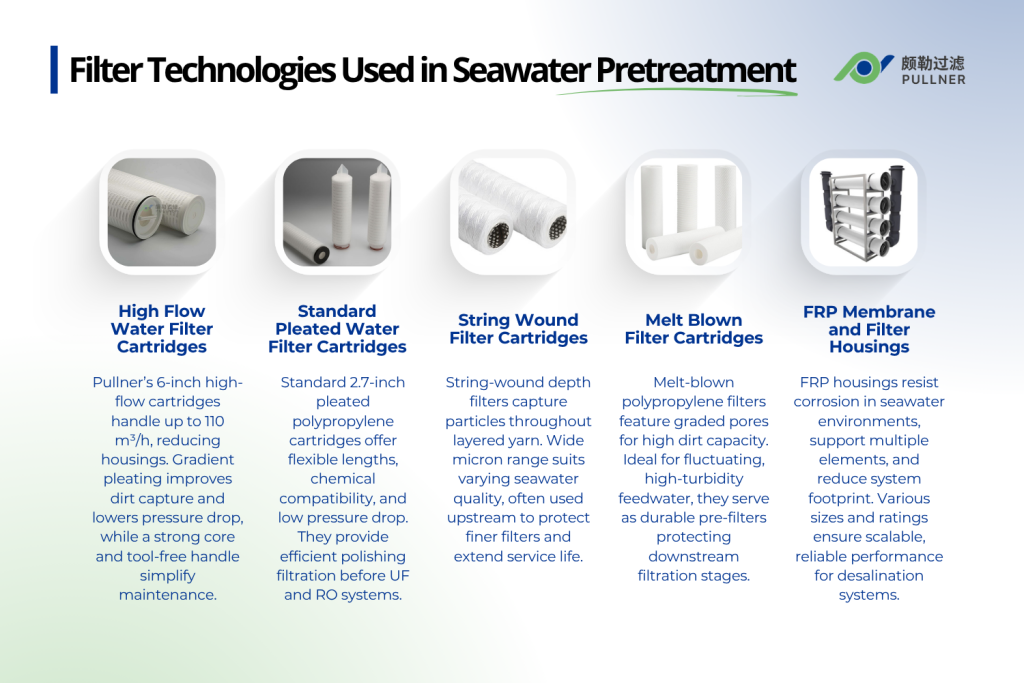
Not every seawater pretreatment train faces the same feedwater conditions or flow demands. Filter selection depends on feedwater solids loading and the SDI target specified by the RO membrane manufacturer.
High Flow Water Filter Cartridges
بولنر high-flow cartridges are large-diameter pleated elements measuring 6 inches (152 mm) and are built specifically for large-scale desalination applications. A single element handles >60 m³/h per 40″ element (standard conditions), reducing the number of housings required for a seawater filtration system.
High-density pleating creates a large effective filtration area, delivering high dirt-holding capacity across high-throughput plants. A multi-layer gradient design traps larger particles in the outer layers and finer particles progressively inward.
As a result, depth capture efficiency improves and pressure drop remains lower throughout the element’s service life. The internal polypropylene core resists reverse differential pressure, adding mechanical robustness during backpressure events.
For plants where change-out downtime and personnel exposure to saline water must be minimized, Pullner’s integrated handle design allows tool-free installation and removal.
Standard Pleated Water Filter Cartridges
Standard pleated polypropylene cartridges measure approximately 2.7 inches (68.5 mm) in outer diameter and are available in 10-, 20-, 30- and 40-inch lengths. Length options make seawater filtration systems easier to retrofit into existing plant layouts.
All-polypropylene construction provides chemical compatibility with common seawater treatment chemicals and cleaning agents. Pleated geometry delivers a larger filtration surface area than cylindrical depth filters of similar size. Lower initial pressure drop and longer service intervals follow, making standard pleated elements well-suited to polishing applications.
Consistent water filtration at this stage ensures feed water meets reverse osmosis membrane inlet requirements. Standard pleated cartridges sit ahead of UF modules and RO systems as the final polishing stage. Pullner’s pleated cartridges are available in multiple lengths to match your system configuration.
خراطيش الترشيح ذات الجرح الخيطي
String-wound cartridges are depth filters formed from continuous textile yarn wound tightly around a porous core. Polypropylene and absorbent cotton are the most common yarn materials, matched to the water treatment duty and chemical environment.
Cores are available in polypropylene or stainless steel, with SS 304 and SS 316L suited to sections where corrosion resistance is a priority. A honeycomb winding structure increases density from the outer to the inner layers. Suspended solids carried in variable-quality seawater are captured throughout the filter depth rather than just at the surface.
Micron ratings run from 0.5 to 200 µm, allowing engineers to match saltwater filters to a wide range of seawater qualities. At intakes with seasonal algae blooms or fluctuating turbidity, Pullner’s string-wound cartridges stage upstream of finer pleated elements to extend their service life.
خراطيش الفلتر المنفوخة بالذوبان
Melt-blown cartridges are formed by extruding and blowing polypropylene fibers into a self-supporting depth filter. Graded pore distribution places larger pores on the outer layers and progressively finer pores inward, improving dirt-holding capacity across the full filter depth.
Feed water with elevated solids and turbidity, common after storms or industrial discharges near the intake, places a high demand on upstream filtration systems. Feedwater quality that deteriorates rapidly puts conventional water purification equipment under stress.
Melt-blown elements handle those conditions as stand-alone pre-filters or as a protective stage ahead of pleated or membrane units. For demanding seawater treatment systems where feed conditions shift unpredictably, Pullner’s melt-blown cartridges are built to handle demanding intake conditions where feed quality shifts unpredictably.
FRP Membrane and Filter Housings
FRP (fiber-reinforced plastic) housings resist corrosion in seawater and brine environments where metallic housings degrade. Multiple elements per housing enable high total flow rates with fewer vessels, reducing skid footprint and simplifying piping in space-constrained desalination systems.
Multiple diameters and pressure ratings are available, letting designers match housing specifications to a wide range of desalination plant sizes. For offshore or coastal seawater reverse osmosis systems, corrosion resistance determines long-term reliability.
Selecting the correct housing configuration at the design stage avoids costly retrofits as reverse osmosis desalination capacity grows. Pullner’s FRP housings accommodate high-flow filter cartridges and are available in multiple specifications to match your plant’s flow requirements.
Designing Effective Seawater Filtration for Desalination Plants
Effective seawater filtration design begins with a thorough characterization of raw seawater quality at the intake. Turbidity and biological activity are the two variables that most directly shape pre-treatment specification. Seasonal variability and proximity to industrial or urban discharges near the intake affect filter selection and staging.
Engineers define target SDI and turbidity values at the RO inlet based on recommendations from the membrane supplier. Working backward from those targets sets the filter specification at each stage. Cartridge selection depends on several factors:
- Expected solids loading at the intake
- Available space and skid footprint constraints
- Desired change-out intervals and maintenance access
- Operating pressure limits across each filtration stage
Differential pressure monitoring across each filtration stage provides the operational data needed to optimize change-out schedules. Running filters beyond their effective service life risks a breakthrough that damages downstream membrane units. Pressure data separates a scheduled change-out from an unplanned shutdown.
Lifecycle cost evaluation consistently shows that robust seawater filtration reduces the total cost of ownership. Filter consumption and change-out labor are two cost drivers that lifecycle evaluation must capture alongside membrane replacement frequency. Higher filter spend up front pays back through longer membrane service life.
Stable, Cost-Effective Desalination Starts with Filtration
High-quality seawater filtration protects RO membranes from fouling and keeps plants running at design permeate flow. Stable feedwater quality at the RO inlet makes that possible.
A well-designed filtration train combining intake screening with media or UF clarification delivers stable feedwater quality even as raw seawater conditions shift.
Properly selected cartridge technologies at each stage protect the RO membrane and reduce unplanned downtime.
Pullner Filter works as a technical partner across the full pre-treatment train, not just a component supplier. Each product in Pullner Filter’s lineup addresses a defined role in the pre-treatment train. From high-flow pleated cartridges to corrosion-resistant FRP housings, Pullner Filter gives engineers flexible building blocks for seawater pretreatment. Specifying the right combination from the start reduces complexity and controls footprint.
Pullner Filter is ISO 9001 certified, runs 100% batch testing across all filter elements, and offers two free samples for evaluation before any procurement commitment.
Request a quote today to find the right seawater filtration solution for your plant.
Sea Water Filtration FAQs
Why does SDI matter in seawater desalination?
The silt density index (SDI) measures how quickly suspended particles in feed water clog a test filter under defined pressure conditions. RO membrane suppliers specify maximum SDI values at the RO inlet and exceeding those limits accelerates fouling. Staying within the specified SDI range keeps clean-in-place frequency low and extends membrane service life.
How often should cartridge filters be replaced in a seawater RO pretreatment train?
Replacement frequency depends on solids loading and cartridge type, but differential pressure is the practical trigger. Operators set a maximum allowable pressure drop across each filter stage. When that limit is reached or trend data indicates accelerating fouling, cartridge change-out prevents breakthrough and protects downstream RO membranes.
Can desalination plants upgrade to high-flow cartridges without a full redesign?
In many cases, yes. High-flow cartridges fit within existing skid footprints while increasing flow per element. Matching connection types and pressure ratings allows plants to replace multiple standard cartridges with fewer high-flow elements. Housing count drops and change-out time shortens without altering the core reverse osmosis process or intake infrastructure.
العودة إلى الأعلى Seawater Filtration: How to Filter Salt Water for Desalination
 English
  Spanish
  Arabic