
Industrial processes consume water at a scale most people never see. Thermoelectric power generation alone accounts for roughly 41% of total industrial water withdrawals in major industrial regions.
A single kilogram of fabric requires approximately 200 liters to produce, while manufacturing one car can use over 147,600 liters. Plants handling those volumes need filtration that keeps pace without multiplying footprint or driving up pressure drop.
Unplanned downtime caused by frequent cartridge changes adds unnecessary pressure. Industrial high flow filter cartridges are large-diameter, high-surface-area designs built to sustain high flow rates and long service life where standard filters fall short.
What is a High-Flow Filter Cartridge?
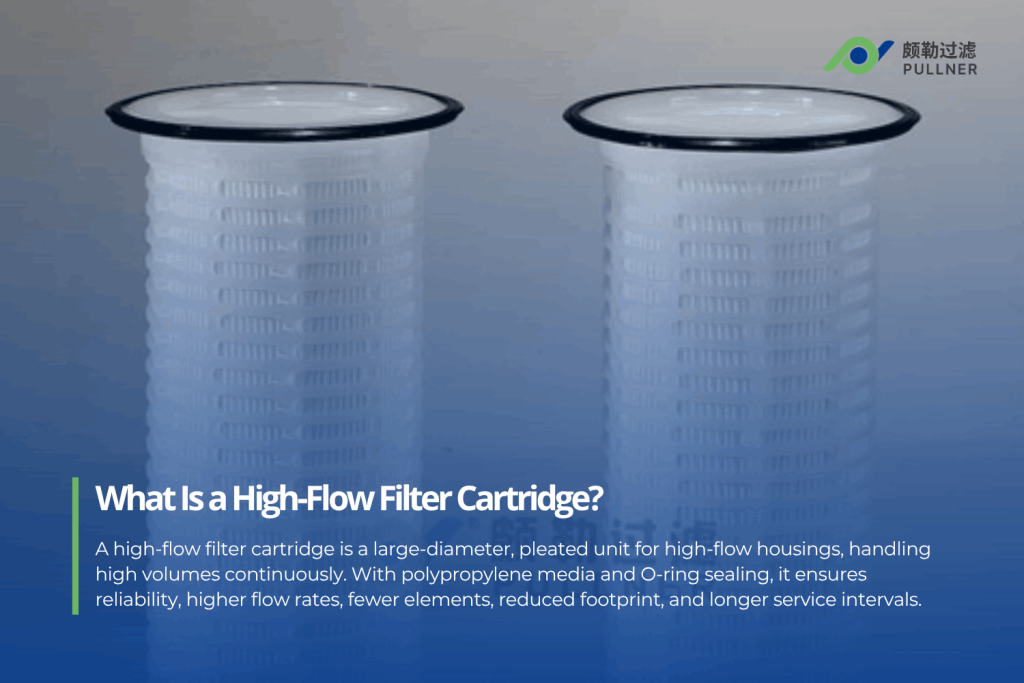
A high-flow filter cartridge is a large-diameter, pleated design built for dedicated high-flow housings. Most handle high liquid volumes continuously. Construction typically combines pleated polypropylene media with a single open end, sealed by an O-ring to prevent bypass.
Proper sealing makes the high-flow cartridge filter dependable when throughput consistency and long service life matter. Compared to conventional 2.5” or 2.75” cartridges, high flow cartridges deliver greater surface area and higher flow rates per element.
Fewer cartridges per housing significantly reduce the system footprint. Change-outs become faster and safer for maintenance teams, while the high surface area of each large-format filter extends service intervals between replacements.
How a High-Flow Filter Cartridge Works
Flow path, media construction, and pressure behavior each shape filtration performance differently. Understanding how these elements interact helps engineers size high-flow systems correctly for real process conditions. Get any one wrong and the system underperforms.
Flow Path and Filtration Mechanism
High-flow filter cartridges work by directing pressurized fluid into the housing. Flow direction determines where and how contaminants are captured within the element. In outside-to-inside designs, fluid flows into the outer cartridge surface and passes inward through the pleated depth media toward the core.
Inside-to-outside flow reverses that path entirely. Fluid enters the core first, then moves outward through the filter layers. Both configurations rely on depth filtration to progressively trap particles throughout the media thickness.
Retaining contaminants through the full depth makes the filtration system far more tolerant of variable solids loading than surface-capture designs.
Role of Pleated and Gradient-Porosity Media
Pleated filter construction folds the filter media into uniform pleats, maximizing active surface area within a fixed cartridge diameter. More surface area means lower face velocity at the same flow rate.
Lower face velocity reduces the pressure drop across the element. A pleated cartridge with a gradient-aperture design extends dirt-holding capacity by grading pore sizes across the media depth. Coarser pores on the outer surface capture larger solids first. Finer pores toward the core handle progressively smaller particles.
Media provides high dirt-holding capacity precisely because solids distribute across the full depth rather than blinding the outer surface immediately. High dirt-holding capacity extends run time between changeouts.
Impact on Pressure Drop, Filter Life, and System Uptime
Higher flow rates and lower pressure drops depend on matching cartridge size to actual process conditions. Viscosity, solids loading, and temperature govern the build-up of differential pressure.
As fouling accumulates, resistance rises. Flow rates and lower pressure become harder to maintain without intervention. Properly sized high-flow cartridges slow fouling progression by spreading the solids load across a larger media area. Filter life lengthens when differential pressure builds gradually rather than sharply.
Longer service life reduces changeout frequency directly. In continuous processes, fewer unplanned stops protect both output consistency and rates and lower pressure drops across the wider system.
Features and Performance Parameters
High-flow cartridge design directly determines filter performance in service. Construction details, performance specifications, and material selection each carry weight when matching a cartridge to a specific process application.
Design Features of High-Flow Cartridges
A high-flow filter cartridge combines a large-diameter body with a single-open-end configuration that seats securely in dedicated housings. Pleated, depth-type polypropylene media packs high dirt-holding capacity into a compact element. All-thermal-welded construction eliminates adhesives from the assembly entirely.
Removing adhesives delivers broad chemical compatibility across a wider range of process fluids. Food-contact and pharmaceutical regulations require a lower extractable risk as a direct procurement requirement. Chemical compatibility depends on the cartridge’s construction, not just on the media it contains.
Every PHF series cartridge leaves Pullner’s ISO 9001-certified facility with full batch-level traceability and 100% factory inspection. In-house lab testing, including pressure drop measurement and particle retention analysis, confirms performance before any product ships, with full test reports available on request.
Performance Specs Buyers Look At
Buyers evaluating a high-flow filter start with the micron rating. Nominal and absolute ratings determine what particle sizes the filter reliably retains across operating conditions. The flow rate per element is the next specification buyers confirm.
Pullner’s PHF high flow series provides a useful reference point, with the 40” series filter element exceeding 60 m³/h under standard conditions. Exceeding 60 m³/h per 40” element reflects genuine flow capacity relative to standard 2.5” cartridge formats.
Maximum operating temperature and pressure limits define the safe operating envelope. Terminal differential pressure serves as the trigger for cartridge changeout.
Materials and Compatibility Considerations
Polypropylene suits industrial water and general aqueous duties because it balances chemical resistance with low extractables. Industrial applications involving hydrocarbons or elevated temperatures require alternative media and hardware materials.
Matching every wetted component to the process fluid protects performance. Regulatory requirements add another layer to material selection. Food-contact and pharmaceutical duties impose restrictions that go beyond basic compatibility. Selecting the wrong material risks both filtration performance and compliance throughout the full service life of the installation.
Applications for High-Flow Filter Cartridges
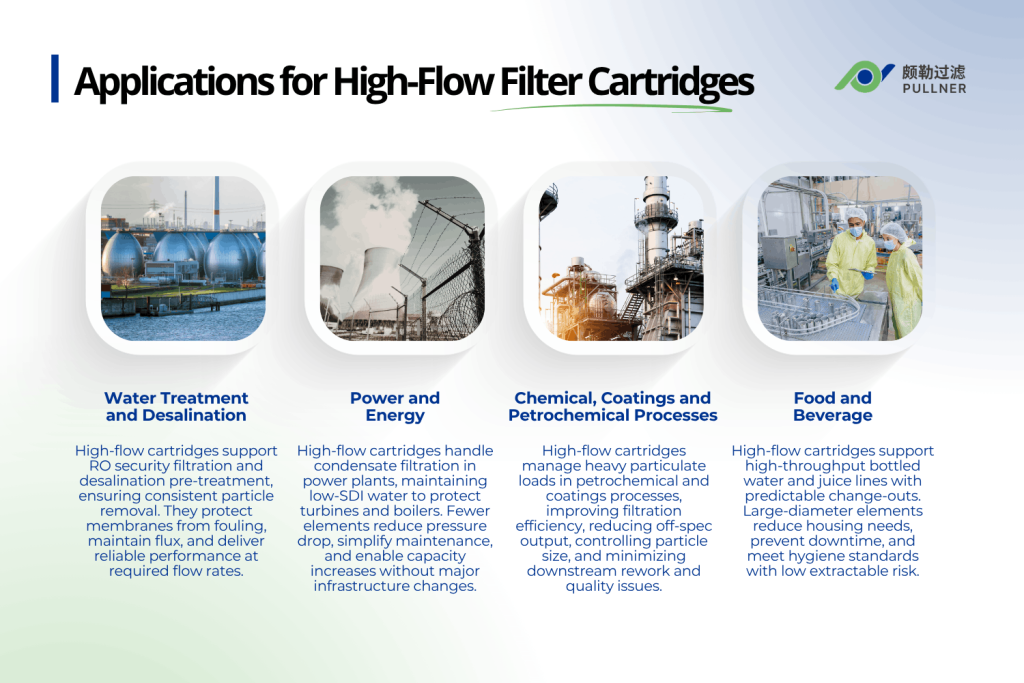
Many plant engineers adopt a high flow cartridge filter when line capacity increases, but equipment room space does not. Compact filtration solutions that deliver high throughput without multiplying housing count address exactly that operational constraint.
Water Treatment and Desalination
التناضح العكسي (RO) security filtration and seawater desalination pre-treatment rank among the highest-priority water treatment duties for high-flow filter cartridges. Both demand consistent particle removal at scale.
Protecting downstream equipment from fouling is the central objective in both cases. A fouled RO membrane reduces flux and increases operating pressure. High-flow water filtration ahead of RO membranes reduces fouling risk at the source.
Pullner supports these applications with membrane solutions engineered for purification and filtration performance at the flow rates required by desalination and security filtration demand. Their PHF high-flow series, available in 20″, 40″, and 60″ lengths, is sized to handle the volumetric demands of RO security filtration and seawater desalination pre-treatment, with flow rates exceeding 60 m³/h per 40″ element.
Power and Energy
Condensate filtration in power generation ranks among the most demanding high-volume filter duties in any industrial facility. Stable, low-SDI water protects turbines and boiler systems from particulate damage throughout continuous operating cycles.
High flow cartridge filter designs suit this application because fewer elements per vessel simplify both maintenance access and pressure management. Pressure drop penalties associated with standard formats disappear at this scale.
Filter cartridges are designed for these high-flow conditions and efficiently handle large volumes. When plants retrofit or expand capacity, advanced filtration using high-flow elements increases throughput without rebuilding existing vessel infrastructure.
Chemical Coatings and Petrochemical Processes
Petrochemical and coatings product streams generate high particulate loads that demand reliable, high-volume filtration at every processing stage. Fewer housings can handle equivalent loads when high-flow filter cartridges replace standard arrays.
Efficient filtration at this scale directly reduces off-spec production caused by contaminant carry-through into finished product streams. A high flow cartridge filter with the right micron rating controls particle size distribution across batch and continuous processes.
Better contaminant control at the filter stage reduces downstream rework and quality failures across petrochemical operations.
المأكولات والمشروبات
Food and beverage lines running bottled water and juice operations share one filtration requirement. High throughput with predictable change-out intervals defines the standard. A high-flow filter cartridge suits these lines because large-diameter elements handle the volumes without oversizing the housing count.
Unplanned filter stops disrupt filling lines immediately. Hygiene standards in F&B processing directly shape cartridge selection. Construction methods must minimize extractable risk between production runs.
High Flow Filter Cartridges vs. Conventional Cartridge Systems
Choosing between high-flow filter cartridges and traditional systems comes down to scale and how maintenance demands affect overall filter economics. Each approach suits different operating conditions.
System-Level Differences
Large filtration duties quickly expose the core difference between high-flow and conventional cartridge systems. Standard filter housings use many small-diameter elements arranged across multiple vessels or manifolds to achieve the target flow.
High flow filter cartridges merge equivalent capacity into fewer, larger-diameter elements per vessel. Fewer cartridges mean fewer connections and less manifold complexity across the installation.
Maintenance access improves when technicians work with a small number of large elements rather than a dense array of standard ones. Reduced connection points also lower the number of potential leak paths across the high-flow system.
Advantages of High Flow Designs
High flow cartridge filter designs provide higher flow per element than standard formats. Flow capability enables fewer cartridges to cover the same application. Fewer elements mean faster changeouts and less handling time for maintenance teams.
High efficiency across each element also reduces the total number of filter vessels required, which cuts the installation footprint directly. Lower housing counts reduce capital outlay for vessels and manifold connections. Fewer components and simpler maintenance tend to lower the total cost of ownership across the system’s operating life.
Situations Where Standard Cartridges May Still Be Suitable
Not every application justifies a high-flow filter cartridge. Small systems operating at low flow rates and short or intermittent application cycles rarely achieve the volume throughput required to make large-diameter elements cost-effective.
Switching formats adds retrofit costs without a guaranteed benefit. A high-flow filter cartridge placed in a low-demand system runs underutilized. Larger format hardware returns meaningful gains only at scale. Standard filter formats remain the practical choice where flow demand is low and existing installation constraints favor smaller elements.
How to Choose a High-Flow Filter Cartridge for Your Application from a Manufacturer
Selecting the right high flow cartridge filter starts with process conditions, not product specifications. Flow rate, application type, and fluid chemistry each narrow the field before cartridge format and rating enter the conversation.
Start From Operating Conditions
Flow rate, temperature, and viscosity define the baseline for any filtration selection. Pressure limits narrow it further. The target cleanliness or turbidity level determines the tightness of the micron rating the filter needs to deliver.
Application type shapes the selection equally. Continuous duties, such as power plant condensate filtration and RO security filtration, require elements rated for sustained, uninterrupted high-flow operation.
Batch and intermittent processes carry different loading profiles. Accurate condition mapping before filter specification prevents undersizing and premature fouling.
Match Cartridge Type and Rating to the Job
- Flow and footprint: Where plants need very high flows in a compact footprint, Pullner’s PHF high flow series is typically considered. Each high-flow element handles higher flow rates than standard 2.5” cartridge filter formats, reducing the overall housing count directly.
- Micron rating and efficiency: Fine micron ratings protect RO membranes from fouling in water treatment and desalination duties. For paint or petrochemical pre-filtration, a broader micron range may be acceptable depending on upstream solids loading.
- Construction: Where chemical compatibility and extractables matter, all-thermal-welded polypropylene cartridges are direct-fit replacements for Pall Ultipleat™ and 3M™ high-flow formats, offering comparable performance at competitive pricing.
- Customization / 3D Prototyping: For retrofit projects where existing vessel geometry doesn’t match standard cartridge dimensions, Pullner produces 3D-printed prototypes of end caps and frames, allowing fit and performance to be validated before full production.
Consider Materials and Compatibility
For neutral pH process water, polypropylene media and hardware are frequently selected because the polymer balances chemical resistance with low extractables. Where solvents or aggressive chemicals are present, alternative polymers or metals become necessary.
Polypropylene does not cover every process condition. For water and condensate service, Pullner supplies high-flow polypropylene cartridges across standard configurations. Aggressive chemical and high-temperature duties call for stainless steel or specialty polymer construction instead.
Engineers replacing a bag filter or upgrading an existing filtration train can align material choice with fluid properties across the full operating range.
Align With Application Priorities
Application type shapes the final selection once conditions and materials are confirmed. Three application categories illustrate where high flow filter cartridges deliver the clearest fit:
- Water and desalination: In RO security filtration and seawater desalination pre-treatment, high flow filter cartridges exceeding 60 m³/h per 40” element keep housing count and footprint manageable at plant scale.
- Power and energy: For power plant condensate, Pullner’s high-flow cartridges combine high flow with fine ratings suited to condensate polishing systems.
- Food and beverage: In food and beverage processing, high-flow filter cartridge elements are selected for throughput and predictable changeout intervals. Hygiene compatibility runs as a parallel selection criterion across all F&B duties.
High-flow filter cartridges reduce housing count and control system footprint while supporting stable filtration performance across water treatment, power generation, chemical processing, and food and beverage applications.
مرشح بولنر manufactures high-flow cartridge and housing solutions tested to perform under real process conditions. Engineers can request up to two free sample cartridges to validate performance before committing to a full purchase.
Pullner’s engineering team works directly with plant engineers and procurement buyers to specify the right cartridge for each process – from initial system sizing through to material compatibility review and performance validation.
Request a quote today to find the right high-flow filtration solution for your plant.
High Flow Filter Cartridges FAQs
How do high-flow cartridges affect operator safety?
High-flow systems reduce cartridge count per vessel, shortening changeout time and limiting handling exposure. Fewer elements mean fewer connections to manage during maintenance. Reduced leak points and less repetitive handling lower the risk of slips and strain injuries across scheduled service intervals.
What is the impact on lifecycle filtration cost?
High-flow elements reduce vessel count and manifold complexity at high application scales. Lower housing counts directly cut capital outlay. Extended service life and shorter changeouts reduce labor costs over time. The total cost of ownership falls across the full system operating life.
Why are high-flow cartridges attractive for retrofit projects?
Retrofit projects typically face limited pad space and a lack of appetite for civil work. High-flow housings hit new flow targets with fewer vessels. Limiting the vessel count reduces structural changes and shortens project schedules without compromising filtration performance at the new capacity.
العودة إلى الأعلى High Flow Filter Cartridges: Features, Applications and Selection Guide
 English
  Spanish
  Arabic