
In أنظمة الترشيح الصناعية, the wrong membrane can reduce process stability and shorten filter service life. Many teams still select filter options by micron rating and price, even though chemical compatibility often determines whether a membrane filter remains stable during service.
Understanding membrane types helps teams eliminate incompatible options before testing and narrow the field to a smaller group for evaluation. Physical testing still determines final suitability, but more rigorous material screening provides the method with a more rational starting point.
Knowing how polytetrafluoroethylene (PTFE) and polyvinylidene fluoride (PVDF) respond under operating conditions reduces validation delays and lowers the risk of premature failure.
Why Membrane Compatibility Matters More Than Micron Rating
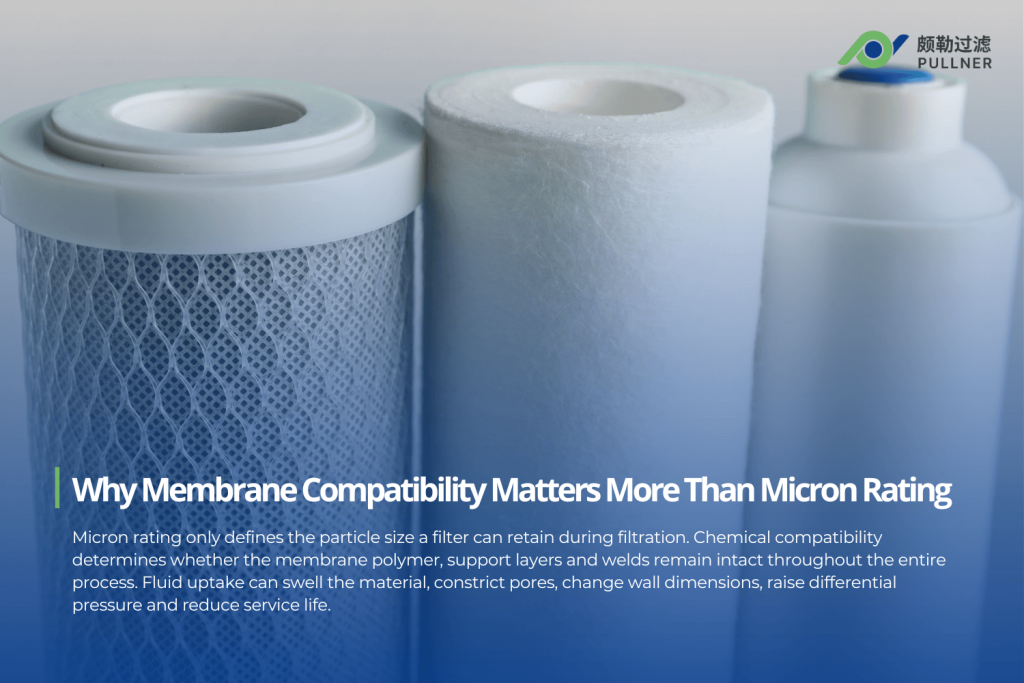
Micron rating defines the particle size a filter can retain during filtration. Chemical compatibility is a much broader success plan by determining whether the membrane polymer, support layers, and welds remain intact throughout the entire process.
Fluid uptake can swell the material, constrict pores, change wall dimensions, raise differential pressure, and reduce service life. A chemical attack can break polymer chains, weaken the structure, and create cracks that fail integrity testing.
Leaching creates a different risk. A solvent, acid, or base can pull extractables into the process solution, even when the flow still looks normal. Real compatibility depends on concentration, temperature, pH, and contact time across the full wetted assembly.
How to Read a Filter Membrane Compatibility Chart
A chemical compatibility chart assigns a membrane rating such as compatible, limited compatibility, incompatible, or no data. Each entry reflects expected filter behavior during filtration, not simple pass-fail chemistry.
Limited compatibility means the polymer can tolerate a specific chemical or solvent only within a narrow operating window. Exposure severity depends on concentration, temperature, and contact time, so a dilute solution may remain compatible during short recirculation but fail during a longer static hold.
Most published compatibility charts provide an initial reference, not a release decision. Suppliers often build chart values from short, single-phase exposures near room conditions, often at full concentration and without real differential pressure.
Engineering teams should eliminate IC pairings, then bench-test LC combinations for mass change, pore retention, and extractables. C ratings still require process verification across the full wetted material set before bulk purchase.
The Membrane Materials and Their Compatibility Profiles
Each polymer responds differently to solvent exposure, acid strength, and base attack because resin chemistry and surface energy shape fluid interaction. Buyers and specifiers who study each profile can apply the guide with greater precision and choose PES or PVDF for the application.
The table below summarizes each membrane type’s core properties and broad application fit from Pullner’s product specifications.
| Membrane Type | نطاق الأس الهيدروجيني | Surface State | Broad Compatibility Notes | التطبيقات النموذجية | Recommendation |
|---|---|---|---|---|---|
| PES | 1-14 | Hydrophilic | Broad chemical compatibility; no binders or surfactants | Aqueous, pharma, biologics, UPW, beverage | Test via a free sample for specific fluids |
| PTFE (Hydrophobic) PFL | 1-14 | Hydrophobic | Excellent corrosion, oxidation, and organic solvent resistance | Aggressive chemicals, solvents, acids | Pre-wet for aqueous use; test via free sample |
| PTFE (Hydrophilic) PFLH / CPFLH | 1-14 | Hydrophilic | Same broad resistance as hydrophobic PTFE; no pre-wetting required | Aqueous and solvent-based processes, electronics chemicals, and electroplating | Test via a free sample |
| PVDF | توافق كيميائي واسع النطاق | Hydrophobic | Extensive chemical compatibility; high temperature and oxidation resistance | Acids, alkalis, organic solvents, and biological products | Pre-wet for aqueous use; test via free sample |
| PVDFH | توافق كيميائي واسع النطاق | Hydrophilic | Same resistance as PVDF; no pre-wetting required | Biologics, vaccines, culture media, acidic pharma liquids | Test via a free sample |
| Nylon PN | Aqueous service | Hydrophilic | Naturally hydrophilic; GMP and Pharmacopoeia cleanliness standards | Aqueous, pharmaceutical preparations, process water | Test via a free sample |
| PFA | 1-14 | Hydrophilic | Perfluorinated structure; no additives or adhesives; maximum corrosion resistance at elevated temperatures | Semiconductor, microelectronics, highly corrosive acids and solvents | Purpose-built for semiconductors. Test via a free sample. |
| Glass Fiber PLGF / GFH | توافق كيميائي واسع النطاق | Depth filter | High porosity; high dirt-holding capacity; broad solvent tolerance | Pre-filtration of high-colloid, high-grease, high-particulate streams; gas vent filtration | Use upstream of sterilizing-grade membrane; test via free sample |
| PP WPP / CMPW | توافق كيميائي واسع النطاق | Slightly hydrophobic | Broad chemical compatibility in many aqueous and solvent systems; no adhesives; gradient pore structure | CMP slurry, high-solids streams, broad chemical service | Test via a free sample for specific solvents |
| PBT | Specialist | Specialty media | Withstands 120°C continuous operation; 4 bar maximum differential pressure | Aromatic hydrocarbon solvents at elevated temperatures | Specialist use only; test via free sample |
| GPF | 1-14 | Hydrophobic | Broad chemical compatibility; absolute filtration accuracy 0.003 µm; reliable in dry and wet conditions | High-efficiency gas filtration, vent filtration | Test via a free sample |
Disclaimer: Pullner recommends process-condition testing for all membrane selections. Request a free sample or contact Pullner’s technical team to confirm compatibility for your specific fluid and operating parameters.
PES: Aqueous, Biological, and High-Purity Liquid Filtration
PES is the preferred membrane for aqueous processing and biological service because it’s produced as a hydrophilic media for these applications. Binder-free construction keeps extractables low and asymmetric pores support high flux across a wide pH range.
Pharma sterilization uses PES and biologics production favors the polymer. Electronics-grade water and beverage filtration fit the material. Aggressive organic solvents can approach the limits of PES compatibility, so teams should verify exposure with supplier data and a sample.
Pullner’s line fits demanding pharmaceutical, biotech, electronics, and high-purity water applications where process stability and retention control matter. Each PES configuration addresses a distinct processing environment, enabling buyers to align membrane structure with sterilization requirements, water-purity targets, or precision slurry control.
- HFPS: Serves as a sterilizing-grade pharma and biologics platform with an asymmetric gradient pore structure.
- DHPS: A double-layer PES that withstands 50 SIP/autoclave cycles.
- ULPS: Provides low diffusion flow for critical biotech bacteria retention.
- EPS: Supports electronics-grade process water and UPW, flushed with 18 MΩ water.
- WPS: Handles UPW terminal filtration at 0.02 µm and can replace ultrafiltration.
- CMPS2: Covers CMP polishing fluid precision filtration at 0.05 to 1.2 µm.
PTFE: Broadest Chemical Resistance for Aggressive Solvents and Acids
PTFE offers among the broadest chemical resistance, as fluoropolymer chemistry resists attack from concentrated acids and many organic solvents. The membrane performs well in oxidizing service, so teams often select the product for semiconductor chemical lines and gas filtration applications.
Standard PTFE is hydrophobic, so aqueous service often needs pre-wetting before startup. That surface behavior can raise initial pressure and alter early flow through the device. Hydrophilic PTFE can overcome that wetting barrier, keep the same solvent tolerance, and remove the pre-wetting step.
Process selection depends on fluid composition and dominant phase. Buyers should recommend hydrophobic grades for solvent service, then choose hydrophilic grades when water drives the process factor.
Pullner’s PTFE line fits aggressive chemical processing and high-purity electronics applications where membrane stability and wetting behavior directly affect process control.
- PFL: Handles hydrophobic PTFE filtration for aggressive chemicals and solvents across pH 1-14.
- PFLH: Delivers hydrophilic PTFE with the same resistance and no pre-wetting required.
- GPF: Enables high-efficiency gas filtration at 0.003 µm absolute.
- CPFL: Covers electronics, chemical filtration and electroplating baths at 0.02-10 µm.
- CPFLH: Adds a hydrophilic version of CPFL for aqueous service.
- PRFF: Targets photoresist terminal filtration in semiconductor and display manufacturing at 0.02-10 µm.
- PFA: Uses a perfluorinated body without adhesives or additives for corrosive acids and solvents at elevated temperatures.
PVDF: Low Protein Adsorption with Broad Chemical Resistance
PVDF combines strong resistance to aggressive liquids with the option of low-protein-adsorption hydrophilic grades, useful when protein loss would reduce yield or shift analytical results.
Biological fluids and sensitive process streams benefit because more active product passes through the membrane instead of binding to the media. Hydrophobic PVDF resists water wetting, so startup may require additional conditioning and a higher initial pressure.
Hydrophilic PVDF wets rapidly in aqueous systems, simplifying line preparation for vaccines, culture media, and acidic pharmaceutical liquids.
Solvent exposure still needs confirmation because ester families and other reactive chemistries can change membrane response under real process conditions, so a bench sample remains a good control step.
Pullner’s PVDF line suits biological processing where both adsorption control and chemical stability matter.
- PVDF: handles hydrophobic service with extensive chemical compatibility plus high temperature and oxidation resistance.
- PVDFH: delivers a hydrophilic variant with the same chemical resistance and no pre-wetting step.
- PDF: targets low protein adsorption in culture media, biological reagents, sterile vaccines, and acidic liquids.
Nylon: Naturally Hydrophilic for Aqueous and Polar Solvent Filtration
Nylon is a hydrophilic membrane with a uniform pore structure that supports low differential pressure and stable flow in aqueous and polar solvent service. Easy wetting with water and alcohol makes the media a practical choice for process water and general liquid filtration.
Teams use nylon in pharmaceutical process water, lab filtration, and photoresist service in semiconductor manufacturing. Higher protein binding limits the recovery of valuable biomolecules, so buyers should not treat nylon as the first option for sensitive biological product streams. Bench sample checks still confirm solvent fit.
Pullner’s nylon line serves regulated aqueous processing and semiconductor photoresist applications where cleanliness standards and retention control matter.
- PN: suits sterilizing-grade filtration for aqueous and pharmaceutical process liquids under GMP and Pharmacopoeia cleanliness standards.
- PRFN: targets photoresist terminal filtration in semiconductor display manufacturing.
Glass Fiber, Polypropylene, and Specialty Materials
Glass fiber works as a depth pre-filter for high-colloid liquids and grease-laden streams, then protects the final element with broad solvent resistance and strong dirt-holding performance. Polypropylene offers broad compatibility and supports stable particle distribution in slurry service.
PBT polyester resists hot aromatic streams that can deform softer media. Teams should test before use with strong organic exposure or chloride salts because both can alter membrane behavior under process conditions.
Pullner’s specialty line supports demanding liquid and gas applications. The range fits processes where solids loading, broad chemical exposure, or elevated temperatures can exceed the practical limits of standard membrane media.
- GFH: Covers particulate gas vent filtration.
- WPP: Uses all-polypropylene winding with high dirt-holding capacity and broad compatibility.
- CMPW: Controls CMP slurry filtration by intercepting oversized particles without fiber shedding.
- PBT: Targets aromatic hydrocarbon filtration at 120°C with 4 bar maximum differential pressure.
How to Apply the Filter Membrane Compatibility Chart to Your Process Fluid
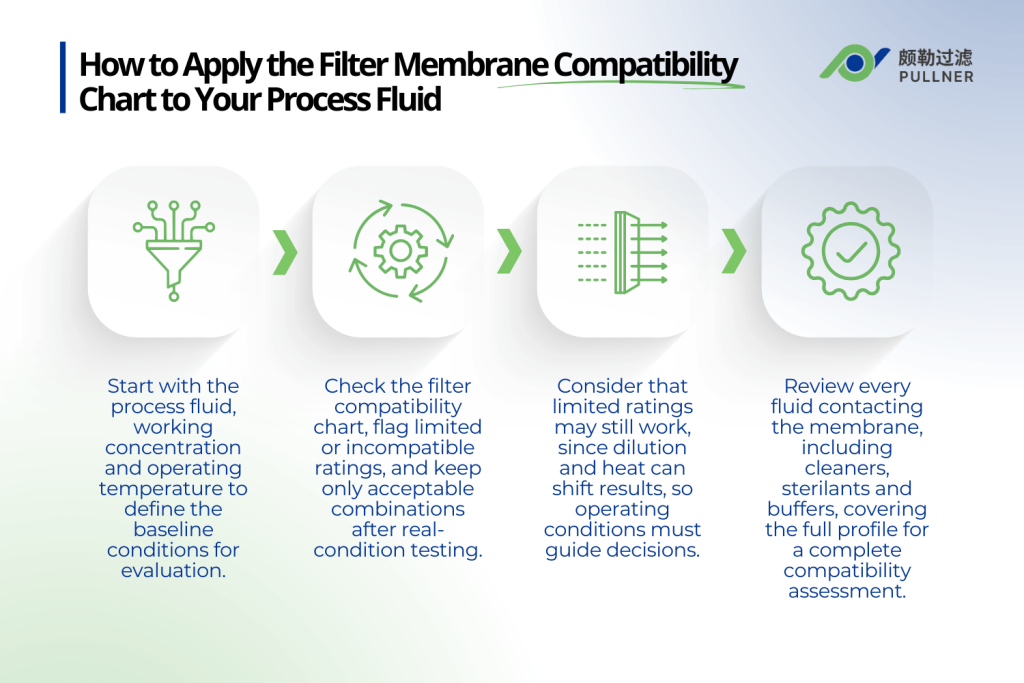
Start with the process fluid, working concentration, and operating temperature. Then check the filter compatibility chart for the selected membrane, flag any limited or incompatible ratings, and treat only acceptable combinations as candidates after real-condition testing.
A limited rating does not always rule out use. Many data sets on filter compatibility come from full-strength solvent exposure at room temperature, so diluted service conditions can shift the results. Heat can change membrane behavior, so operating conditions must guide the decision.
Review every fluid that reaches the membrane, including cleaners, sterilants, and buffers. A sound compatibility filter review should cover the full contact profile, especially when PES membrane compatibility is part of the selection.
Seal, End Cap, and Housing Compatibility
Membrane selection covers only one wetted surface inside a cartridge. Process fluid contacts gaskets, end caps, O-rings, and the housing body, so chemical fit depends on the full assembly.
Silicone suits many sanitary systems and EPDM often fits water-based chemicals. BUNA-N and Viton serve different oil or solvent conditions, so seal choice must follow fluid chemistry, temperature, and exposure time. End cap and core construction must match the membrane specification to avoid a mismatch at the cartridge structure.
Pullner uses adhesive-free thermal welding throughout, so adhesive chemistry does not enter the compatibility decision. Standard builds use thermally welded polypropylene. Higher-temperature service can use PVDF and Nylon end caps are available for selected requirements.
Pullner offers the following connection and housing options.
- Connection styles: Pullner offers DOE, 222 O-ring, 222 Fin, 226 O-ring, and 226 Fin configurations to match the housing and prevent bypass.
- Housing compatibility: Pullner cartridges replace standard Pall, Cuno/3M, Sartorius, Millipore, and Meissner housings in 63 mm, 83 mm and 130 mm outer diameter sizes.
When the Compatibility Chart Isn’t Enough: Test Before You Commit
A filter compatibility chart reflects controlled solvent tests under standard conditions. Real processes add concentration shifts, heat, contact time, and cleaning chemistry, so charts alone can’t predict every effect in production.
A proper compatibility filter trial should confirm stable dimensions, intact seals, low extractables, and flow behavior that matches the pre-exposure baseline. Teams should test before full purchase when the process risk is high.
With 20+ years in industrial filtration and 4,000+ membrane elements produced daily across 30+ production lines, مرشح بولنر supports teams from selection through validation by providing free samples, with customers covering shipping.
Every cartridge passes a 100% integrity test before delivery and UPW units arrive flushed with 18 MΩ water. Their in-house ISO 9001-certified lab supports compatibility evaluation with PMI pore size analysis, SEM verification, and ICP-MS testing – providing documentation beyond what most suppliers can offer.
الاتصال بفلتر بولنر to review your process conditions and confirm the right cartridge for your system.
Filter Membrane Compatibility Chart FAQs
What is the most chemically resistant filter membrane?
PTFE offers the broadest chemical resistance across acids, solvents, and oxidizing agents. PVDF provides strong resistance and adds a lower-binding surface for protein-sensitive applications.
Can one membrane handle aqueous and solvent-based fluids?
Hydrophilic PTFE and hydrophilic PVDF can handle both aqueous and solvent-based fluids without pre-wetting. Hydrophobic versions require pre-wetting for water-based service, adding an extra process step.
How does temperature affect compatibility?
Most compatibility data comes from 68 to 77°F testing. Higher temperatures accelerate chemical interactions and can change membrane behavior.
Which membranes have the lowest extractables?
Extractables can contaminate the filtrate or affect analytical results. PTFE, PVDF, and PES constructions without binders or surfactants produce the lowest extractables.
العودة إلى الأعلى Filter Membrane Compatibility Chart: Selecting the Right Membrane
 English
  Spanish
  Arabic