
In industrial filtration systems, teams often use filter elements and filter cartridges interchangeably, which creates confusion during specification and purchasing.
The perceived difference between the terms rarely reflects a functional change, since a cartridge filter describes the same replaceable unit installed inside a housing. However, in oil processing applications, selecting the wrong filter can disrupt flow and contaminate oil streams.
Procurement teams must confirm the correct type, dimensions, and housing material before they replace a worn cartridge. Clear terminology reduces errors, prevents delays, and supports consistent filtration performance across industrial operations.
What Is a Filter Cartridge?
A filter cartridge is a replaceable cylindrical insert designed to capture contaminants within an industrial housing. The cartridge holds the active filter element, which performs the actual filtration as fluid passes through the media. Maintenance teams remove the used unit and replace it without discarding the outer vessel. This approach lowers operating costs and reduces material waste.
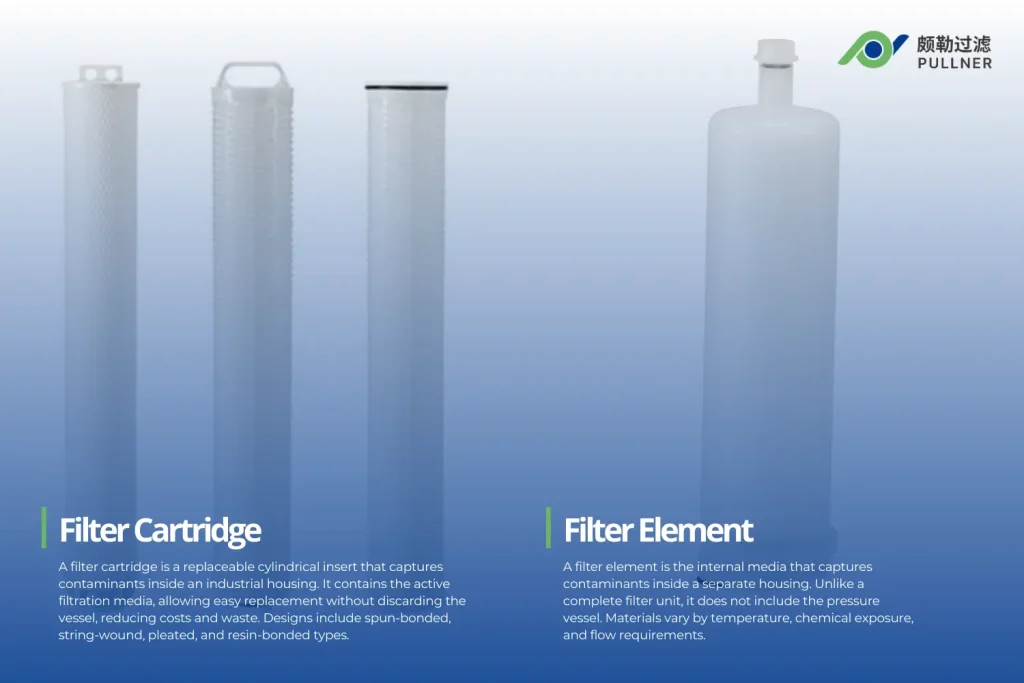
Each cartridge filter is designed for a specific application, including oil processing systems. Common construction material options include spun-bonded, string-wound, pleated, and resin-bonded designs.
What Is a Filter Element?
A filter element refers only to the internal media that captures contaminants as fluid moves through a housing.
The element fits inside a separate vessel that directs flow and maintains pressure. Procurement teams must understand the difference between filter element assemblies and complete filter units before placing orders.
Manufacturers produce filter elements from different materials based on temperature, chemical exposure, and flow rate. Industrial systems, whole-house filters, and high-volume liquid processing lines each require a specific configuration.
Buyers can often identify a filter element by its cylindrical core and exposed media surface. Still, the presence or absence of an outer pressure casing depends on the manufacturer and design.
Filter Element vs. Filter Cartridge: How They Work
Process fluid enters the housing and moves radially through the installed element under controlled pressure. As the stream contacts the filter media, the structure captures each particle that exceeds the rated micron threshold.
Surface designs retain contaminants on the media’s outer layer. Depth configurations hold each particle within internal pores as fluid advances through the matrix. As solids accumulate within the filter media, the differential pressure across the assembly increases.
Maintenance teams monitor the pressure rise to evaluate loading conditions. When the measured pressure reaches the specified limit, operators schedule replacement to maintain the flow rate and protect downstream equipment.
Differences at a Glance: Cartridge vs. Element
In most industrial systems, both components function as replaceable inserts and do not include the pressure housing.
In some product lines, cartridges use polymer media formed into spun or wound cylinders, while elements may include reinforced cores and sealed end caps for higher pressure ratings. Exact construction details vary by manufacturer and application. In practice, this means a polymer cartridge that performs reliably in standard water filtration may not be the right choice for a high-temperature or chemically aggressive process, where a reinforced element with sealed end caps is the safer specification.
Construction details influence service life and cleaning options. Appearance and handling characteristics also vary. Many cartridges appear as smooth white or gray cylinders with fine pleats or wrapped fibers, while some elements exhibit deeper pleats, wire-mesh backing, or sintered metallic surfaces. Weight and rigidity also vary, so appearance and feel should not be the only way to distinguish between the two.
Pullner’s خراطيش تصفية الفولاذ المقاوم للصدأ, for example, use reinforced metallic construction rated for high differential pressures and corrosive media — making them a practical choice when polymer cartridges have reached their operational limits. For high-volume liquid processing, the PHF Series High Flow Filter Cartridge handles flow rates exceeding 60 m³/h per 40″ element, with thermally welded connections that eliminate adhesive contamination risk. Buyers working in oil processing, power generation, or chemical applications can request free samples to evaluate compatibility before committing to a replacement program.
Service procedures remain consistent across both formats. Technicians open the housing, remove the used insert, and install a compatible replacement with double-open-end or single-open-end fittings. In practice, this means that switching between a cartridge and an element from a different supplier is procedurally straightforward — provided the dimensions, end cap style, and O-ring seal dimensions have been confirmed in advance. Both inserts are consumable media products, while the housing remains a reusable capital asset within the filtration system.
Matching the Right Filter to Your Setup
Select the correct configuration by confirming housing specifications, operating limits, and contaminant profile before ordering a replacement insert.
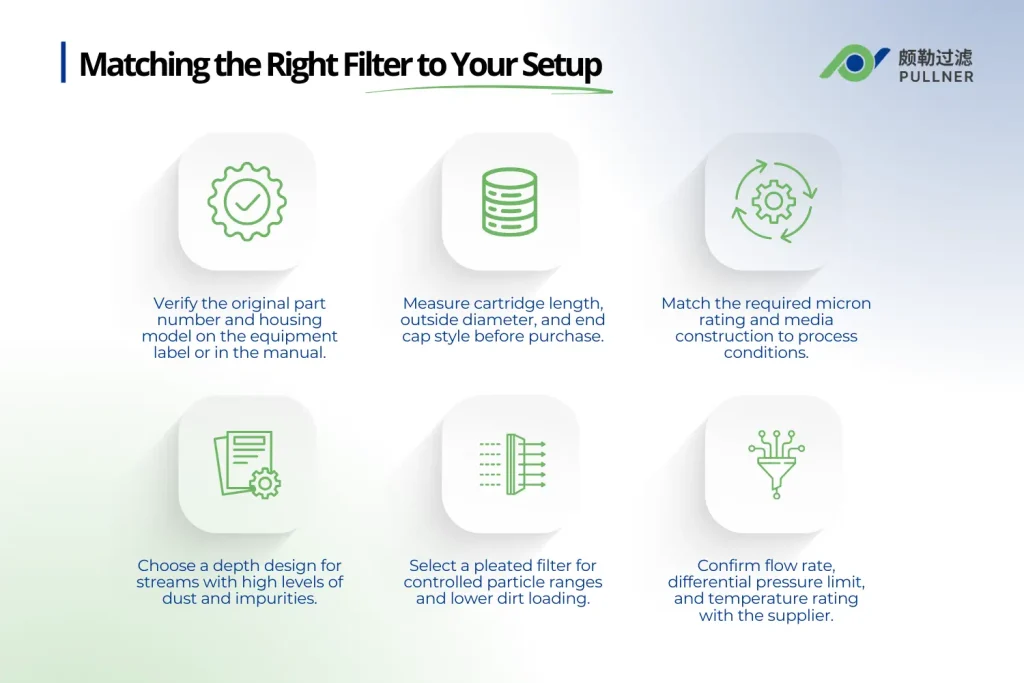
- Verify the original part number and housing model on the equipment label or in the manual.
- Measure cartridge length, outside diameter, and end cap style before purchase.
- Match the required micron rating and media construction to process conditions.
- Choose a depth design for streams with high levels of dust and impurities.
- Select a pleated filter for controlled particle ranges and lower dirt loading.
- Confirm flow rate, differential pressure limit, and temperature rating with the supplier.
Misaligned part numbers or incorrect dimensional assumptions increase replacement delays and raise operating costs. A clear understanding of how suppliers define each insert supports accurate procurement and stable process performance.
Pullner Filter’s engineering team works with buyers to confirm housing compatibility, media selection, and pressure ratings before any order is placed – at no cost. Moreover, Pullner Filter offers up to two free samples for evaluation, with ISO 9001-certified manufacturing and full test documentation available upon request.
Contact Pullner Filter to discuss your housing details and confirm the correct insert configuration for your system.
Filter Element vs. Filter Cartridge FAQs
Can you mix brands in the same housing?
Do not mix brands unless the length, outside diameter, end cap style, and O-ring seal dimensions match exactly. Even minor dimensional variance can create bypass gaps inside the vessel. A mismatch may cause leakage or uneven flow distribution. Confirm tolerances against the housing specification before installation.
What is the typical shelf life for spare inserts?
Many spare units maintain integrity for roughly 2 to 5 years when stored in cool, dry, and dark conditions below 60% relative humidity, but actual shelf life depends on the media and manufacturer. Exposure to heat or ultraviolet light can degrade polymer media and elastomer seals. Always follow the manufacturer’s labeled storage limits and expiration date.
How do you verify a spare insert is still fit for use before installation?
Inspect the outer packaging for damage, discolouration, or a compromised seal before opening. Once unwrapped, check end cap integrity, O-ring condition, and media surface for deformation or contamination. If the unit has been stored beyond the manufacturer’s recommended period or under uncertain conditions, do not install it without testing it first. Pullner Filter provides material compatibility testing and filtration performance verification as part of its pre-order and evaluation support; buyers can request test documentation or submit a sample for lab assessment before committing to a full replacement batch.
Does terminology affect compliance or audits?
Regulators focus on documented material certifications rather than naming conventions. Audit reviews examine compliance with standards such as Food and Drug Administration requirements, NSF International guidelines, and United States Pharmacopeia Class VI testing, where applicable. Inspectors verify traceability, pressure ratings, and chemical compatibility. The label cartridge or element does not affect regulatory acceptance.
When should you upgrade to cleanable elements?
Consider upgrading when contaminant loading exceeds 4 replacements per year, as a general benchmark. A total cost of ownership analysis can identify payback within 12 months. Cleanable designs reduce recurring media purchases in high-solids applications. Confirm compatibility with process temperature and chemistry before conversion.
Do elements handle higher differential pressure?
Reinforced cores and rigid construction support higher collapse ratings in many designs. Cleanable metal elements are often rated for differential pressures on the order of 50 to 100 psi. In comparison, many standard polymer cartridges fall in roughly the 20 to 35 pounds per square inch range. Verify the manufacturer’s test data before selecting a higher-pressure configuration.
العودة إلى الأعلى عنصر الفلتر مقابل خرطوشة الفلتر: فهم الفرق بينهما
 English
  Spanish
  Arabic