
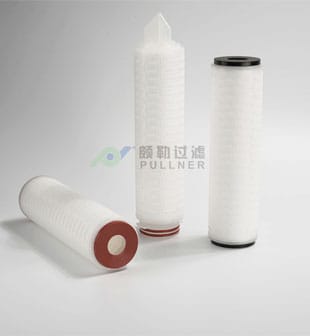

Cartucho de filtro de agua plegado de PP
A pleated cartridge rarely fails through its media. It fails at a pinhole in a pleat fold or an incomplete seam weld, and both of those pass a visual inspection without comment. The plant that receives one finds out weeks later, as an unexplained particle count downstream with no obvious cause.
Pullner tests every PPL element for integrity before it ships. Not a sample from the batch — every element, in a cleanroom, with the record available on request. The cartridge itself is pleated polypropylene in ten grades from 0.1 to 100 µm, on a 2.7″ (69 mm) body in 10″, 20″, 30″ and 40″ lengths.
- Clasificación Micron
- 0.1–100 µm
- Caudal
- 1–5 GPM per 10"
- Temperatura máxima
- 80°C
- SKU
- PPL
- Integrity tested per element, not per batch
- Cleanroom assembly throughout
- Ten grades from 0.1 to 100 µm on one construction
- DOE and SOE end caps — 226 and 222, fin or flat
- Four seal materials — Silicone, NBR, Viton, EPDM
- Four lengths — 10", 20", 30", 40"
- ISO 9001 with batch documentation on request
| Serie | PPL |
| Medio filtrante | Polypropylene, pleated |
| Micron rating | 0.1 · 0.22 · 0.45 · 1 · 3 · 5 · 10 · 20 · 50 · 100 µm |
| Outer diameter | 2.7" (69 mm) |
| Length options | 10" · 20" · 30" · 40" |
| Tapa | DOE · SOE (226 fin, 226 flat, 222 fin, 222 flat) |
| O-ring / gasket | Silicone · NBR · Viton · EPDM |
| Flow rate | 1–5 GPM per 10" element (suggested) |
| Max. differential pressure | 2.5 bar |
| Max. temperature | 80 °C · continuous duty below 60 °C |
| Certificaciones | Cleanroom production · integrity tested per element · ISO 9001 |
| Minimum order | 25 pieces |
| Lead time | 7 working days |
- Prefiltración por ósmosis inversa: membrane protection ahead of the skid.
- Process water: particle control on treated water loops.
- Fine chemical: clarification and polishing duty.
- Final filtration: the 0.22 and 0.45 µm grades on validated lines.
Integrity testing is the difference between a cartridge that is rated and a cartridge that is verified. A bubble point or diffusion test applies a controlled gas pressure to a wetted element and measures what passes. A pinhole shows up immediately. A sound element does not.
Most manufacturers test a sample from each batch. Pullner tests each element, records the result, and will supply those records on request. For a validated process that record is usually what the quality team needs before a supplier change is signed off, and it is the point at which most alternative suppliers cannot follow.
Ask for the integrity records with the sample rather than after it. It shortens the qualification by a cycle.
The cartridge is rated to 80 °C. Continuous duty should sit below 60 °C.
That gap is not caution for its own sake. Polypropylene softens as it approaches its ceiling, and a pleat pack that relaxes under load loses effective surface area before it loses integrity. The symptom is a cartridge that seems to reach change-out pressure early and inconsistently, which is easy to misread as a dirty feed.
If the process genuinely runs hot and continuous, specify polyester or glass fibre instead. Both hold their geometry where PP starts to give.
Ten grades: 0.1, 0.22, 0.45, 1, 3, 5, 10, 20, 50 and 100 µm. The 0.22 and 0.45 µm grades are specified for final filtration. Everything from 1 to 20 µm does the bulk of the work as prefiltration ahead of membranes.
End caps are DOE, or SOE in 226 and 222 patterns, fin or flat. Seals are Silicone, NBR, Viton or EPDM. Confirm the seal against the fluid separately from the element — on aggressive chemistry the seal is frequently the lower-rated of the two.
Up to two samples ship worldwide free of charge, with freight paid by the customer.
 English
  Spanish
  Arabic