
Plant engineers specifying a filter housing often discover that two vessels with identical port sizes and pressure ratings behave completely differently in service. This is because the material, configuration, and seal weren’t matched to the actual process.
How to choose a filter housing correctly starts with screening process chemistry against wetted materials, then using temperature and pressure to set the design limits. Get either step wrong, and the consequences show up in ways external inspection won’t catch early: incompatible metal pits around closures from the inside out, and pressure surges distort sealing surfaces enough to cause bypass before anyone notices.
After material selection, match bag or cartridge construction to the contaminant profile and required filtration duty. Design flow and clean differential pressure set the required element area, and available floor space determines whether a single-round vessel or a multi-round arrangement is the practical fit. Finally, align the connection geometry with existing pipework, confirm gasket chemistry against the process stream, and apply the vessel code that completes the specification before procurement releases the order.
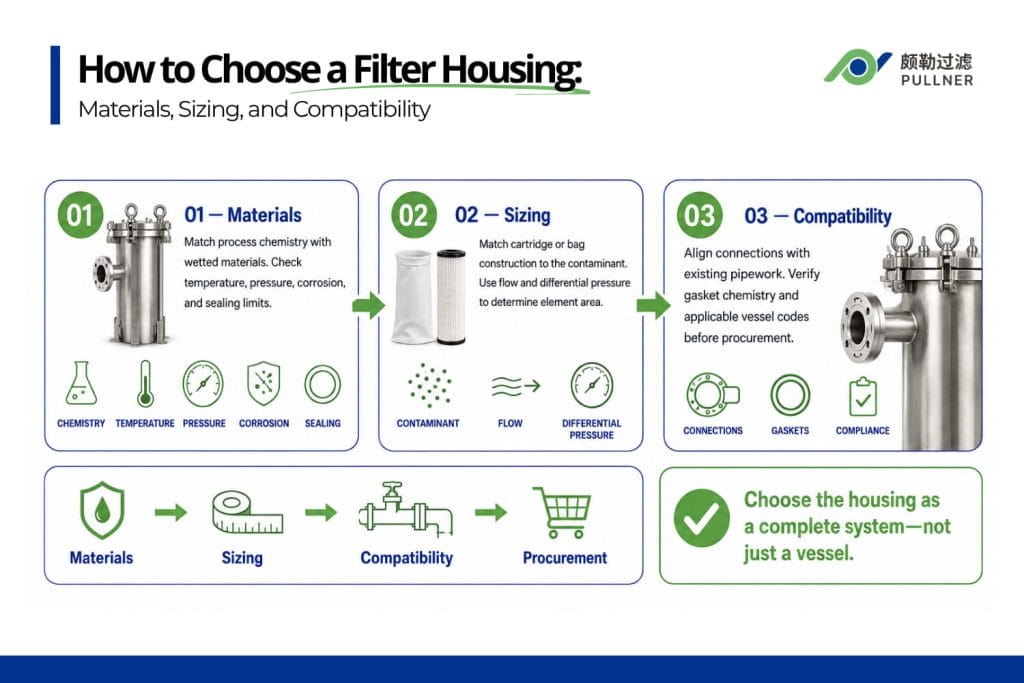
Filter Housing Selection Decision Table
Check the process fluid first – its chemistry determines which housing materials resist corrosion. Then use operating temperature and pressure to set the vessel limits before calculating housing size and element count from the required flow. Connection type, gasket material, and code requirements complete the specification.
| Selection Factor | Information Required | Specification Decision |
|---|---|---|
| Process medium | Fluid name, concentration, pH, and cleaning chemicals | Compatible wetted materials |
| Operating limits | Maximum temperature, working pressure, and credible pressure surge | Design temperature and pressure class |
| Filter style | Contaminant size, solids concentration, and required retention efficiency | Bag or cartridge housing |
| Hydraulic duty | Maximum flow, viscosity, and allowable clean differential pressure | Required filtration area |
| Configuration | Element capacity, service clearance, and available footprint | Single-round or multi-round housing |
| Conexiones | Pipe size, joint standard and required bore | Flanged, tri-clamp or threaded ports |
| Seals | Fluid chemistry, cleaning exposure and temperature range | Compatible gasket compound |
| Vessel code | Installation location and owner specification | Code basis and certification mark |
Record the measured operating value behind every decision in this table – a catalog rating alone doesn’t confirm suitability. Process temperature and chemical concentration need to stay within the conditions the published rating was tested under.
Why Does the Correct Filter Housing Matter?
The right housing maintains pressure containment and directs the full process stream through the filter media. Get the geometry, area, or material wrong, and the failure shows up before differential pressure ever flags a problem.
Housing geometry controls bypass
Internal sealing surfaces have to hold the cartridge end cap firmly against its adapter—a dimensional mismatch opens a path around the media, and fluid reaches the outlet without passing through it.
Double-open-end cartridges seal by axial compression at both ends, with springs, seats, gaskets, and hold-down parts specific to the housing design; Code 222/226 cartridges instead rely on O-rings and adapter geometry. The drawing needs to specify the complete interface, not just cartridge length.
Element area controls pressure loss
Insufficient filter area forces more fluid through each section of media, raising clean differential pressure from the first operating cycle and pulling more pump head than necessary. Once solids accumulate, the restricted area reaches terminal differential pressure sooner—the plant replaces cartridges more often even when the media itself has adequate dirt capacity at its rated flow.
Process conditions control vessel life
Chemical exposure attacks the shell fastest at welds and gasket channels where liquid pools after draining—chlorides create localized pits that penetrate deep with little surface rust to show for it.
Molybdenum gives 316L stronger resistance to chloride-driven pitting than 304, though elevated temperatures raise the same risk, particularly where deposits or stagnant liquid concentrate salts against the surface.
Normal operating pressure won’t represent every load the vessel sees—pump deadhead and a blocked outlet can trap the full upstream load inside the shell.
How Should Process Chemistry Determine the Housing Material?
Base the material choice on every fluid that contacts the vessel during production or cleaning, with concentration and temperature noted beside each one—both change corrosion behavior.
When SS316 and 316L fit the process
Specify SS316 or 316L when the process needs cleanable metal surfaces and the chemistry remains within the alloy’s verified resistance range. Common uses include compatible industrial-water duties and process liquids requiring a corrosion-resistant cartridge vessel.
Molybdenum improves resistance to localized chloride attack. The lower carbon content in 316L reduces the risk of sensitization after welding, which lowers susceptibility to intergranular corrosion in heat-affected zones. Unsuitable heat exposure or fabrication conditions can still sensitize 316L.
Bulk-fluid analysis still can’t represent every internal surface. Liquid trapped beneath a gasket can lose water during shutdown, raising the local salt concentration above the value measured in the main process stream.
The stainless steel review should document these conditions:
- Chloride concentration: Use the highest verified result rather than the normal average.
- Cleaning chemistry: Include chemical strength and contact time for each wash cycle.
- Operating temperature: Check production and cleaning conditions separately.
- Drainage condition: Identify low points or seal grooves that retain liquid.
When FRP fits the process
Choose fiber-reinforced plastic (FRP) for compatible membrane systems where saline water or aggressive chemistry makes metal corrosion a concern. Pullner’s Carcasas de membrana FRP contain spiral-wound reverse osmosis elements used in pressurized industrial-water treatment.
FRP suitability depends on the resin system and fiber construction rather than the general material name. Feed chemistry may remain compatible with one resin but attack another, especially when elevated temperatures increase chemical activity.
FRP membrane housings serve a different function from stainless steel cartridge vessels. The composite shell contains reverse osmosis, nanofiltration, or ultrafiltration membrane elements rather than standard particle-removal cartridges.
When carbon steel fits the process
Consider carbon steel only for compatible, noncorrosive industrial service where the project specification confirms the required corrosion allowance. The same specification must define the coating or lining system and inspection method. Pressure-vessel design requirements need separate confirmation.
A coating defect exposes a small steel area beneath a larger protected surface, concentrating corrosion at the damaged point. Inspection access and lining-repair procedures therefore belong in the original specification rather than the maintenance plan alone.
Carbon steel represents a general housing-material option rather than a confirmed Pullner product. Pullner’s supplied product information confirms in-house stainless steel and FRP housing production.
During the filter housing material review, record fluid concentration and exposure time beside each chemical. Include the highest temperature and cleaning frequency before procurement compares construction options.
When Should You Use a Single-Round or Multi-Round Housing?
Use a single-round housing when one cartridge carries the design flow within the allowable clean differential pressure. Use a multi-round housing when the flow needs multiple cartridges sharing the load inside one vessel.
When a single-round housing fits
Single-round housings suit lower-flow duties and tighter floor space, though high-flow single-cartridge formats handle far more throughput than standard formats—larger elements cut vessel count and footprint when one cartridge meets the required flow. Fewer cartridges also means fewer internal seals, but the installation still needs enough vertical clearance to withdraw the element without fouling nearby equipment.
When a multi-round housing fits
Multi-round housings divide process flow across more media area in parallel, inside one shell. Element count has to come from tested pressure-drop data for the specific cartridge—dividing a catalog water-flow value into the process rate can understate resistance if the actual fluid is more viscous.
A single vs. multi-cartridge housing review should compare these operating factors:
- Element flow: Confirm each cartridge remains below its recommended hydraulic limit.
- Changeout interval: Estimate solids loading across the media area.
- Service labor: Count the cartridges removed during each shutdown.
- Installation space: Include shell diameter and vertical withdrawal clearance.
- Piping requirement: Include isolation valves and manifold branches for parallel vessels.
When parallel housings support continuous production
Parallel housings are a separate architecture—isolation valves let one full vessel go offline for element replacement while a second keeps carrying flow for processes that can’t stop for changeout. It costs more pipework than a single multi-round vessel, and the manifold has to divide flow evenly, or a lower-resistance branch overloads one housing first.
When Should You Choose a Bag or Cartridge Housing?
Choose a bag housing for high solids loading, economical changeout, and coarse-to-intermediate filtration. Choose a cartridge housing where retention efficiency or a cleanliness target makes cartridge media the better fit.
When a bag housing fits
A bag housing directs unfiltered liquid into supported media, with a perforated basket preventing the bag from stretching toward the outlet as differential pressure rises. Bag systems support relatively fine ratings when the media provides the required retention, and their larger solids capacity often suits high-volume duties where economical changeout matters more than format.
Bag size sets the available media area and capacity—compressible contaminants can cake against the surface and raise pressure loss before the bag reaches its apparent volume limit.
When a cartridge housing fits
A cartridge housing holds cylindrical depth or pleated elements. Pleated media packs a substantial area into a limited shell diameter (the exact area depends on the element chosen), while depth media captures particles through the thickness of its structure—a good fit for streams with a range of particle sizes when tested efficiency meets the outlet requirement.
Equal micron labels don’t mean equal performance between bag and cartridge media; compare test methods and efficiency at the actual flow rate, since particle loading and viscosity affect how fast a cartridge reaches terminal differential pressure regardless of its rated cleanliness.
Pullner’s stainless steel filter housings support industrial cartridge configurations – the vessel spec needs element length, diameter, and end-cap design confirmed up front.
Which Connections and Gaskets Should You Specify?
Match the connection to the installed pipe standard and required flow area, then choose the gasket from compatibility data covering both the process stream and cleaning fluids.
When flanged connections fit
Flanged ports suit larger pipe sizes and bolted-joint systems—the flange class has to support design pressure at maximum temperature, since pressure capacity drops as metal heats up, and both mating flanges need the same dimensional standard and facing type to compress the gasket evenly.
When tri-clamp connections fit
Tri-clamp connections suit sanitary systems needing quick disassembly, typically to ISO 2852 dimensions. The clamp and ferrules form part of the pressure boundary, so their rating has to cover the vessel’s design condition—normal production pressure alone won’t confirm the assembly handles an upset.
When threaded connections fit
Threaded (NPT) ports suit smaller lines where the piping standard permits tapered threads. Thread sealant fills the clearance between mating surfaces, so its chemical and temperature limits often end up controlling joint performance. NPT ratings vary by size and temperature, and the sealing method can lower the usable rating below the fitting’s metal capacity.
How gasket compounds differ
Choose the gasket after reviewing the complete fluid list because production chemistry and cleaning solutions can affect the same compound differently. Concentration and exposure duration must be considered alongside pressure and temperature.
Common gasket options include:
- EPDM: Choose it for compatible water-based fluids, but verify every petroleum exposure because oils can damage the compound.
- FKM (Viton®): Choose it for compatible oils, fuels, or solvents and elevated-temperature service, subject to compound-specific confirmation.
- Silicone: Choose it for compatible static seals, but limit repeated abrasion because closure movement can damage its softer surface.
Confirm the final compound against chemical compatibility data. A generic material name can’t confirm compatibility without the actual concentration and exposure duration.
How Should Flow and Differential Pressure Determine Housing Size?
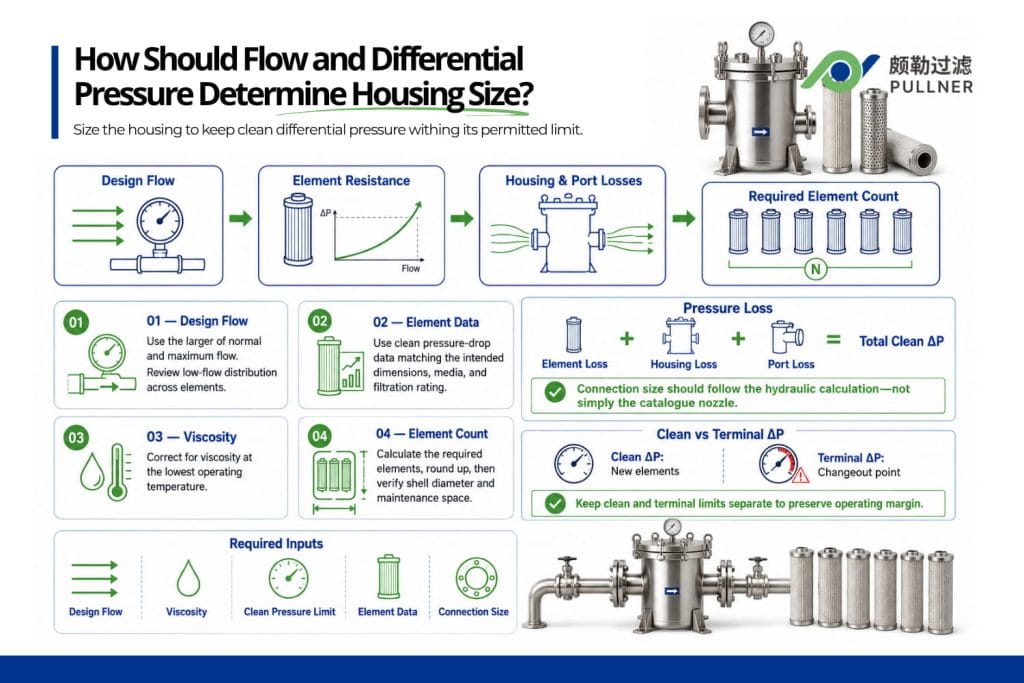
Size the housing by dividing design flow across enough elements to stay within the permitted clean differential pressure, then add the pressure losses from ports and the internal flow path.
Calculate the required element area
Begin with normal and maximum process flow, using the larger value to calculate capacity. The lower operating point still needs review because a large housing may distribute reduced flow unevenly across several elements.
Obtain clean pressure-drop data for the proposed cartridge or bag. The test must reflect the intended dimensions and filtration rating because tighter media can create more resistance at the same flow.
Correct the result for process viscosity at the lowest operating temperature. As liquid becomes more viscous, it requires greater pressure to pass through the same media at an unchanged rate.
Calculate the element count from the flow each unit can carry within the clean-pressure limit. Round the result upward, then check whether the resulting shell diameter fits the installation and maintenance area.
Include housing and connection losses
Clean differential pressure includes resistance through the new media and vessel. Fluid changes direction as it enters the shell and moves toward the filter surface, creating losses before contaminants begin loading the element.
An undersized port can control total pressure loss even when the vessel contains ample media area. For this reason, connection size should follow the hydraulic calculation rather than the standard nozzle offered on a catalog model.
Separate clean and terminal differential pressures.
Clean differential pressure measures resistance through a housing fitted with new elements. By comparison, the terminal setting marks the replacement point after contaminant loading restricts flow.
Treating both limits as one value removes the operating margin needed for a useful filter life. The elements may reach the changeout setting soon after startup because the clean assembly already consumes most available pump heads.
The hydraulic calculation for how to choose a filter housing requires these inputs:
- Design flow: Include normal and maximum operating values.
- Fluid viscosity: State the temperature used for the viscosity value.
- Clean pressure limit: Separate it from the terminal changeout setting.
- Element data: Identify the media type and filtration rating.
- Connection size: Include the existing pipe standard and bore.
What Pressure and Temperature Ratings Should the Housing Have?
Choose ratings that cover the maximum credible internal pressure at the highest design temperature. The lowest-rated pressure-boundary component or assembly element controls the final operating limit.
The rating review must include the shell and closure, followed by the ports and joining hardware. Fasteners and gaskets require separate checks, as do the applicable cartridge or end-cap interface. A gasket may set the temperature or chemical-compatibility limit without controlling the complete pressure rating.
Set the design pressure
Normal pump discharge can’t represent every load because pressure can rise when flow stops against a closed path. Pump deadhead and a blocked outlet must enter the calculation when the process can create either condition.
Match maximum flow with the maximum operating pressure before choosing a housing range. Add credible surge pressure from rapid valve movement when the piping system can produce it.
Set the design temperature
Use the highest temperature produced during operation or cleaning. A hot wash may control the rating even when the normal production stream remains cool.
Metal shells can tolerate more heat than their elastomer seals, making the gasket the controlling component in some assemblies. Clamp hardware and connection seals need the same temperature check before the vessel receives its final rating.
When Do You Need an ASME Filter Housing?
Specify an ASME filter housing when the jurisdiction, project requirement, customer specification, or insurer calls for code-stamped construction.
ASME Boiler and Pressure Vessel Code Section VIII, Division 1, applies to pressure vessels above 15 psig within its scope, though local laws and exemptions still determine whether a code-stamped vessel is mandatory for a given installation.
Confirm the requirement before fabrication
The manufacturer needs the design pressure and temperature before completing vessel calculations. Material specifications and welding procedures must follow the selected code edition from the start of production.
A vessel designed with ASME methods doesn’t automatically carry a certification mark. Code stamping requires an authorized manufacturer and the inspection steps assigned to the requested scope.
The purchase specification for an ASME filter housing should include:
- Design pressure: Use the maximum pressure selected for vessel calculations.
- Design temperature: Include the hottest production or cleaning condition.
- Process medium: Identify any corrosion allowance required by the service.
- Code edition: Name the edition required by the project.
- Certification mark: Specify the mark required by the jurisdiction or owner.
Get a Quote or Speak to an Engineer
Send Pullner the process-fluid composition and concentration range, the design flow and allowable clean differential pressure, and the maximum pressure and temperature used for the vessel rating.
Pullner manufactures industrial filter housing systems in stainless steel and FRP. In-house production means one engineering review covers material choice and vessel configuration, with batch-level records maintaining traceability through manufacturing.
Include the cartridge or bag dimensions and installed connection standard in your inquiry, along with the selected gasket compound and any required pressure-vessel code, so that we can choose the best filter housing for your project requirements.
How to Choose a Filter Housing FAQs
What are the signs of a bad filter housing?
Leaks around the closure, ports, or drain mean the housing can no longer hold a reliable seal—damaged threads or uneven clamp engagement causes the same problem. Pitting or rust inside the shell signals corrosion worth investigating; cracks or permanent deformation need immediate review. Unexpected downstream contamination or a sudden pressure change after installing a verified element usually points to a bypass, blocked flow paths, or incorrect cartridge seating.
What is the difference between a bag filter housing and a cartridge filter housing?
A bag housing collects solids inside supported media and suits heavier contaminant loading or economical changeout. A cartridge vessel supports depth or pleated elements when the required micron rating or retention efficiency makes cartridge media the better fit.
How do I size a filter housing for flow rate?
Divide the maximum design flow across enough elements to stay below the allowable clean differential pressure, then correct the element data for fluid viscosity before adding losses through the vessel and connections. Record flow and clean pressure loss together; either value alone can produce an undersized vessel.
When do I need a single-cartridge versus multi-cartridge filter housing?
Use single-round when one cartridge meets the design flow within the clean pressure limit and multi-round when multiple cartridges need to divide the hydraulic load inside one vessel. Factor in service clearance and changeout labor either way; parallel vessels are a separate architecture used for redundancy or uninterrupted operation.
What pressure rating should a filter housing have?
Enough to exceed the maximum credible internal pressure at the design temperature, including pump deadhead and blocked-outlet pressure where either can occur. The shell rating alone doesn’t confirm the completed vessel rating—closures, ports, clamps, fasteners, and seals all need their own check against the same conditions.
When is an ASME-certified filter housing required?
When the jurisdiction, project requirement, customer specification, or insurer calls for it. ASME Section VIII, Division 1 covers pressure vessels above 15 psig within its scope, though local legal requirements and exemptions still determine whether certification is mandatory for a specific installation.
Which gasket material is compatible with my process fluid?
Select the gasket from compound-specific data for the fluid’s concentration and maximum temperature, checking production chemistry and cleaning solutions separately since either can control seal life. EPDM suits are compatible with water-based services, FKM (Viton®) suits are compatible with oils or fuels, and silicone supports compatible static sealing across a broad temperature range.
Back to Top : How to Choose a Filter Housing: Materials, Sizing, and Compatibility
 English
  Spanish
  Arabic