
Choosing an industrial filter supplier is a due-diligence exercise, not a quick comparison of spec sheets—and the risk usually surfaces months later, when a poorly vetted supplier’s certification turns out not to cover the factory that actually built the order. Buyers evaluating filter suppliers need a structured way to separate documented quality controls and verified technical capability from marketing claims.
Certification provides the management baseline, but laboratory records show whether stated performance actually rests on measured results, not assumptions. Production data then indicates whether the factory can supply the required volume within the agreed schedule.
Certification and Quality Systems to Verify
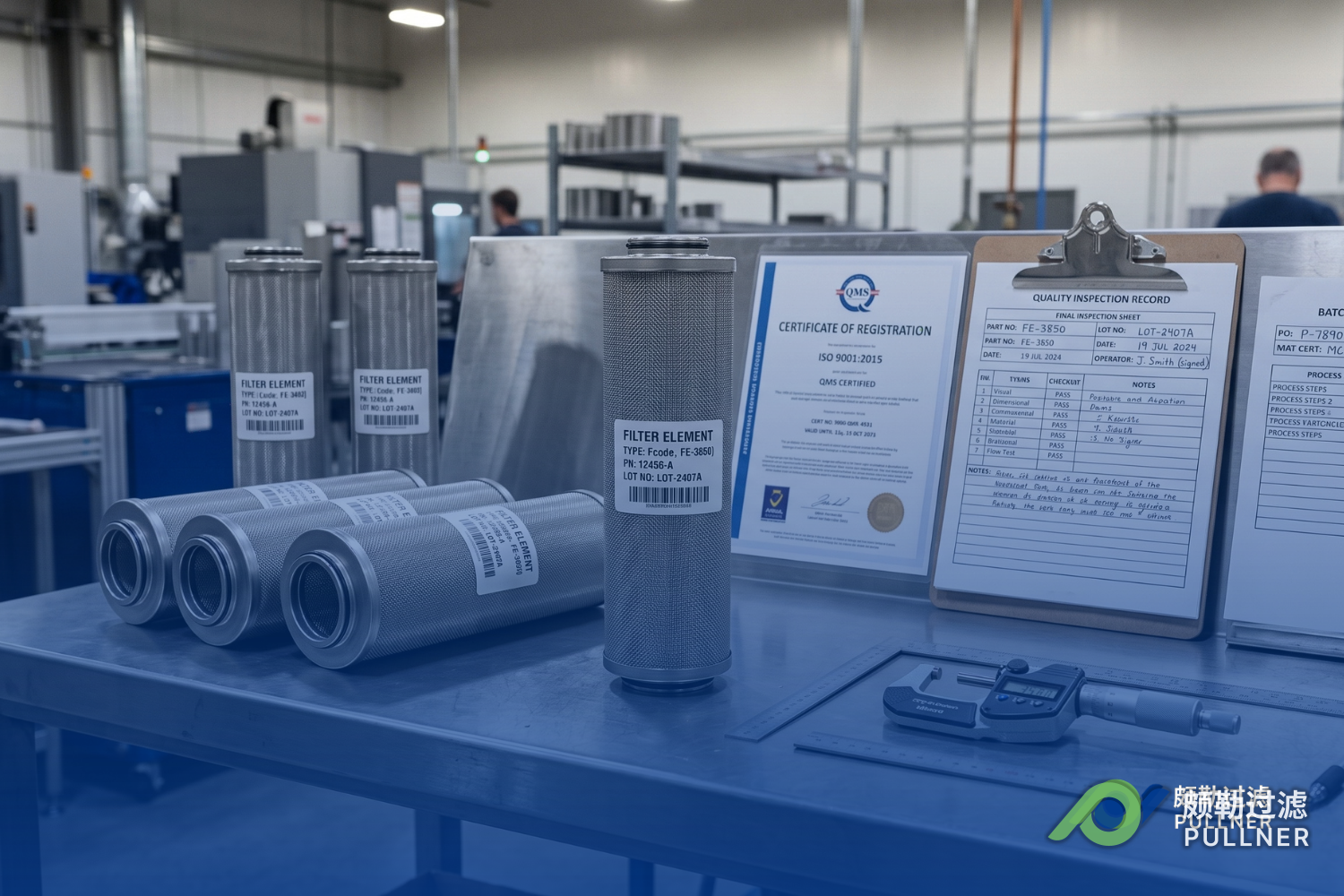
A supplier’s quality system should connect its current ISO 9001 certificate with records from the factory producing your filter. Verify the legal entity and certified address against the quotation. Then confirm that the certificate’s scope covers the proposed manufacturing activity.
A common challenge in supplier vetting is discovering, only after signing, that a certificate covers a parent company rather than the specific factory building the order—a gap the certificate alone won’t reveal without a direct check.
| Evidence to Request | What to Verify | Why it Matters |
|---|---|---|
| Current ISO 9001 certificate | Legal entity and certified manufacturing scope | Confirms that the proposed manufacturing location sits within the certified quality system |
| Incoming-material record | Material identity and inspection result | Shows how the factory controls inputs before production begins |
| In-process inspection plan | Inspection method and acceptance limit | Connects written procedures with controls applied during manufacturing |
| Finished-product release | Product code and approving employee | Shows who authorized shipment after completing the required inspections |
| Batch-traceability record | Material lot and production date | Creates a documented route from incoming material to the delivered filter |
Pullner uses an ISO 9001-certified quality system with 100% inspection and batch-level traceability, backed by more than 20 years in industrial filtration since the company’s founding in 2013. Testing and inspection run from raw materials through finished goods, and factory testing applies to every production batch covered by the documented quality process.
Traceability links the batch designation with inspection results from the corresponding production cycle. Buyers can ask Pullner what traceability records are available for review during the evaluation process.
Testing and Lab Capability: What Independent Verification Looks Like
Many buyers stop at the spec sheet, then discover during a plant audit that no underlying test data supports the numbers. Verification that buyers can actually check requires a named method and a report tied to the proposed filter.
Begin with the measurable performance requirement documented in your technical application specification. Then ask the supplier to identify the equipment and controlled test conditions. A useful report places the acceptance limit on the measured result.
| Laboratory Method | What it Examines | Evidence to Request |
|---|---|---|
| PMI pore analysis | Pore-size characteristics across the tested media | Sample-linked distribution data and test conditions |
| Scanning electron microscopy (SEM) | Membrane surface or cross-section at high magnification | Dated images tied to the proposed media |
| Inductively coupled plasma mass spectrometry (ICP-MS) | Trace elements within a prepared sample | Method reference and measured concentration |
| Ion chromatography | Ionic species associated with anions or cations | Chromatogram and reported values for the relevant ions |
| Flow or pressure-drop testing | Hydraulic behavior under defined conditions | Test setup and results across the specified flow range |
Pullner’s in-house laboratory capability includes PMI pore analysis and SEM verification. Its scanning electron microscope provides resolution down to 3 nm. ICP-MS and ion chromatography support anion and cation precipitation testing.
Particle-counting analysis measures particulate concentrations before and after filtration under defined conditions. Pressure-drop testing records resistance across the selected flow range for buyer review. Material-compatibility testing examines how the proposed construction responds to the stated process fluid.
Pullner’s IFTS single-pass test bench supports controlled performance testing with documented results, covering pressure drop, flow, efficiency, and dirt-holding performance.
Production Scale and Lead Time Reliability
Reliable capacity means the assigned production line can meet your order volume within a documented schedule. For buyers managing tight schedules, an unplanned filter changeout can stall an entire production line—which is why lead-time reliability deserves the same scrutiny as the filter’s technical specification.
Total factory output provides the context, but product-specific availability determines delivery performance. Buyers should connect every capacity figure with the specific filter type under review.
- Assigned equipment: Identify the production line planned for the proposed filter and its available weekly output.
- Current loading: Compare open manufacturing commitments with the capacity reserved for your order window.
- Standard lead time: Request the normal schedule for stocked materials and established configurations.
- Custom lead time: Include drawing approval and prototype acceptance before manufacturing begins.
- Delivery history: Review completed orders with a comparable construction and purchasing volume.
- Growth planning: Confirm how the factory reserves capacity when a trial develops into repeat demand.
Over 100 employees support Pullner’s 15,200-square-meter production workshop, and the more than 30 production lines produce over 4,000 filter elements per day. The facility includes Class 100 and Class 1,000 cleanrooms. Class 10,000 cleanrooms provide another controlled manufacturing environment within the facility.
Risk-Free Evaluation: Samples and Trials
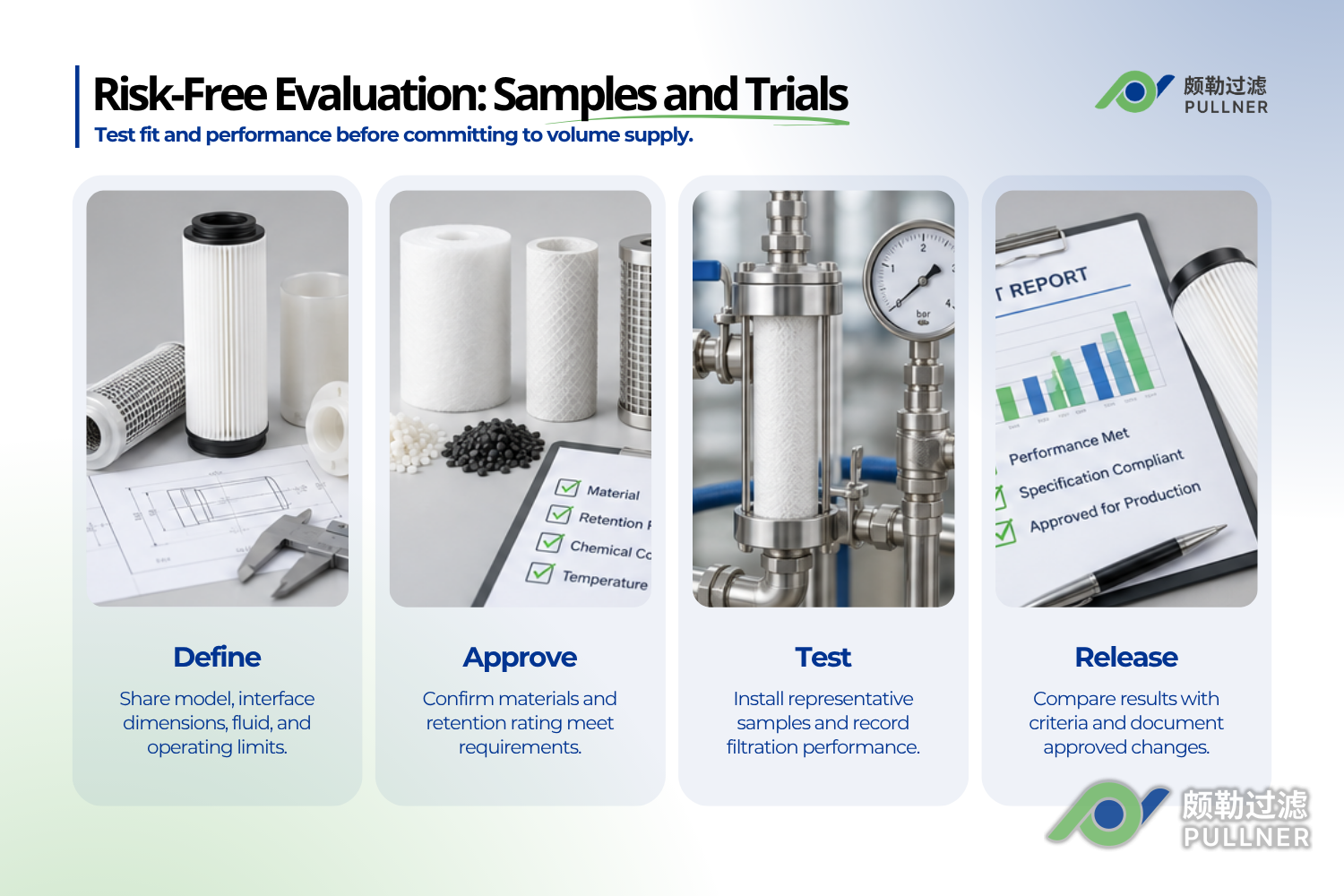
Representative samples let buyers confirm fit and process performance before approving volume supply. Many buyers treat sample evaluation as a formality, but it’s the one stage where switching risk can be tested cheaply before a full production commitment.
The evaluation works best when both parties agree on the construction and acceptance criteria in advance. Each step should produce a record that supports the final purchasing decision:
- Define the application: Provide the current model number and equipment interface dimensions. Add the process fluid and operating limits in a technical application sheet.
- Approve the proposal: Review the proposed materials and retention rating. Confirm that the selected construction supports the stated operating conditions.
- Run the trial: Install a representative sample produced under the controls planned for volume manufacturing. Record pressure behavior and filtration results throughout the agreed test period.
- Release the specification: Compare measured performance with the approved criteria. Document every accepted specification adjustment before authorizing the full production order.
Pullner provides up to two free samples worldwide, and the buyer pays the shipping costs. Free filtration-system testing supports this validation step, letting buyers confirm performance before committing to a volume order. Buyers can test those samples under documented operating conditions before approving a replacement option or second-source candidate.
Custom design assistance can convert application data into a proposed configuration. For custom frames or end caps, 3D printing supports dimensional review before tooling approval.
Global Support and Local Presence
Regional support matters when technical personnel can connect application questions directly with factory capability. Buyers should distinguish local engineering support from a distributor relationship focused on order handling. Ask who will review the application and interpret trial data. Then confirm how that person engages laboratory or production specialists.
| Support Stage | Capability to Confirm | Evidence of Coverage |
|---|---|---|
| Supplier selection | Application review and filter recommendation | Named technical contact with relevant filtration experience |
| Sample evaluation | Trial planning and result interpretation | Documented response process during testing |
| Implementation | Installation guidance and specification confirmation | Assigned owner for technical follow-up |
| Ongoing supply | Troubleshooting and reorder coordination | Escalation route connecting the regional team with the factory |
Pullner maintains technical teams across the Middle East, Europe, Southeast Asia, and South Korea, backed by a Dubai office and a physical factory in Saudi Arabia for regional Middle East and Europe support. That support begins with custom design and continues through manufacturing and ongoing delivery, all coordinated through the same regional team.
Questions to Ask Any Candidate Supplier
Score each supplier’s response as accepted or rejected against the approved application requirements. Record supporting evidence in a shared audit template and route technical gaps to the responsible reviewer. Complete the assessment after engineering and procurement approve the documented findings.
Ask each candidate supplier the following:
- Certification scope: Does the current ISO 9001 certificate cover the legal entity and factory assigned to our order?
- Inspection controls: What documented checks are applied from incoming material through finished-product release?
- Batch continuity: How does the traceability record connect a delivered element with its materials and production date?
- Test selection: Which laboratory method verifies the performance requirement in our specification?
- Pore evidence: Can you provide PMI results tied to the media proposed for our application?
- Imaging review: When would SEM support examination of the proposed membrane structure?
- Chemical analysis: When does ICP-MS or ion chromatography support our process evaluation?
- Reserved capacity: What weekly output can the assigned production line commit to our order?
- Schedule control: What are the approval and manufacturing milestones leading to shipment release?
- Sample provenance: Will trial units follow the same material controls planned for volume supply?
- Trial support: Who reviews the measured results and documents an approved specification change?
- Regional ownership: Who is the technical contact responsible for implementation support in our market?
Speak to a Filtration Expert
Once your audit identifies a viable candidate, confirm how the supplier will support evaluation before approving a production order—the difference between a component supplier and a technical partner shows up here, in whether that support continues after the sale.
Pullner supports supplier assessment through ISO 9001-certified quality controls and 100% factory testing. Batch-level traceability connects the delivered filter element’s batch with the corresponding production records.
Buyers can request free filtration-system testing and custom filtration design before committing to volume supply. Pullner offers up to two free samples worldwide, with the buyer covering shipping costs. To review your operating conditions or discuss a custom configuration, speak with Pullner’s filtration team.
FAQs on How to Choose an Industrial Filter Supplier
What should you look for in a filter supplier?
Look for certification covering the proposed factory and relevant manufacturing activity. Review batch records and product-specific test reports before assessing capacity. Then confirm that qualified technical support remains available through validation and implementation.
How do you vet a filter manufacturer?
Begin with a documented application specification and measurable acceptance criteria. Verify the quality system against production records from the relevant filter family. Complete the assessment through representative sample testing and engineering review.
Can you receive samples before a full production order?
Representative samples support evaluation before approval of a full production quantity. Confirm how many units the supplier provides and who pays for shipping. Pullner offers up to two free samples worldwide, with the buyer covering shipping.
Can you test samples under your operating conditions?
Application testing should reproduce the conditions governing filter performance in your process. Record fluid properties and operating limits in the written trial plan. Compare measured results with acceptance criteria approved before testing begins.
Does the supplier support the evaluation process?
Technical support should begin with the supplier’s review of your application data. During testing, an assigned engineer should answer questions and interpret results. Afterward, the same contact should document each approved specification change.
Can a supplier develop a custom prototype?
Custom development starts with verified equipment dimensions and documented process requirements. The supplier should convert those inputs into a drawing or testable component. Pullner can use 3D printing for custom frames or end caps before production approval. Before final tooling, buyers should approve the interface dimensions and revision-controlled drawings. The prototype record should identify the material set used during dimensional assessment.
What information supports fit and performance validation?
Provide the current model number and complete equipment interface dimensions for review. Supply fluid characteristics and operating limits in the application brief. Add the required retention performance and trial acceptance criteria for technical review.
Back to Top: How to Choose an Industrial Filter Supplier: What to Look For and What to Ask
 English
  Spanish
  Arabic