
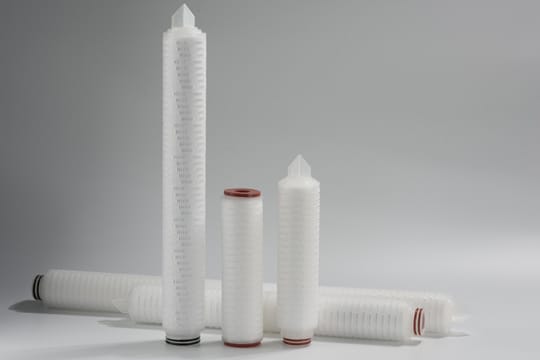
عنصر المرشح عالي اللزوجة
Viscosity does not change what a filter removes. It changes what it costs to push fluid through, and that is the entire design problem. Differential pressure across a clean element rises roughly in proportion to viscosity, so a fluid at 200 cP reaches change-out pressure long before water would — while holding barely any more dirt than it started with.
The answer is surface area, not a coarser grade. This element is pleated polypropylene on a 2.7″ (69 mm) body in 10″ to 40″ lengths, and on viscous duty it is normally specified longer, or in greater numbers, than the flow rate on its own would suggest.
- تصنيف الميكرون
- 0.1–100 µm
- معدل التدفق
- 1–5 GPM per 10"
- درجة الحرارة القصوى
- 80°C
- SKU
- وحدة قياس الأداء الوظيفي
- Specified on viscosity, not on flow rate alone
- Grades 0.1 to 100 µm
- Four lengths — 10" through 40", for area rather than a coarser grade
- Pressure published at two temperatures — 4 bar at 21 °C, 2.4 bar at 80 °C
- Standard fitment — DOE and SOE end caps
- آيزو 9001 with batch documentation on request
| السلسلة | وحدة قياس الأداء الوظيفي |
| وسائط الترشيح | Polypropylene, pleated |
| Micron rating | 0.1–100 µm |
| Outer diameter | 2.7" (69 mm) |
| Length options | 10" · 20" · 30" · 40" |
| الغطاء النهائي | DOE · SOE (226 fin, 226 flat, 222 fin, 222 flat) |
| O-ring / gasket | Silicone · NBR · Viton · EPDM |
| Flow rate | 1–5 GPM per 10" element, water-equivalent — derate for viscosity |
| Max. differential pressure | 4 bar at 21 °C · 2.4 bar at 80 °C |
| Max. temperature | 80 °C |
| الشهادات | آيزو 9001 |
| Minimum order | 25 pieces |
| Lead time | 7 working days |
- Resins and adhesives: particle control at elevated viscosity.
- Coating fluids: filtration ahead of application.
- Oils and process fluids: where pressure drop sets the stage size.
- Heated process streams: viscosity reduced upstream of the filter.
The published figure of 1 to 5 GPM per 10" element assumes a water-like fluid. It is a starting point on viscous duty, not an answer.
As a working rule, divide that figure by the fluid’s viscosity ratio to water before counting elements, then check the result against the differential pressure the system can actually supply — 4 bar at 21 °C, 2.4 bar at 80 °C. A stage sized on the water figure will be undersized by roughly the viscosity ratio, which on a 200 cP fluid is not a rounding error.
Send the fluid, its viscosity at working temperature, the flow rate and the available differential pressure. Pullner sizes the stage rather than quoting a cartridge count.
There are two ways out of a viscosity problem and one of them is usually much cheaper.
Many viscous fluids thin sharply with modest heating. A stage that is impractical at ambient often becomes straightforward at 60 °C, and the element is rated to 80 °C, so there is room to work with. Where the process tolerates heating upstream of the filter, that is almost always worth more than adding housings or changing media.
Where it does not — heat-sensitive resins, curing chemistry, anything that skins — the answer is area. Specify longer elements before considering a coarser grade, because a coarser grade changes the product and a longer element does not.
Up to two samples ship worldwide free of charge, with freight paid by the customer.
 English
  Spanish
  Arabic