
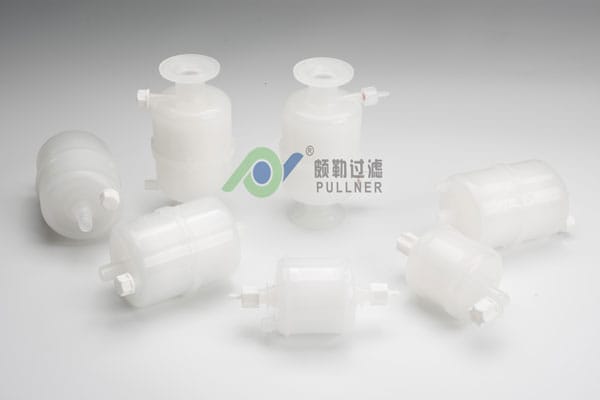
خرطوشة تصفية الحبر النافثة للحبر
Ink is an awkward fluid to filter. The pigment is the product, not the contaminant, so the filter has to pull out agglomerates and stray fibre while leaving the dispersion intact — and it has to do that without shedding anything of its own into a fluid heading for a printhead worth more than the filter by three orders of magnitude.
This cartridge is built on Pullner’s capsule platform: media, cage and connections welded into one sealed body, with no housing to open and no elastomer seal in the flow path. The body is 72 mm across in five lengths from 114 mm to 202 mm, with 1/4″, 3/8″ or 1/2″ connections in NPT thread or Swage compression fitting, and it is available in four media so the element can be matched to the carrier rather than the other way round.
- معدل التدفق
- 1–10 GPM
- درجة الحرارة القصوى
- 50°C / 122°F
- SKU
- N/S
- Four media on one body — PP, glass fibre, PES and PTFE
- No elastomer in the flow path — welded body removes the solvent-compatibility question at the seal
- Clean change-out — replaced whole, no open bowl beside the press
- Pleated internal element — 1–10 GPM from a 72 mm body
- Five lengths — 114, 138, 152, 183 and 202 mm
- Six connection options — 1/4", 3/8", 1/2" in NPT or Swage
- آيزو 9001 manufacture with batch test documentation on request
| السلسلة | N/S |
| Format | Capsule — self-contained, no separate housing |
| وسائط الترشيح | Polypropylene (PP) · glass fibre · PES · PTFE |
| Micron rating | Confirm with factory |
| Body diameter | 72 mm · non-standard available |
| Length options | 114 · 138 · 152 · 183 · 202 mm |
| Inlet / outlet | 1/4", 3/8", 1/2" NPT · 1/4", 3/8", 1/2" Swage |
| ختم | None — thermally welded body |
| Flow rate | 1–10 GPM |
| Max. differential pressure | 4.1 bar / 60 PSI |
| Max. temperature | 50 °C / 122 °F |
| Quality system | آيزو 9001 |
| Minimum order | 50 pieces |
| Lead time | 10 working days |
- Industrial inkjet: ink filtration ahead of the printhead.
- Pigment dispersions: agglomerate and fibre removal without stripping the dispersion.
- Coating fluids: particle control on coating and laminating lines.
- Solvent-carrier inks: PTFE media where PP and PES are not compatible.
- Water-based inks: PP media as the standard specification.
The media choice is driven by the carrier, not the pigment. Getting it wrong shows up either as a filter that dissolves or as colour stripped out of the fluid it was supposed to be cleaning.
| وسائل الإعلام | Specify when |
|---|---|
| البولي بروبلين (PP) | Water-based inks. Broad compatibility and the lowest cost per element — the default unless something rules it out. |
| Glass fibre | Heavily loaded lines. Higher dirt-holding capacity at the same differential pressure, so the interval between changes stretches. |
| بيس | The filter must not strip colour. Low dye and protein binding, which matters on tinted and low-pigment-load fluids. |
| PTFE | Aggressive solvent carriers where PP and PES are not compatible. |
Compatibility depends on the specific carrier, its concentration and its working temperature rather than on the material name alone. Send the ink data sheet with your enquiry and Pullner will confirm the media before quoting.
A note on grade
On ink duty the useful grade is usually set by the printhead nozzle rather than by the specification of the fluid. A common working rule is to filter an order of magnitude finer than the smallest nozzle passage, then confirm against the ink manufacturer’s own guidance, since over-filtering a pigment dispersion removes product rather than contamination.
The capsule is thermally welded shut. There is no housing joint to seal and no elastomer anywhere in the flow path, which is why the seal row in the specification table is empty. On a solvent line that removes a real problem: the O-ring is both a compatibility question and a bypass risk every time it is reseated.
It also changes what a change-out looks like. The capsule is replaced whole, so there is no open bowl, no drip tray and no half-drained housing sitting next to a press. The trade is that nothing is serviceable — when differential pressure reaches its limit, the whole unit goes.
Inside the welded body the element is pleated rather than depth-wound. That is what lets a 72 mm body pass 1 to 10 GPM; a depth wrap in the same envelope would blind far sooner.
Non-standard sizes and connections
Every combination of cage diameter and connection adaptor is a separate mould. Pullner cuts those in-house and prototypes non-standard end caps and frames on a 3D printer first, so unusual geometry is generally possible — but it is a tooling conversation rather than a catalogue selection, and it moves the lead time. Send the dimensions and the fitting standard with your enquiry and engineering will tell you whether an existing mould covers it.
Most enquiries come from press rooms already running an imported capsule that has become slow to source or expensive to hold. Cross-referencing one needs six things, and an enquiry carrying all six is usually quoted the same day:
- The part number printed on the capsule body
- Body diameter and overall length
- Inlet and outlet fitting — thread standard or tube size
- Micron grade currently in service
- The ink or carrier, and its working temperature
- Flow rate and the change-out interval you are getting today
Photographs of the capsule and its fittings help more than a description.
Qualifying the replacement
Every element is tested in Pullner’s own laboratory, from incoming raw material to finished goods, on a bench that includes a PMI pore size analyser, an SEM resolving to 3 nm, ICP-MS, an ion chromatograph and an IFTS single-pass rig. Batch test documentation is available on request.
Up to two samples ship worldwide free of charge, with freight paid by the customer. Standard minimum order is 50 pieces and standard lead time is 10 working days, across 30+ production lines running more than 4,000 elements a day.
 English
  Spanish
  Arabic